

A memory chip outran a Middle East war.
Since the Strait of Hormuz closed on February 28th, oil is up 45%, Micron +80% and even Nvidia 15%.
The last time a Middle East war actually constrained global oil supply, in 1973, the playbook was simple. When the Middle East goes hot, you do not own anything that needs cheap power or cheap capital. Memory chips need both.
I saw the situation in late February and instantly thought this was going to end badly. I cut my risk. I fought to stay long for as long as I could, but at the end of March I cut my AI book in half — from 30 percent to 15 — and bought some Offshore Oil Services. I was about to leave on a three-week trip, and given the time zone I would not be able to react. That logistical fact mattered.
A few weeks later I was sitting in a different time zone, hanging out with people building data centers, launching new AI businesses, and I was watching the price turn before the narrative did.
There is an old saying on Wall Street:
Price drives narrative. Narrative does not drive price.
The price kept turning. I kept watching. And at some point that week, the thing every trader spends a career trying not to feel, I felt.
I had sold the bottom.
The position I had built to express my view was working, oil up 45%. The trade I had cut to fund it was working harder. Memory up 80%. The thing I had not owned at size was running through every screen on the desk.
I had been watching the right indicator for the wrong regime.
I wrote about this at the beginning of April.
The piece was called The Last Ship. It was about the gap between when things break and when we feel them, what I have called the air pocket. A structural feature of every complex system I had spent my career trying to read. Oil markets, geopolitical crises, careers, relationships, the body. They all carry the same shape. The system absorbs the damage, and the price, the headline, the dinner reservation, the daily run keep arriving for a while, looking completely normal.
The instrument underneath it all is the second derivative. Not the number itself but the rate at which the number is changing. Markets don’t turn when bad news stops. They turn when bad news decelerates. Watch the change in the change.
The Hormuz shock should have been the cleanest test of that instruction I would ever see. Twenty percent of global crude transit closed. The last laden tankers still in transit. The textbook setup. I was prepared for it. I had cut risk. I was watching the second derivative.
The price didn’t break.
The air pocket arrived. It just didn’t look like one.
Either the framework was wrong, or the canary I was using to see the framework had been hollowed out from underneath me.
This essay is a discussion on how my framework might need to change.
The first thing that has been hollowed out is the marginal trader. The marginal trader in markets today is no longer a human being.
For most of my career, when people called something a bubble, they were borrowing a template from Kindleberger’s Manias, Panics, and Crashes.
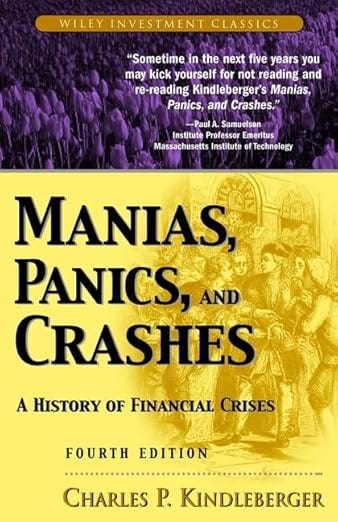
The template described a market made of humans with emotion, memory, information lags, and the specific shape of anchoring that comes from having lived through prior cycles. Druckenmiller bought the top in NASDAQ in 2000 because his analyst’s pitch sounded too good to miss. He felt FOMO. He had a memory of having missed the move. He was overweight humanity.
Most fund AUM today does not flow through that trader. It flows through algorithmic agents that do not anchor, do not fear, and do not remember 1973. The bubble pattern requires bubble-shaped traders. The marginal trader has been replaced.
What does the tape look like when the marginal trader has no 1973 prior? The S&P’s price-to-earnings-growth ratio is 1.03, during a Middle East war. Nvidia is trading at the lowest price-to-earnings multiple of the decade, during a Middle East war. Anthropic planned for 10x growth this year and saw 80x in the first quarter.
None of these readings look like 1999.
The bears didn’t fail because they were stupid. They failed because the people the bear playbook was written about are no longer the marginal price.
That is only half of why the price didn’t break. The other half is on the supply side. Marko Papic of BCA Research has argued for some time that geopolitics is not transitory, and the most useful argument in his most recent piece was buried in the middle, in a back-of-the-napkin box about work-from-home.
In 1973, when oil supply was constrained, the only way to clear the market was to destroy demand. Recession. Lines at gas stations. Real, visible, calamitous shortage.
The economy of 2026 does not have to do that. Work-from-home and business-travel cuts can absorb somewhere between ten and thirty percent of the Hormuz disruption without anything that looks like demand destruction. That buffer did not exist in the 1970s. The pandemic built it almost as an accident, and the world has not given it up.
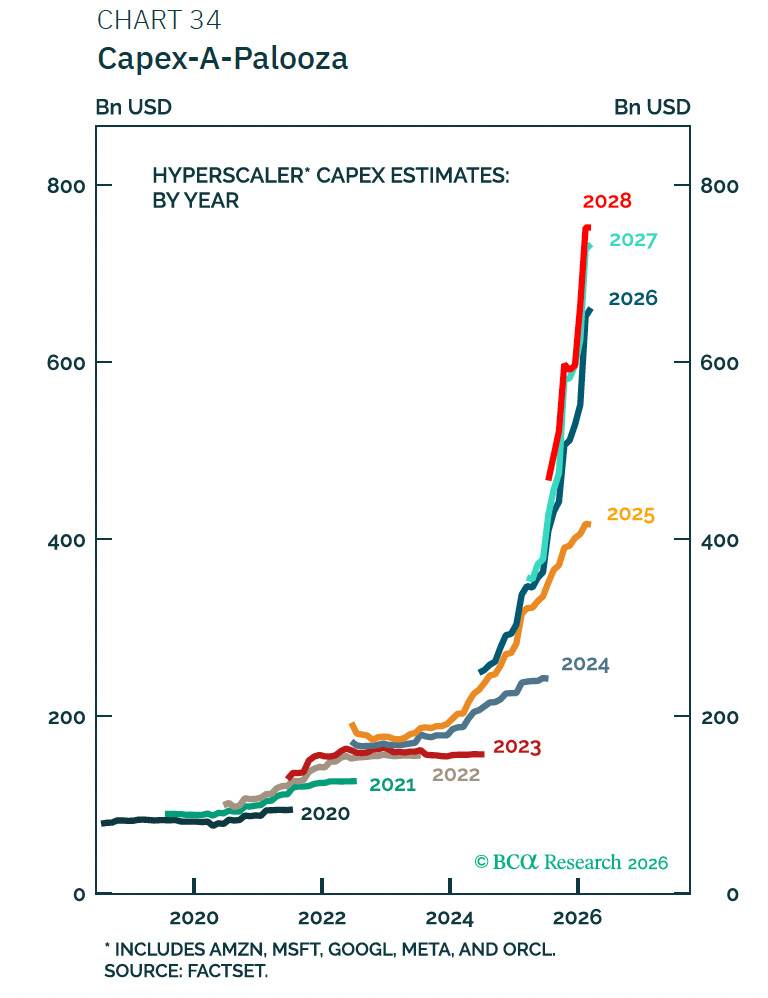
The air pocket is real. It just does not look like an air pocket. It looks like the world getting more expensive in places nobody is watching — sticky inflation, electricity costs that do not normalize, capex that crowds other capex off the calendar.
Those two mechanisms — the algorithmic flow and the absorbed shock — might explain why the price did not break this once.
The harder question is whether they explain a one-off or a regime. Dylan Patel, who runs the most-watched independent research firm on AI infrastructure, is describing the demand side of this year as a phase change.
Anthropic has gone from nine billion in annualized revenue to somewhere between thirty-five and forty-five billion in a matter of months. Gross margins have moved from around thirty percent earlier this year to seventy-two percent and climbing. Willingness to pay is the limiting factor. The supply chain underneath them is sold out two years deep.
The release cadence inside the labs has compressed from six months to two. Anthropic shipped a model in February that was an L4 software engineer in capability. Two months later they had a model that was an L6. The framework you were running six months ago is two model generations stale.
This is not a cyclical story. The economy that produced the 1973 reflex has been replaced by an economy that runs on a different clock.
A memory chip outran a Middle East war because the underlying economy that prices memory has been growing at a rate the underlying economy that prices oil cannot. That is not a market anomaly. That is what a regime change looks like, four months in.
The harder question is what a human being does inside that.