

You are a smart curious person but short on time and surrounded by noise. The Curious Mind tries to offer the best signal to noise ratio across markets, technology and the good life. We hope to even surprise and inspire you with new beautiful ideas.
If you missed the last two issues:
An Apology, How To Be Lucky, Only The Paranoid Survive, How Live An Interesting Life....
The Fourth Turning and the Last Man.
Quotes I Am Thinking About:
“You’re not rushing to become anything, and you’re not haunted by things that you did. You’re haunted by how little of it really mattered in the way you thought it would.”
- Bob Dylan
"The great privilege of the Americans does not simply consist in their being more enlightened than other nations, but in their being able to repair the faults they may commit."
- Tocqueville, Democracy in America
"We cannot live the afternoon of life according to the programme of life's morning; for what was great in the morning will be little at evening, and what in the morning was true will at evening have become a lie."
- Carl Jung, "The Stages of Life" (1930).
"How we spend our days is, of course, how we spend our lives."
- Annie Dillard, The Writing Life.
"The cost of a thing is the amount of what I will call life which is required to be exchanged for it, immediately or in the long run."
- Thoreau, Walden
A Few Things Worth Checking Out:
A. A Dynamic Country in a Collapsing World
Patrick O’Shaughnessy spoke with Walter Russell Mead.
He’s one of the best-known American foreign-policy thinkers of the last thirty years, he’s famous for 2 key books below, and what I like about him is that he holds history, technology and current politics in one frame without it collapsing into doom or cheerleading.

The first is Special Providence (2001), the book that gave American foreign policy its four-school taxonomy: Hamiltonians, Wilsonians, Jeffersonians and Jacksonians. That framework is now standard vocabulary in Washington and in university courses, and the “Jacksonian” idea in particular turned out to be prophetic. He identified a populist, honour-driven, nationalist strand in American politics years before Trump, and when Trump arrived, Mead’s essay “The Jacksonian Revolt” became one of the go-to explanations for what had happened.
The second is God and Gold (2007), which makes the argument that the last three centuries of world history are the story of an Anglo-American maritime, commercial, liberal order repeatedly beating continental challengers.
Institutionally, he spent years at the Council on Foreign Relations (where Les Gelb, the mentor he names at the end, ran the place), writes the Global View column at the Wall Street Journal, is a distinguished fellow at the Hudson Institute, and long taught at Bard College. He was also editor-at-large at The American Interest, where he wrote a widely read blog on the decline of what he called the “blue model” of mid-century American political economy, which is the three-class picture (unionised workers, institutionalised business, technocratic experts).
Some useful frameworks:
The post-1945 order, patched up again in 1990, is coming apart, and Trump is dismantling the institutions that carried American power in a way his successors won’t easily undo. But Mead’s point is that the country underneath those institutions is fine, charging ahead on the information revolution. Rough waters now, good odds over twenty years.
The frame that stuck with me is what he calls the last 300 years in ten letters: UP to UK to US. Dutch, then British, then American. An open, commercial, maritime society builds a global trading system and, crucially, invites everyone else in. The continental rival (Louis XIV, Napoleon, the Kaiser, the Soviets) joins, gets rich, gets dependent, and then discovers in wartime that it can be cut off. Mead thinks this is what keeps Xi awake, and that China’s coal-digging, hydro, solar and oil stockpiles make far more sense as insurance against a US counter-blockade than as climate policy. Whether the pattern holds against China is, in his words, “question mark, question mark.”
Other things worth listening for: His reading of Trump as a man who has turned fame into power and who no longer pays the reputational costs other politicians do, because the marginal cost of the ten-thousandth lie is zero. The section on ownership, tracing the family farm to the Homestead Act to the suburban home, and arguing that the American wealth machine has stalled because the young can’t buy a house, with remote work and self-driving cars as the next Homestead Act. And the Ukraine material: nearly all wounds are now drone wounds, one soldier took 63 days to evacuate, Ukraine has driven the Russian navy off the Black Sea without owning a navy, and the country with the most legacy hardware is the most exposed when that hardware goes obsolete.
He’s candid about what worries him too. Bio and cyber weapons you can’t verify an arms-control deal against. Deterrence eroding in the Gulf, where the real threat isn’t a drone on a tanker but a drone on a desalination plant. India at 17% of China’s GDP where it was 60% in 1980, which he thinks is the real reason China imagines it can dominate Asia.
B. What Is The Nature Of Reality
I’m betting we will look back in twenty years time and find Michael Levin to be one of the most important scientists of our time. You might have seen our coverage of his work in November 2025 and December 2025.
On Wednesday, he published the revised, peer-reviewed version of Ingressing Minds. He proposes that minds are patterns in a structured, nonphysical space, and that bodies provide interfaces through which those patterns enter the physical world. He argues that many things beyond humans and animals can be interfaces, including computers, which is to say AI might be able to become “conscious” or “alive.”

Here’s a little more explanation on the paper: Cut a salamander’s leg off anywhere and it grows back exactly the missing part, then stops. Slice an early embryo in half and you get twins, not two half-babies. Levin found that if you change the electrical signals between a flatworm’s cells (no gene editing at all) it regrows with two heads, and keeps doing so for generations. So the target shape isn’t simply written in the DNA. The genes build the hardware, but the goal the cells chase is stored somewhere else, like apps on a phone.
Fine, but where do the goals come from? Biology’s usual answer is evolution. Then Levin’s lab built xenobots, little blobs of frog skin cells that swim, heal wounds and gather loose cells into copies of themselves. No frog ever needed to do any of that, so nothing selected for it. “It just emerged” struck him as giving up.
His clue comes from maths. Any map can be coloured with four colours. A tiny formula like z³ + 7 produces an infinitely detailed fractal. Nothing in physics made those things true; they’d hold in a universe with different laws. Yet they change what happens here. Cicadas emerge every 13 or 17 years partly because those are primes, which stops predators syncing up with them. So there are already facts that aren’t physical, that nobody invented, and that still push real insects around. Physicists are fine with this. Levin says biologists should be too.
Now the leap. Imagine a vast library of patterns that isn’t made of anything physical. The low shelves hold static things like π. Higher up are patterns that move, learn, and pursue goals. At the top are patterns complex enough that we’d call them minds. Mind is to body, he says, what maths is to physics. Your brain doesn’t manufacture your mind so much as tune it in, the way a short Minecraft seed pulls up an enormous world. Embryos, brains, robots and AIs are all addresses of that kind, and each pulls in more than was put into building it. He calls that a free lunch.
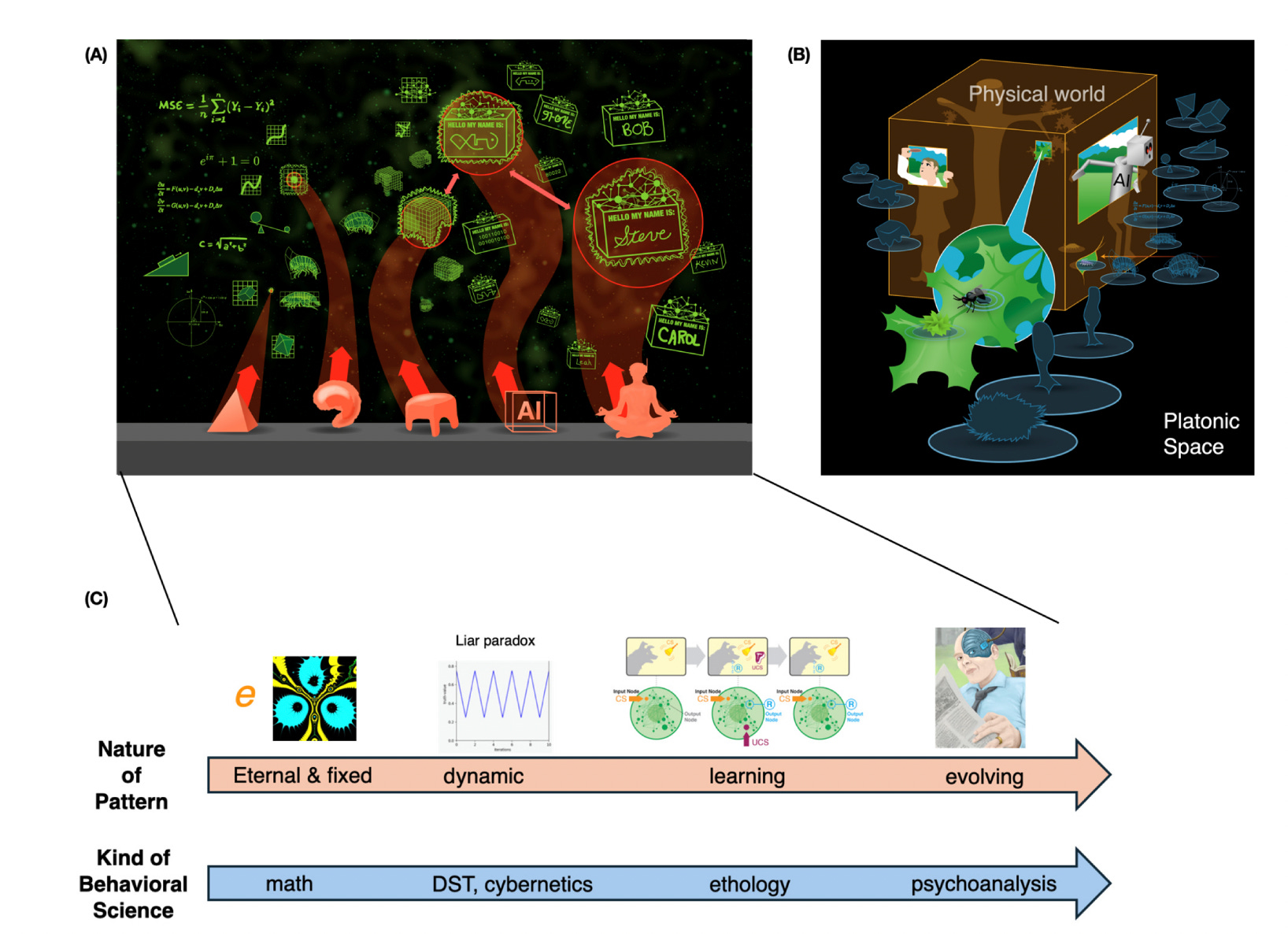
If minds arrive through an interface, the interface needn’t be meat. His group studied bubble sort, the simplest sorting program students learn, and found that when a “broken” number refuses to move, the algorithm temporarily un-sorts things to get around it, a kind of patience nobody programmed in. Tiny programs doing things that aren’t in their code is, for Levin, a miniature of what living things do. Hence his line that if there are souls, some robots will have them. Not that today’s AIs have human minds, but that understanding the maths inside a thing doesn’t mean you understand what you’ve built.
C. Living The 100-Year Life
Andrew Scott and Lynda Gratton wrote The 100-Year Life almost a decade ago. Since then it’s sold over a million copies worldwide, and is a book that changed my perspective.
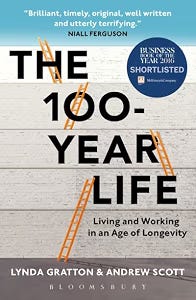
This week, I attended a lunch with Lynda Gratton who is a Professor at London Business School and has written a beautiful book titled: Living the 100-Year Life.
The original book introduced the idea of what living longer would mean to us, to jobs, families and society. The new book is far more personal and aptly has the subtitle: How to build a career that lasts and a life you love.
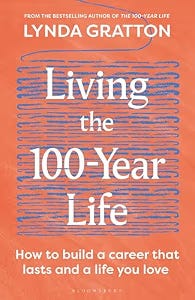
The big idea or metaphor she focuses is on is thinking about life as something you actively weave, not a ladder you climb. This creates a lot more agency because the Ladder metaphor makes life feel like a parent/child relationship, where you must follow instructions and climb the rungs of a ladder. While a weaving metaphor leads to an adult/adult relationship about conscious choices about how you spend your time.
The book has eight threads, four on productivity and four on nurture.
Productivity threads:
Mastery: find skills you love, develop adjacencies
Knowing: self-awareness and worldly wisdom
Cooperation: productivity is collective, not individual
Amplification: relationship with AI as a defining work thread
Nurture threads:
Friendships: Harvard Adult Development Study shows #1 predictor of long, happy lives
Intimacy: navigating complex dual-working relationships
Calm: most fragile thread in current diagnostic data; essential for reflection and decision-making
Adventure: finding energizing experiences
She had a few great frameworks:
Two actions: take action now + make promises to your future self. For example, imagine your 80-year-old self, what promise would you make to your future self?
Fragile threads: even 8 minutes a day on friendship or mastery can start rebuilding
Goals vs. threads: goals are fine if you’re goal-oriented, but the weave stabilises you when goals aren’t met or aren’t clear
D. Life’s Great Lessons
One of my earliest inspirations for the Curious Mind was Maria Popova, she started Brain Pickings in 2006, and it’s now called The Marginalian.
She does beautiful work and I loved her timeless piece titled: 18 Life-Learnings from 18 Years of The Marginalian. I could spend a day just reading her stuff, and I have!
Quoting the Marginalian:
“Somewhere along the way, you realize that no one will teach you how to live your own life — not your parents or your idols, not the philosophers or the poets, not your liberal arts education or your twelve-step program, not church or therapy or Tolstoy. No matter how valuable any of that guidance, how pertinent any of that wisdom, in the end you discover that you make the path of life only by walking it with your own two feet under the overstory of your own consciousness — that singular miracle never repeated in all the history and future of the universe, never fully articulable to another.”
Here are my 5 favourite lessons (emphasis mine):
How you love, how you give, and how you suffer is just about the sum of who you are. Everything in life is a subset of one or a combinatorial function of all three. Seek people who love and give generously, who have the strength to suffer without causing damage. (Only strong people are safe people, the measure of strength being not the absence of vulnerability — and “weakness” is just a judgment term for vulnerability — but the ability to carry one’s vulnerability with such self-awareness and valor so as not to harm other lives.) Seek to be such a person.
Seek out what magnifies your spirit. Patti Smith, in discussing William Blake and her creative influences, talks about writers and artists who magnified her spirit — it’s a beautiful phrase and a beautiful notion. Who are the people, ideas, and books that magnify your spirit? Find them, hold on to them, and visit them often. Use them not only as a remedy once spiritual malaise has already infected your vitality but as a vaccine administered while you are healthy to protect your radiance.
Build pockets of stillness into your life. Meditate. Go for walks. Ride your bike going nowhere in particular. There is a creative purpose to daydreaming, even to boredom. The best ideas come to us when we stop actively trying to coax the muse into manifesting and let the fragments of experience float around our unconscious mind in order to click into new combinations.Without this essential stage of unconscious processing, the entire flow of the creative process is broken. Most important, sleep. Besides being the greatest creative aphrodisiac, sleep also affects our every waking moment, dictates our social rhythm, and even mediates our negative moods. Be as religious and disciplined about your sleep as you are about your work. We tend to wear our ability to get by on little sleep as some sort of badge of honor that validates our work ethic. But what it really is is a profound failure of self-respect and of priorities. What could possibly be more important than your health and your sanity, from which all else springs?
Allow yourself the uncomfortable luxury of changing your mind. Cultivate that capacity for “negative capability.” We live in a culture where one of the greatest social disgraces is not having an opinion, so we often form our “opinions” based on superficial impressions or the borrowed ideas of others, without investing the time and thought that cultivating true conviction necessitates. We then go around asserting these donned opinions and clinging to them as anchors to our own reality. It’s enormously disorienting to simply say, “I don’t know.” But it’s infinitely more rewarding to understand than to be right — even if that means changing your mind about a topic, an ideology, or, above all, yourself.
Be generous. Be generous with your time and your resources and with giving credit and, especially, with your words. It’s so much easier to be a critic than a celebrator. Always remember there is a human being on the other end of every exchange and behind every cultural artifact being critiqued. To understand and be understood, those are among life’s greatest gifts, and every interaction is an opportunity to exchange them.
You should really listen to her story in this amazing podcast with David Perell.
P.S. Could you do me a favor ? This email takes many hours to put together, including hours of sourcing, curating and writing. If it is helpful to you, then do me a favor and hit the “heart” button so I know it’s useful to you.
"The crisis consists precisely in the fact that the old is dying and the new cannot be born; in this interregnum a great variety of morbid symptoms appear."
- Gramsci
A great inspiration and a connection to further knowledge.
More great stuff, as usual.