

You are a smart curious person, short on time and surrounded by noise.
The Curious Mind tries to offer the best signal to noise ratio across markets, technology and the good life. We hope to even surprise and inspire you with new beautiful ideas.
If you missed last week’s discussion: Take Weird Ideas Seriously, The New Middle East, Energy Reality Check, AI’s $5 Trillion Gamble, Your Money Or Your Life...
Believe it or not, that “♡ Like” button is a big deal – it serves as a proxy to new visitors of this publication’s value, plus a lot of blood and sweat goes into producing it by hand every week. I reckon I spend over 2 hours writing it and 3-4 hours researching and reading to prepare.
Quotes I Am Thinking About:
“The only person you are destined to become is the person you decide to be.”
- Ralph Waldo Emerson
“The cave you fear to enter holds the treasure you seek.”
- Joseph Campbell
“We spend our lives trying to be rich in the wrong currencies.”
- Alain de Botton
“The real voyage of discovery consists not in seeking new landscapes, but in having new eyes.”
- Proust
“Energy is the only universal currency.”
- Vaclav Smil
“The future is already here — it’s just not evenly distributed.”
- William Gibson
A. A Few Things Worth Checking Out:
1. The New Infrastructure of Intelligence
AI isn’t a theme anymore — it’s the infrastructure layer of everything.
The technology that once lived in research labs is now rebuilding the real economy: rewiring factories, reshaping labour markets, and redrawing global power maps. The pace of capability improvement — doubling roughly every seven months — is breaking every linear forecast.
The constraint is no longer compute, but power.
Data centres are straining the grid. Bitcoin miners are turning into landlords for hyperscalers. Humanoid robots are preparing to make reshoring viable again.
We’re entering the decade where code meets concrete — and value creation shifts from software margins to physical infrastructure. Morgan Stanley had two great reports titled: Powering AI: Capitalizing on Market Weakness, and AI Adoption and the Future of Work
Here are the five big ideas driving the next wave of the AI economy:
1. AI is no longer a theme — it’s the economy’s new operating system.
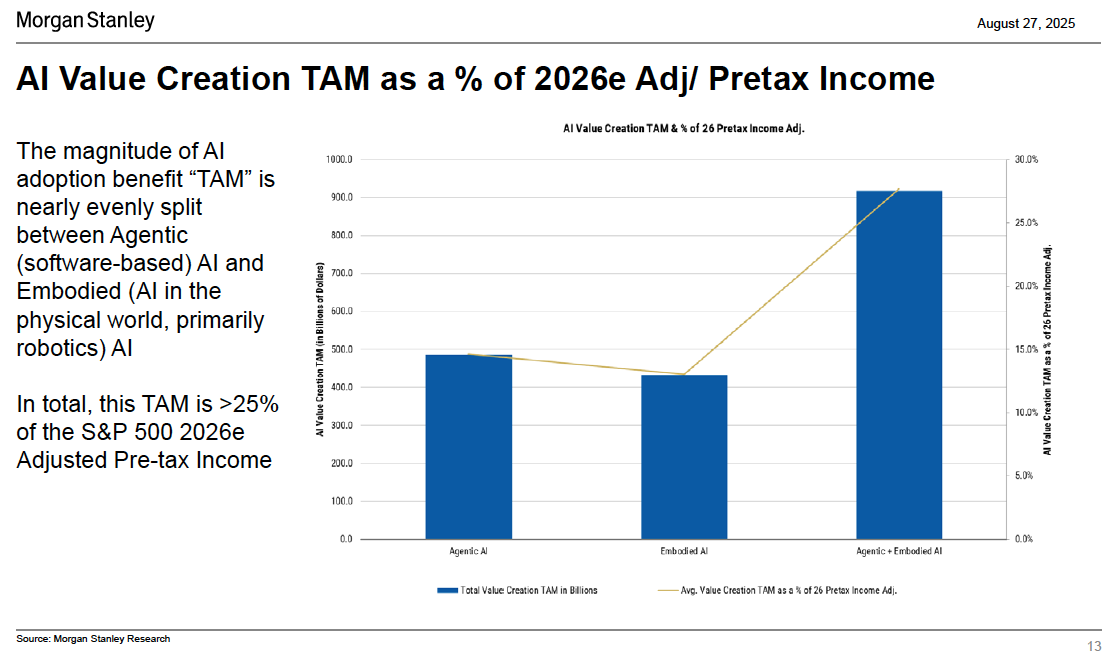
AI adoption has reached an inflection point: 90% of occupations will feel its impact, and the total productivity upside could unlock $13–16 trillion in market value. From logistics to healthcare, companies are embedding AI as both a cost reducer and creativity amplifier — automating repetitive work while accelerating product innovation. The next decade’s outperformers will be those that integrate AI into every workflow, not those that treat it as an add-on.
2. AI progress is compounding faster than markets can price.
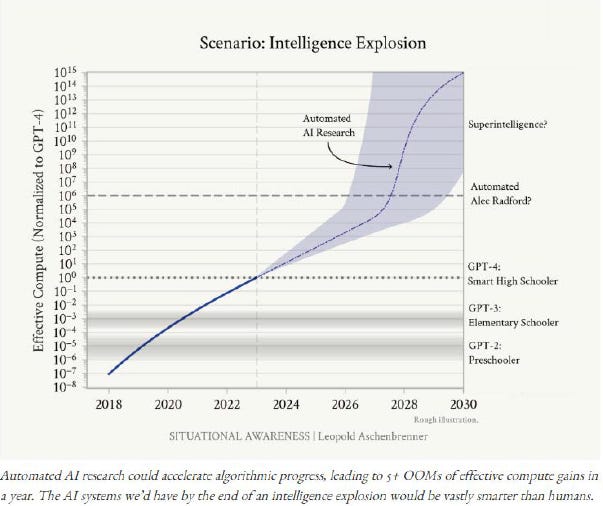
Morgan Stanley estimates agentic AI capabilities — the ability of models to autonomously complete complex tasks — are doubling every seven months. This non-linear improvement means productivity gains and market leadership will accelerate exponentially, not gradually. Investors still using linear adoption models are systematically underestimating the scale and speed of the AI-driven value creation wave.
3. The bottleneck isn’t chips — it’s power.
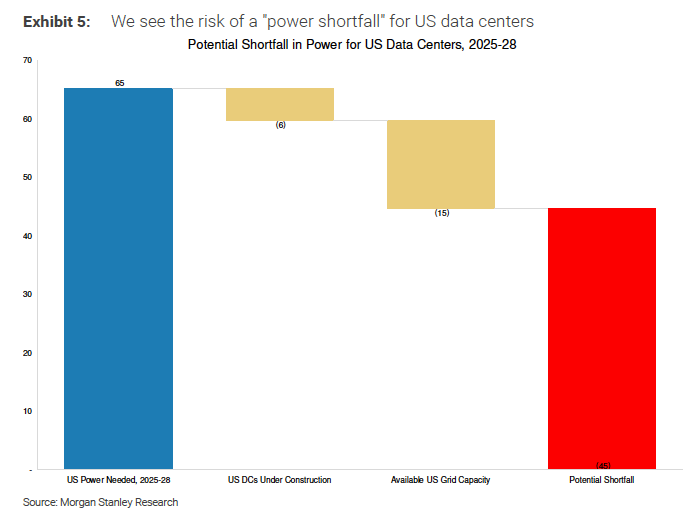
AI’s next constraint is energy, not compute. The U.S. faces a 45–68 GW power shortfall for data centers by 2028, forcing a reconfiguration of the power grid and opening new alpha frontiers. From Bitcoin-to-data-center conversions and fuel cells to nuclear and gas turbine projects, “time-to-power” solutions have become the critical enablers of the AI economy. The winners won’t just sell GPUs — they’ll sell electricity, infrastructure, and time.
4. Humanoid robotics will rebuild manufacturing — and geopolitics.
AI-driven robotics could become a $5 trillion market by 2050, surpassing the size of today’s global auto industry. With humanoid robots operating at roughly $5/hour vs. $36/hour for human labor, AI-embodied automation could return manufacturing to high-cost economies like the U.S., accelerating reshoring and energy demand while rewriting global supply chains. The industrial age is ending — the embodied intelligence age is beginning.
5. The future of work depends on augmentation, not elimination.
AI won’t just replace jobs — it will reshape them. Roles that rely on creativity, emotional intelligence, and strategic judgment will multiply as machines take over routine processes. The most resilient firms will upskill and redesign their workforce, turning employees into AI-augmented problem solvers. The future of productivity is not man versus machine — it’s man through machine.
Curious Thinking: Yes parts of the markets are in a bubble, yes AI models are still not that smart or close to AGI, but also yes that all of these forces will have a large impact on society. I’m looking for ideas around energy and power shortfall not chips or models.
2. Programmable Dollars: The Most Important Financial Innovation You’re Not Seeing
Stablecoins are no longer a thought experiment — they’re the quiet infrastructure shift happening beneath global finance. What started as a trading tool is becoming the default rail for cross-border payments, treasury flows, and fintech wallets. The technology is maturing, regulation is catching up, and the economics are flipping. The next phase won’t be about speculation, but about integration: stablecoins moving from crypto novelty to financial plumbing.
John Collison (Stripe founder) spoke with Zach Abrams, the CEO and cofounder of Bridge, the leading stablecoin orchestration platform, and Henri Stern, CEO and cofounder of Privy, the leading crypto wallet infrastructure.
The 5 BIG IDEAS:
1. Stablecoins are already happening, just not where most people look.
The leading uses are cross-border payments, remittances, and holding dollars outside the US. Companies move local receipts into USD via stablecoins and repatriate quickly; neobanks in LATAM and Africa give users dollar balances they can actually spend. If you only stare at US retail checkout, you’ll miss the real adoption curve.
2. The stack is modular, but payments need their own rails.
Embedding wallets directly in apps lets users hold and spend without detouring to external crypto tools. Yet chains optimized for trading drop too many transactions and impose gas and UX hurdles. Payment workloads need sponsored gas, reliable batching, priority lanes, and account-level safeguards against double spend—features that payment-focused chains and wallet infrastructure now provide.
3. Open issuance makes economic and product sense.
Any platform that holds user balances can issue a branded stablecoin, earning the underlying yield and avoiding third-party burn/fast-redeem fees. You also control where the asset lives (which chains, or even your own) and how it behaves. With interoperability, moving between branded coins should feel like today’s interbank transfers—under the hood, not a new user burden.
4. Policy clarity widens the funnel while USD keeps the lead.
The tech didn’t change, but GENIUS (US) and MiCA (EU) lowered perceived regulatory risk, so more enterprises are willing to build or issue. USDT’s dominance comes from trading and EM brand network effects; at the same time, yield-bearing options will attract balances and grow the overall market. Expect USD to remain the supermajority with local stables rising where they’re needed for day-to-day transactions.
5. Money experiences will be embedded everywhere—and portable.
Apps will ship payouts, spending, saving, credit, and investing through embedded wallets and crypto cores. Users won’t need to see “crypto” for it to work; it will feel like faster, cheaper, more global money. Incumbent banks stay sticky for payroll anchors, but the next wave of fintechs will win by composing better global stacks. Stablecoins recede into the plumbing for consumers while staying visible to developers and treasurers who need control and composability.
Curious Thinking: We are moving to Money 2.0, think of it as Programmable Dollars, but you might not even notice it because it’s all happening in the background. There will be winners and losers as a new financial infrastructure layer is created for the first time in 100 years.
3. Life’s Great Lessons
One of my earliest inspirations for the Curious Mind was Maria Popova, she started Brain Pickings in 2006, and it’s now called The Marginalian.
She does beautiful work and I loved her timeless piece titled: 18 Life-Learnings from 18 Years of The Marginalian. I could spend a day just reading her stuff, and I have!
Quoting the Marginalian:
“Somewhere along the way, you realize that no one will teach you how to live your own life — not your parents or your idols, not the philosophers or the poets, not your liberal arts education or your twelve-step program, not church or therapy or Tolstoy. No matter how valuable any of that guidance, how pertinent any of that wisdom, in the end you discover that you make the path of life only by walking it with your own two feet under the overstory of your own consciousness — that singular miracle never repeated in all the history and future of the universe, never fully articulable to another.”
Here are my 5 favourite lessons (emphasis mine):
How you love, how you give, and how you suffer is just about the sum of who you are. Everything in life is a subset of one or a combinatorial function of all three. Seek people who love and give generously, who have the strength to suffer without causing damage. (Only strong people are safe people, the measure of strength being not the absence of vulnerability — and “weakness” is just a judgment term for vulnerability — but the ability to carry one’s vulnerability with such self-awareness and valor so as not to harm other lives.) Seek to be such a person.
Seek out what magnifies your spirit. Patti Smith, in discussing William Blake and her creative influences, talks about writers and artists who magnified her spirit — it’s a beautiful phrase and a beautiful notion. Who are the people, ideas, and books that magnify your spirit? Find them, hold on to them, and visit them often. Use them not only as a remedy once spiritual malaise has already infected your vitality but as a vaccine administered while you are healthy to protect your radiance.
Build pockets of stillness into your life. Meditate. Go for walks. Ride your bike going nowhere in particular. There is a creative purpose to daydreaming, even to boredom. The best ideas come to us when we stop actively trying to coax the muse into manifesting and let the fragments of experience float around our unconscious mind in order to click into new combinations. Without this essential stage of unconscious processing, the entire flow of the creative process is broken. Most important, sleep. Besides being the greatest creative aphrodisiac, sleep also affects our every waking moment, dictates our social rhythm, and even mediates our negative moods. Be as religious and disciplined about your sleep as you are about your work. We tend to wear our ability to get by on little sleep as some sort of badge of honor that validates our work ethic. But what it really is is a profound failure of self-respect and of priorities. What could possibly be more important than your health and your sanity, from which all else springs?
Allow yourself the uncomfortable luxury of changing your mind. Cultivate that capacity for “negative capability.” We live in a culture where one of the greatest social disgraces is not having an opinion, so we often form our “opinions” based on superficial impressions or the borrowed ideas of others, without investing the time and thought that cultivating true conviction necessitates. We then go around asserting these donned opinions and clinging to them as anchors to our own reality. It’s enormously disorienting to simply say, “I don’t know.” But it’s infinitely more rewarding to understand than to be right — even if that means changing your mind about a topic, an ideology, or, above all, yourself.
Be generous. Be generous with your time and your resources and with giving credit and, especially, with your words. It’s so much easier to be a critic than a celebrator. Always remember there is a human being on the other end of every exchange and behind every cultural artifact being critiqued. To understand and be understood, those are among life’s greatest gifts, and every interaction is an opportunity to exchange them.
4. The Secret of Secrets
Just finished Dan Brown’s latest book The Secret of Secrets.
His usual hero, Robert Langdon is in Prague for this action packed book. It is definitely going to be blockbuster movie at some point. The book discusses consciousness and mysticism.

I don’t usually read fiction, and this was my first Dan Brown book, but totally worth it and highly recommended.
5. Notes From The Next Bull Market
If ‘23-24 was about U.S. data centers and AI infrastructure, ‘25-26 might just belong to somewhere very different.
Not Texas. Not the Nasdaq.
China — and Hong Kong.
That’s the real story I came back with after a week on the ground in Hong Kong, Macau, and Shenzhen. From an investor’s perspective, the setup feels very interesting: battered property markets, ultra-low yields, a government desperate to reflate wealth — and a new asset class waiting to run.
From collapsed Hong Kong office rents to a wall of BYD patents in Shenzhen, from robots nobody cared about (yet) to a commodities CEO flying to the DRC twice a year, the signs of renewal were everywhere.
My friend Erik wrote a great piece diving into our trip.
Big thanks to Louis-Gave (at Gavekal) for organising it all and bringing us together.
Here is Louis’ latest China Megatrends piece.
Curious Thinking: How scary does it feel to even think about investing in China, isn’t that how all bull markets feel in the beginning?
B. It Was Never Really About The Money….
Is money a driving force in your life? How many of your decisions and actions does it drive?
Ever since I was 9, money has been a big driver for me. But not always positive. It took me till my mid 40’s to learn how to use money rather than be used by it.
One of the experts that has helped me is Nadjeschda Taranczewski.
She is a psychologist and executive coach, with expertise in guiding, exploring and dismantling your unconscious narrative around money that keeps you locked in unhealthy patterns of saving, spending and investing.
I’ve asked her to present to a few of us in a 90-min workshop on November 10th, 10am EST, covering issues such as:
Processes to reflect about your personal relationship to money
What would happen if you stopped being afraid of having too little or too much money?
Why does money show up as a source of conflict in your life?
Here are two things to give you a flavour.
Listen: Mindful Money podcast Why More Money Never Feels Like Enough
Read: Tom Morgan on the Real Value of Money.
Numbers limited to 30 people, we are at 25 now. 1st priority goes to The Brain Trust.
I recommend joining.