

You are a smart curious person, short on time and surrounded by noise.
The Curious Mind tries to offer the best signal to noise ratio across markets, technology and the good life. We hope to even surprise and inspire you with new beautiful ideas.
“The change from atoms to bits is irrevocable and unstoppable... [but] we cannot live on bits alone.
We are, after all, made of atoms.”
- Nicholas Negroponte, Being Digital (1995)
You know that feeling when you read something weeks ago, but you can’t get the idea out of your head. Well I’ve been having these two ideas collide in my head. One is from the book Underground Empire by Farrell and Newman, and the other this magistarial post titled Return of Matter by Tindale.
For three decades, the West operated under the Sovereignty Delusion: the belief that if you control the “thinking”: Intellectual Property, Finance, and Code, the “doing” would simply manifest itself via a friction-free market.
Wall Street and Silicon Valley are an acute manifestation of this idea.
We built a world of digital surveillance and financial blockades, an “Underground Empire” of fiber-optic hubs and SWIFT messaging.
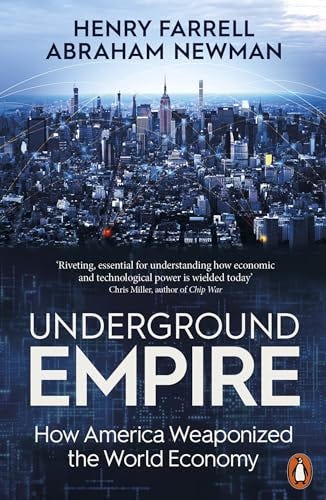
But it turns out that while we were playing digital border guard, we were being quietly evicted from the physical world.
"A common mistake that people make when trying to design something completely foolproof is to underestimate the ingenuity of complete fools."
- Douglas Adams
The Great Inversion: Bits vs. Atoms
The original Underground Empire was a U.S. masterpiece.
The Underground Empire goes into great depth in the building and maintenance of the global plumbing, the cables and the banks. Washington learned to weaponise interdependence to eavesdrop on enemies and isolate rivals. It was a world of “bits” where the spider at the center of the web (America) held the ultimate veto.
However, as Craig Tindale argues in the “Return of Matter,” this digital dominance seems to have a hollow core.
The entire 40-page piece is a must read and I’ll share the key ideas.
We optimised for “Just-in-Time” efficiency and got “Just-Too-Late” security. We specialised in high-margin services while offshoring the “dirty” work of smelting and refining to the lowest bidder.
By 2026, the physical availability of matter, not the availability of credit, sets the limit on national power.
"We optimized for the spreadsheet and forgot the shipyard."
- Modern Geopolitical Adage
The Midstream Cage and the Separation Wall
The most dangerous mental model in Western policy is:
The Feedstock Paradox: the strategic illusion that owning a mine equals owning the material.
In reality, a copper mine in Arizona or a lithium project in Australia is merely a “quarry for a Chinese smelter” if you do not control the midstream.
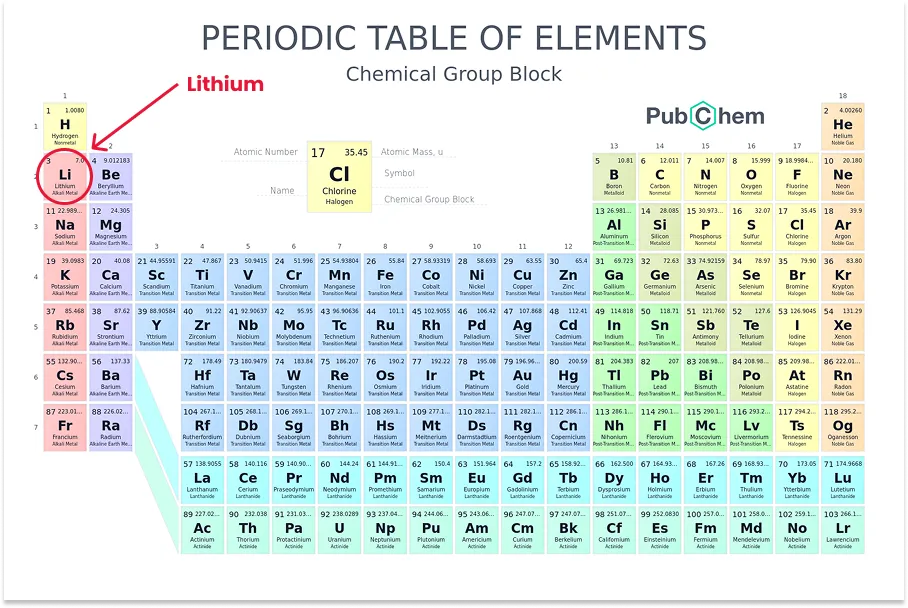
China didn’t just win the mining war; they won “Processing Sovereignty.” By building an integrated lattice of refineries and chemical plants, they became the gatekeepers of the periodic table.

This is the Separation Wall: the technical and environmental barrier that makes mining Rare Earth Elements (REEs) easy but “ungluing” them nearly impossible for the West.
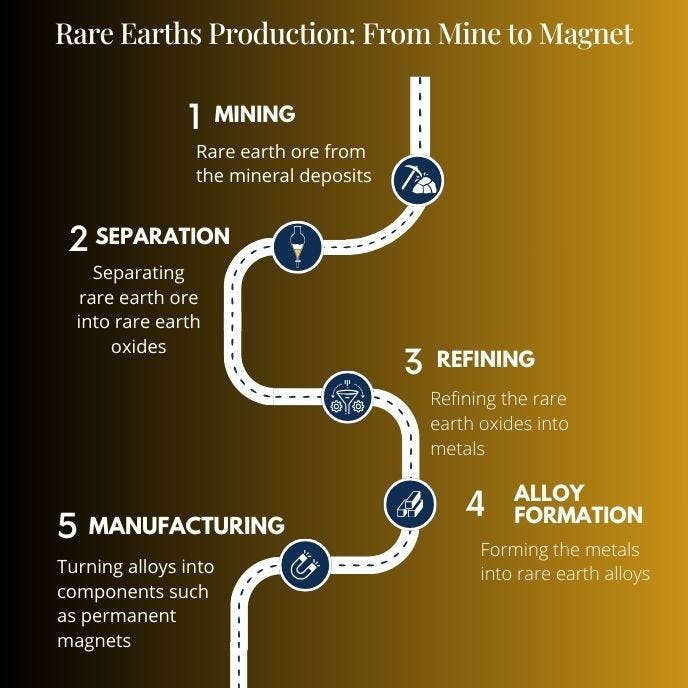
As of 2026, Beijing’s grip on separation remains the “kill switch” for Western magnet chains.
By the way, if you haven’t ready Packy McCormick The Electric Slide, its mandatory reading to understand why rare earth, critical minerals matter so much for all the electrified future we are working to build.
The Derivative Mineral Trap
Economists treat metals as independent commodities but the thing is Geology & Mining is a package deal.
Critical elements like Tellurium (solar), Indium (chips), and Antimony (munitions), even Silver are “hitchhikers” found as byproducts of host metals like copper and zinc.
You don’t actually go dig up Silver or Antimony directly, and what you dig up out of the ground upstream isn’t immediately usable downstream.
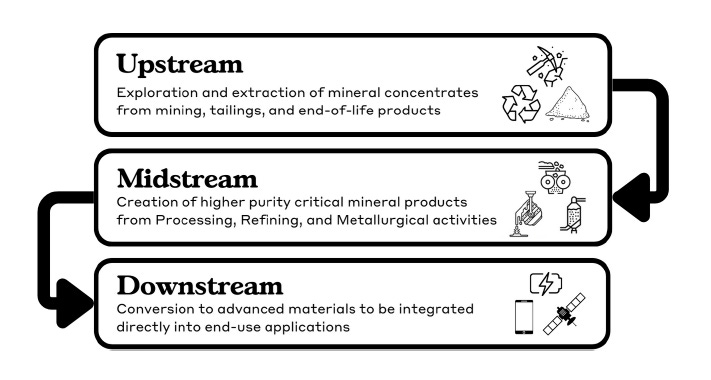
According to Tindale, by capturing the host metal midstream, China has effectively purchased a “control option” on the entire family of derivative elements.
We are in a “Zinc Trap” similar to 1914, when Britain controlled the world’s zinc ore but Germany controlled the smelters.
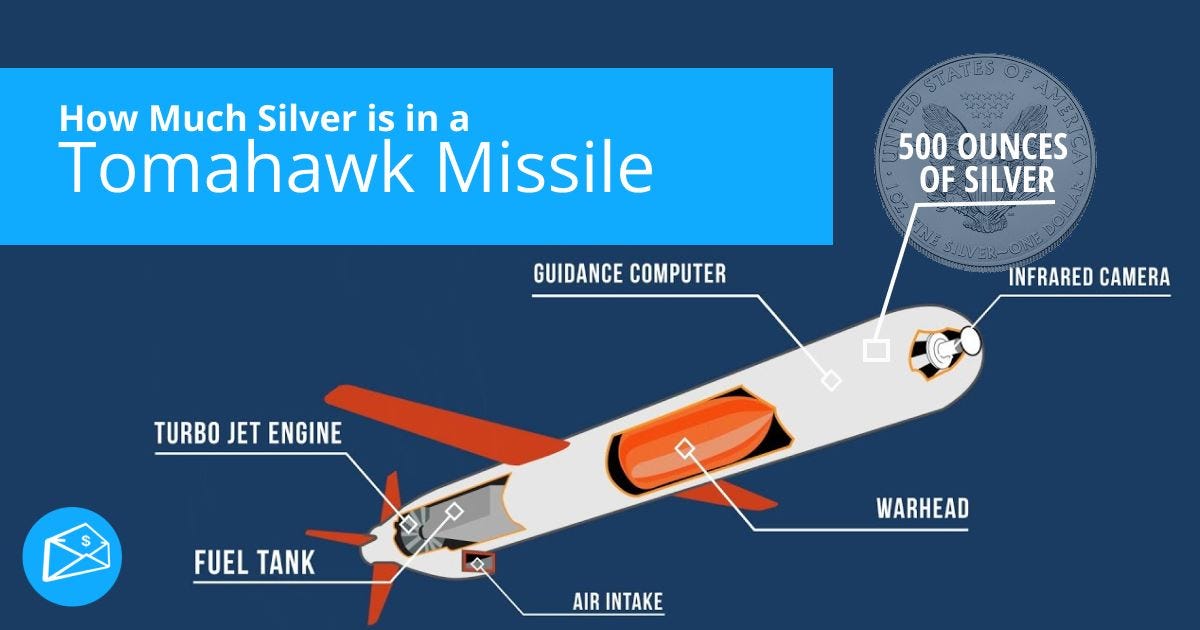
In 2026, we face a “Silver Cannibalisation”: every gigawatt of subsidised solar panels locks up silver that is no longer available for a Tomahawk guidance system.
The Four Clocks
None of this is actually profoundly new information. Well known institutions have been doing writing long white papers about this problem for many years.
The question is does the West have the decision making processes to deal with this New Underground Empire?
Tindale outlines the The Four Clocks as an example of Systems Failure
The New Underground Empire thrives because Western decision making is paralysed by a clash of time horizons:
The Financial Clock: Rewards quarterly buybacks, not 20 year refinery builds.
The Industrial Clock: Requires decades to permit and build a smelter.
The War Clock: Demands immediate surge capacity and physical stockpiles.
The Climate Clock: Demands rapid decarbonisation, which often acts as a “Boardroom Kill Switch” for the “dirty” heavy industry we need for survival.

Recent speeches by the current administration seem to indicate that something has changed.
For example, here’s Secretary of the Interior Doug Burgum recently:
“We have to get back in the refining. China controls 85%... 100% of the refining of the top 20 most essential minerals that we need for our economy. So when President Trump says ‘refining is rare,’ it’s rare in the U.S. because regulations killed it all.”
See 4:30 onwards:
An Investing Framework for Material Sovereignty:
Rather than direct you to stock or an ETF, I think it’s far more important to provide a framework you can use to understand the ecosystem and understand the headlines better.
These are the 5 areas of interest I discovered:
1. The Midstream Gatekeepers (Processing Sovereignty)
In the New Underground Empire, the mine is a “remote appendage” of the refinery. This category focuses on entities that control the Midstream, the industrial “toll booths” that transform raw geology into usable high-purity oxides, metals, and magnets.
Key Logic: Without separation and smelting capacity, a mine is merely a “quarry for someone else’s refinery”.
Where to Look: Companies building solvent extraction (SX) trains, rare earth separators, and host-metal smelters (copper/zinc) that capture the “hitchhiker” byproduct minerals.
Strategic Indicator: Possession of environmental permits for “dirty” chemical processing and the presence of integrated byproduct recovery circuits.
2. The Kinetic Core (Munitions & The “War Clock”)
This category is governed by the War Clock, which demands immediate surge capacity for high-intensity conflict. These are materials where substitution is physically impossible without a catastrophic drop in performance.
Key Logic: You cannot fight a war with “Just-in-Time” logistics; you fight with the stockpiles and production lines you have today.
Where to Look: Materials essential for lethality: Antimony (percussion primers for ammunition), Tungsten (armor-piercing penetrators), and Energetics (TNT and propellants).
Strategic Indicator: Direct funding or “Defense Alpha” contracts from the Department of War (DoW) or Allied ministries to secure domestic offtake.
3. The Disruptive Breakers (Technological Leapfrogging)
The West cannot outbuild the current Chinese midstream using 19th-century acid-heavy physics. This category focuses on the “Breakers”, technologies that change the cost and environmental profile of material production.
Key Logic: Leapfrogging the “Separation Wall” requires new physics, such as thermal shock or membrane-based extraction.
Where to Look: Flash Joule Heating (FJH) for millisecond mineral recovery, HAMR Titanium for low-energy powder production, and Direct Lithium Extraction (DLE).
Strategic Indicator: High Technology Readiness Level (TRL) progression and partnerships with academic hubs like Rice University or the Idaho National Laboratory.
4. The Circular Sovereigns (The Urban Mine)
This category shifts the map from “mining the ground” to “mining our own waste”. It bypasses the primary midstream by harvesting minerals that have already been pulverised and mined.
Key Logic: The U.S. has enough rare earths sitting in coal fly ash and industrial landfills to last for centuries; we lack only the extraction capability.
Where to Look: Entities processing e-waste, coal fly ash, and aluminum “red mud” to recover gold, silver, scandium, and rare earths.
Strategic Indicator: Scalability of “waste-to-value” logistics and the ability to turn environmental liabilities into sovereign stockpiles.
5. The Machinery & Skills Substrate (The Means of Production)
This is the “invisible void” in Western re-industrialisation. You can have the money and the mine, but if you don’t have the machines or the people to run them, the project stalls.
Key Logic: The West is short of the specialised autoclaves, kilns, and SX mixer-settlers required to build refineries—most of which must currently be imported from China.
Where to Look: Non-Chinese machine tool ecosystems, pump and valve manufacturers, and specialised metallurgical engineering firms.
Strategic Indicator: Tacit Knowledge, the presence of experienced process engineers and maintenance crews who know how to “nurse a 200-stage SX train” back into spec.
Further Reading & Sources
“Underground Empire” (Farrell & Newman, 2023): The plumbing of digital power.
“The Return of Matter” (Craig Tindale, 2025): The primary diagnostic for “Material Impairment”.
“MacroVoices: Critical Materials” (2026): A deep dive into the scarcity alpha.
The James Tour Research (Rice University): The physics of Flash Joule Heating.
This was a great conversation between Robert Friedland and Jeff Currie.
Key Quotes:
“When you really start boiling down the scale of our supply chain issues, it’s extremely daunting. This administration understands it. I think there’s a determination to do something about it.”
“….we really need to talk about metals like scandium, rhenium, niobium, or tantalum, you absolutely have to have for national security requirements. These are metals that are more thinly traded, less transparent, and these metals can go up 10x, 20x, 50x in price. And this is really going to open at a theater near you because we’re in touch with the demands of the United States military, and we know that these metals are very hard to find and they absolutely have to be had. So, it’s some of these more interesting metals that we should talk about at some point in the near future…”
Sovereignty now belongs to those who can build the midstream. Without it, your central bank isn’t sovereign downstream; it’s just reacting to a world the West no longer builds.
You can’t build a missile out of software code, and you can’t eat a derivative.
Disclaimer : This article is for informational purposes ONLY and does not constitute financial advice or constitute investment advice or a recommendation to buy or sell any security. Investors should conduct their own due diligence. This service is not intended to constitute legal, tax, accounting, or investment advice. This article contains my opinions and observations only.
I close with a reminder that if you enjoy reading The Curious Mind, please do me the huge favour of simply pressing the like button. It costs you nothing, means the world to me, and makes the algorithm work for us.