

This is Part 5 in our AI bottleneck series.
Its All About Energy, But Not The Way You Think
You can take delivery of an Nvidia Blackwell in a matter of months. The steel box that steps the voltage down so the thing can switch on takes three to four years.
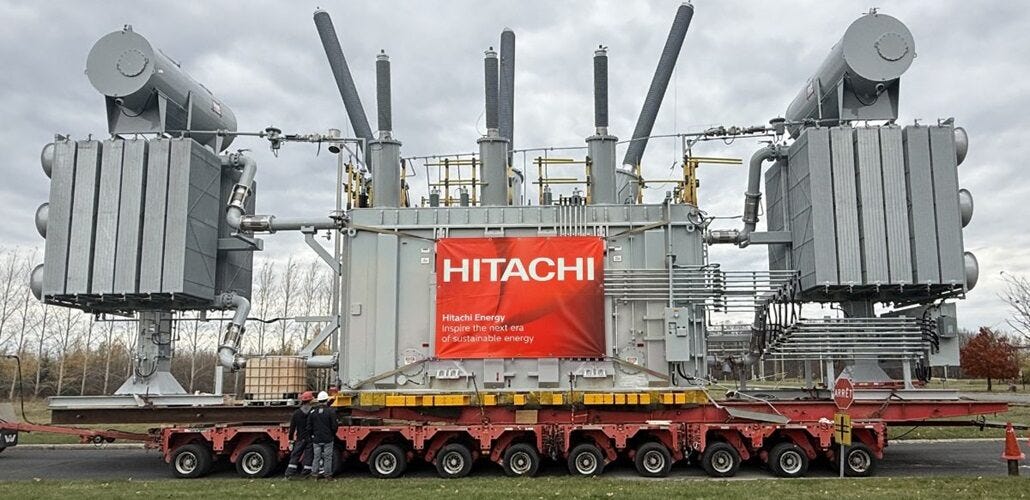
The most sophisticated object humanity manufactures, available almost on demand and the century-old lump of iron and copper that lets it turn on, back-ordered past the end of the decade.
Let’s start with why the box matters at all.
A processor computes by flipping switches, and flipping a switch costs energy. This is not an engineering inconvenience; it is a law. In 1961 Rolf Landauer showed that erasing a single bit of information must dissipate a minimum quantity of heat, that computation and thermodynamics are the same subject seen from two angles.
Every token a model generates warms the room it is generated in.

Which means intelligence, is bought in joules. A trained model is electricity rearranged into a structured artefact; an answer is more electricity poured through that artefact until tokens fall out.
If you want to geek out, go read our summary of James Gleick’s The Information.
This is also why it is a mistake to keep picturing a data centre as a stack of separate parts: chips, then memory, then networking, then power bolted on at the end. It has become a single machine.
Jensen Huang calls it an AI factory: its raw input is energy and its finished product is intelligence, and you design the whole thing, the silicon, the cooling, the power delivery, as one object tuned to that conversion.
If you want to understand the future of the technology business, look at thermodynamics.
We have spent four essays climbing one staircase.
In April, we started with the CPU as the conductor of the AI orchestra, we then discussed why the memory makers are getting half the money you spend on GPUs, we then dove into why optics are needed for AI to work in the future, and we finished with why Elon imported a power plant.
Each of those steps had the same shape, and the same escape. The chip is no longer the unit of analysis; the system is. And each constraint, however painful, was an engineering problem with a manufacturing solution. You build more fabs. You qualify more suppliers. You ramp the line.
Power is the bottom step, and it does not have that shape.
You cannot build a transformer from a backlog. You cannot push five gigawatts through wires that do not exist. Every revolution looks digital from the front and physical from the back; software ate the world for a decade, and now the world is sending the bill, payable in concrete and copper and high-voltage steel.
So where is the opportunity moving to?
Generation Is The Part You See…
When we wrote about Elon Musk importing a power plant, I framed the problem as one of generation, can we make enough electrons. It was the obvious frame, and for that essay it was the right one. But the question I posed there has, in the months since, quietly become consensus. And consensus is not where the interesting part of a problem lives.
Look at how much electricity the largest companies in the world are now contracting for, and how far ahead.
Gas turbines are sold out into the late 2020s; GE Vernova’s order book and reservation slots have run past a hundred gigawatts and are still climbing. Nuclear, declared dead a decade ago, is being resurrected reactor by reactor — Palisades coming back online this year, Three Mile Island’s surviving unit targeted for 2027, each one tied to a hyperscaler’s name.
The integrated owners are uprating the fleets they already run; Vistra is adding hundreds of megawatts of nuclear capacity under a twenty-year contract to Meta without pouring a yard of new concrete. Geothermal has found a second life by borrowing the shale industry’s drilling crews to mine heat instead of gas. And underneath all of it the twenty-year power-purchase agreement has become the unit of the deal: Meta unlocking 6.6 gigawatts in a single January announcement, Amazon contracting Talen’s Susquehanna output through 2042.

This is an enormous amount of capital moving in one direction, and that is precisely the point.
The sheer volume of the generation deal-flow is the tell. It is the part of the problem everyone can see, which means it is the part the market is busy pricing. Each of these names, the turbine makers, the integrated utilities, the restart developers, is being re-rated in real time against exactly this story.
Yes, there is real money in generation, and almost none of it is a secret.
Which leaves two questions worth the rest of an essay.
Can we avoid needing all this power in the first place?
And if we cannot, where in the problem is the part the market has not yet finished pricing?
Maybe We Won’t Need The Power
Before you build a single transformer or turbine, there is an obvious objection to clear. Perhaps we will not need all this power because we will learn to need far less of it, or because we will go and compute somewhere the power is free.
Take the first dodge seriously, because the scientists are smart.
The frontier of making computation cheaper is genuinely radical right now. The largest single waste in a modern chip is not the arithmetic; it is the cost of moving data back and forth to memory, by some measures up to seventy per cent of the energy spent on inference goes on shuffling bits, not computing on them.
So a wave of companies is doing the sums inside the memory itself. d-Matrix claims an order of magnitude less energy per bit than a conventional memory-bound design. Further out, there are people building logic that switches five orders of magnitude more efficiently than a transistor by running it cold, and others abandoning the GPU’s architecture altogether for dataflow designs that do not shuttle data the way we have for seventy years.
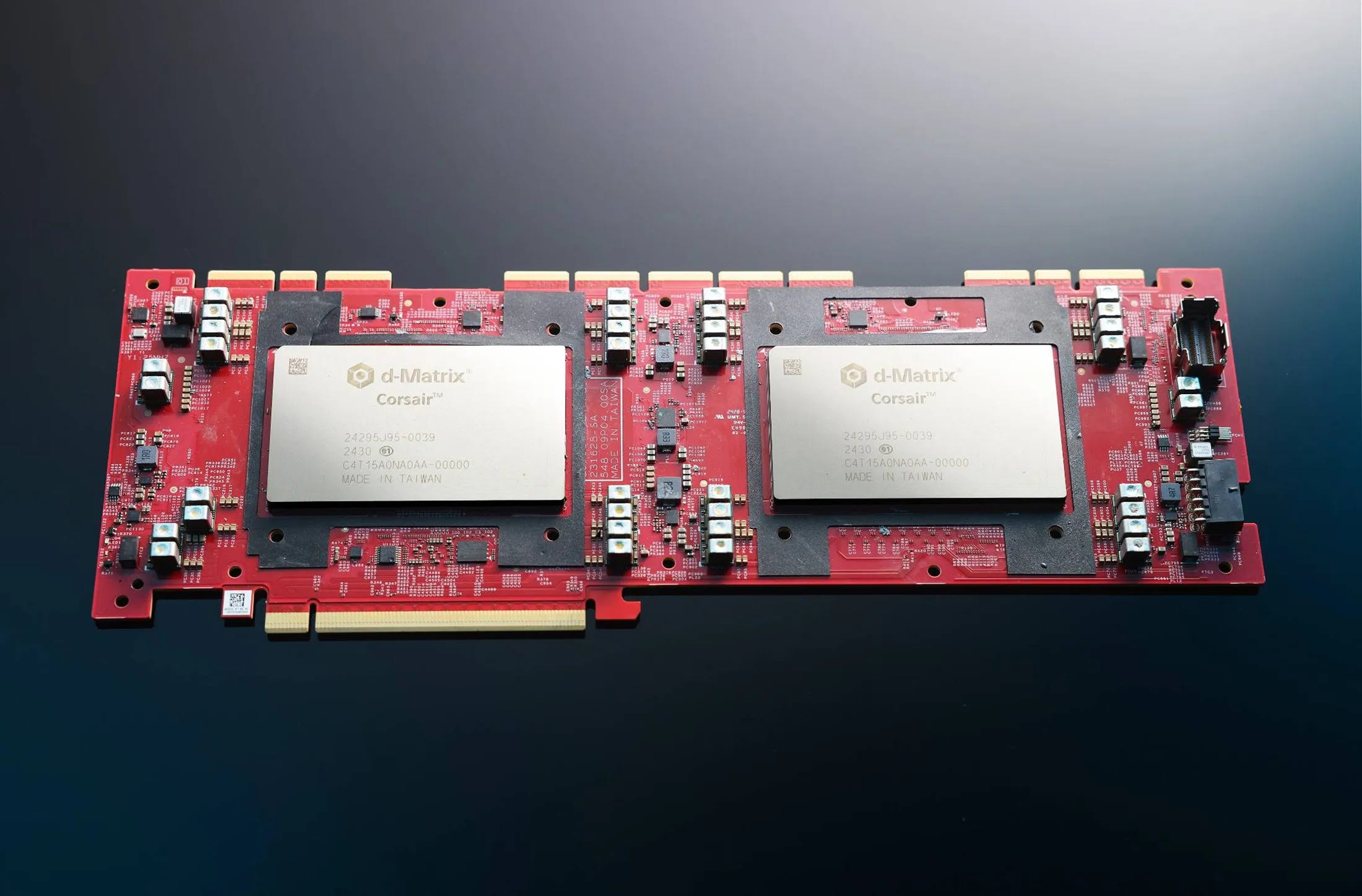
None of it is displacing the GPU at scale today, and none of it will for years; the in-memory designs in particular are limited by how little fast memory you can fit on a chip against the size of a modern model, which blunts the very efficiency they promise. These are real and promising, not imminent. The direction of travel is what matters, and the direction is not in doubt.
The venture firm funding a lot of this, Playground Global, whose partners include Pat Gelsinger, the former chief executive of Intel — will tell you it holds technologies to cut general-purpose compute by a hundred to a thousandfold. And in the same breath it will tell you this does not relieve the constraint, because demand has no ceiling. Computation is endlessly useful; make it cheaper and you simply do more of it.
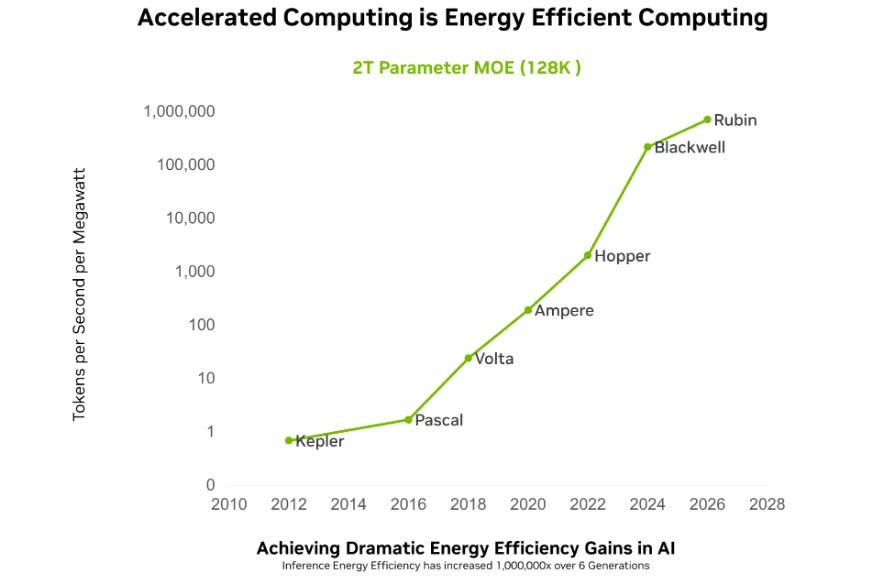
Performance-per-watt is in fact improving faster than almost any curve in the history of computing, not from one clever chip but from designing the whole factory together. And total power consumed is climbing just as fast, because every time a token gets cheaper the world decides it wants vastly more tokens. Both lines go up at once.
The second dodge is to leave the planet.
There is a real and well-funded race to put data centres in orbit, where the sun never sets and there is no neighbour to object. Starcloud reached a billion-dollar valuation faster than any company in Y Combinator’s history and has filed to fly tens of thousands of satellites; Google is testing the idea with Project Suncatcher; SpaceX has asked permission to build a million compute satellites. The pitch is seductive — free solar, and the cold of space to dump your heat into.

The trouble is the second half of that pitch - Space is not cold the way a fridge is cold; it is empty, so the only way to shed heat is to radiate it, and a single high-density rack would need radiators on a serious scale.

But the binding obstacle is not even really the heat, it is the cost of getting mass to orbit, and that cost is falling by orders of magnitude. When a fully reusable heavy-lift rocket flies at cadence, the orbital sums change, and the optimists may yet be right.
The economic case rests on a rocket that is not yet flying, and “eventually” means the 2030s which does nothing for a shortfall dated to the next three years.
So both dodges are real engineering and both are beside the point. Which leaves you exactly where you started: needing to get a very large number of electrons to a very large number of chips, on the ground, soon.
The Last Mile Fixes
So the power has to be made, and we have established that it is being made. The unsolved problem is everything between the place it is made and the chip that consumes it.
Let’s start at the grid, because it’s starting to flash RED.
In December 2025, PJM — the body that keeps the lights on across thirteen American states, the largest such market on earth — held its annual capacity auction, and it cleared at the price cap. Not near the cap; at it, the maximum price the rules allow. And even bidding the ceiling, it came up roughly six and a half thousand megawatts short of the reserve it is required to hold.
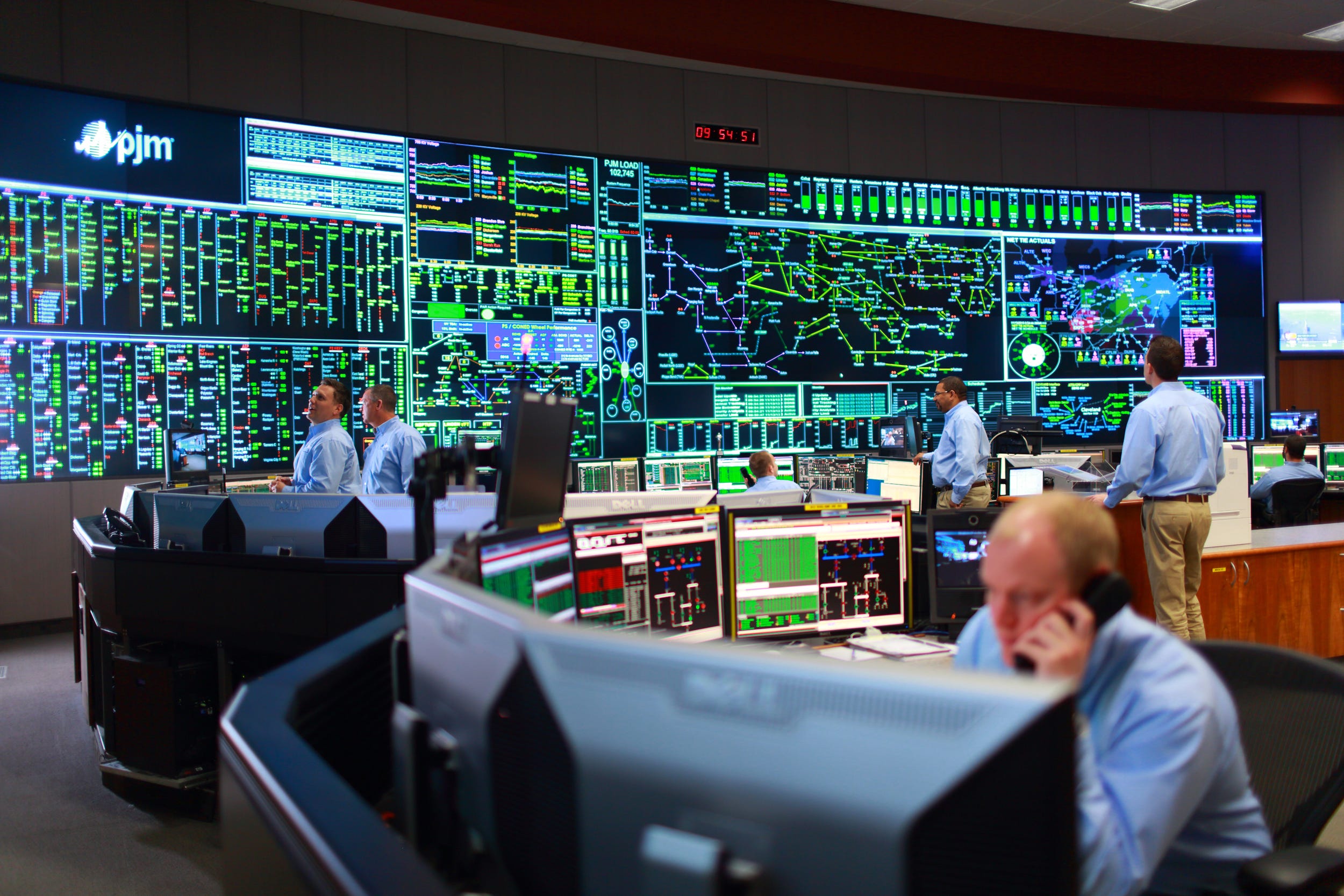
The grid underneath that auction was built for a world that grew its electricity demand by one or two per cent a year. The build-out wants something closer to seventy. In Texas, the queue of large loads asking to connect has passed four hundred gigawatts, the overwhelming majority of it data centres. The wires, the substations, the rights of way — none of it was sized for this, and none of it can be conjured quickly.
Two things complicate that picture.
The first is that the grid grows slowly less because of physics than because of how we have chosen to plan and pay for it: utilities built around one or two per cent growth, multi-year planning cycles, interconnection studies measured in years. Reconductor the lines that already exist, deploy the grid-enhancing technologies already on the shelf, and you can free up well over a hundred gigawatts of headroom without stringing a single new wire. The people who have run this for a living — Brian Janous, who ran energy at Microsoft for a decade, among them — will tell you the binding wall is the process, not the copper.
The second complication is flexibility. A data centre is one of the most flexible large loads ever built, and if the hyperscalers agree to curtail for even a few hundred hours a year at the very tightest peaks, the grid you already have can absorb far more of them than the headline numbers imply.
The bulls underplay this because it muddies the scarcity story; the bears underplay it because it weakens theirs. It is the cheapest and fastest relief valve in the whole problem, and it is barely being used.
Not all compute taxes the grid the same way.
Training a frontier model means assembling a gigawatt or more of synchronised power in one location — which is why the industry is now racing to build single multi-gigawatt campuses, and why the deliverability problem is at its most acute exactly there, at the largest scale. Inference, the running of the models once they are built, is a more forgiving load: it can be spread across many smaller sites and sent to chase power wherever it happens to be, and it is becoming the larger share of the total.
When you hear about megawatts and gigawatts one concept worth remembering is that energy production is measured in terms of accredited capacity: what a plant can be relied on to deliver at the hours of greatest strain, not in nameplate, the rated maximum on the plate.
The two diverge, and the gap is widening. A combined-cycle gas plant is credited at roughly three-quarters of its nameplate; solar and wind, against a grid whose risk has migrated to winter nights, at a small fraction; a four-hour battery’s credit slides toward a fifth as more of them crowd onto the system. The supply being built therefore counts for less than its headline suggests — and counts for less with every intermittent megawatt added.
Make sure you count the right gigawatts of supply.
Inside The Building
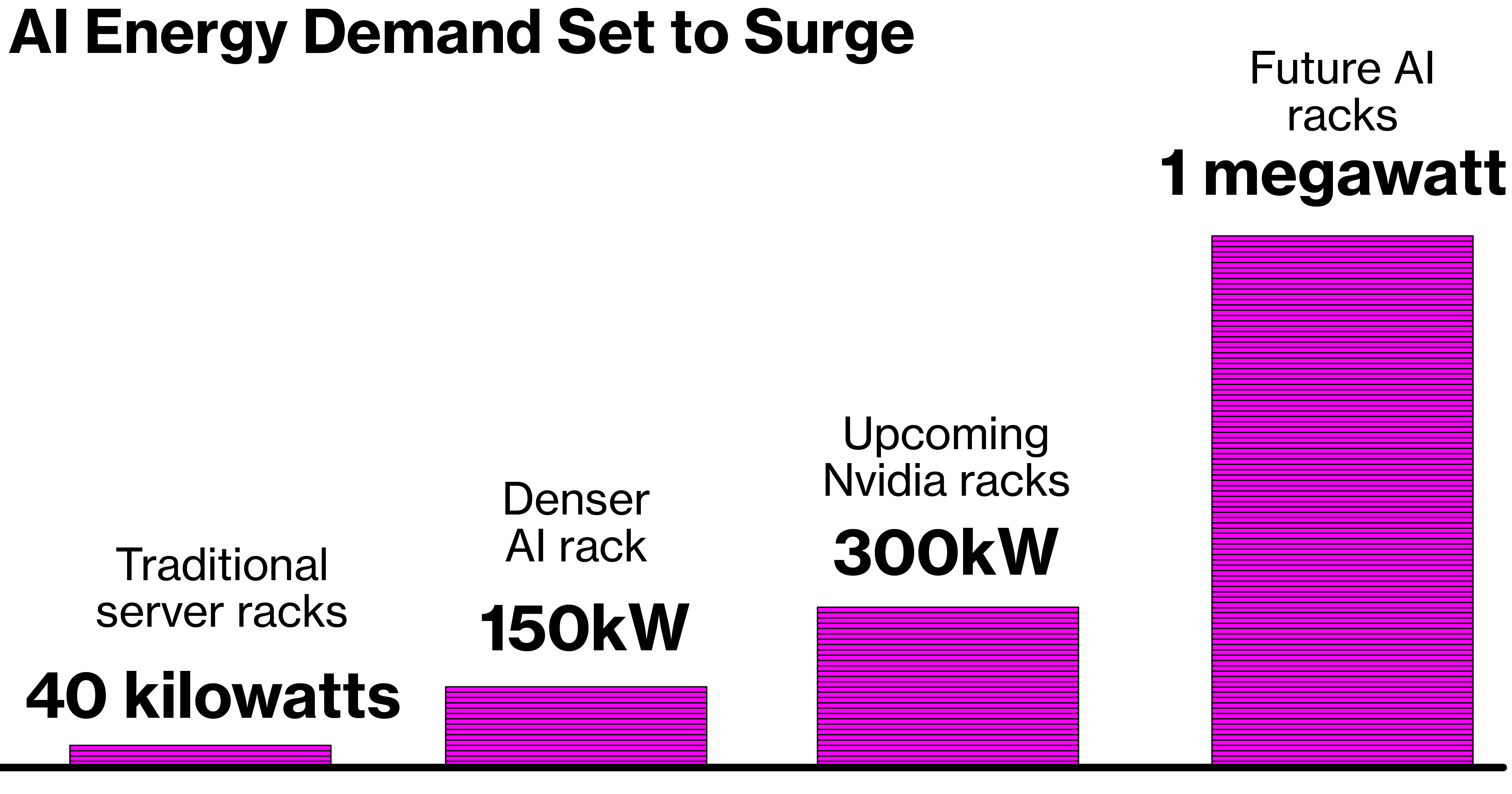
Even getting the power into the building is only half of it. Once it is there you have to get the heat back out, and you can no longer do that with air. A modern AI rack draws as much power as a small street of houses and concentrates it into the volume of a wardrobe; the only way to cool it is to run liquid directly to the chip, and an entire industry — direct-to-chip plates, coolant chemistry, immersion tanks — has grown up in the space of two years to do it.
Because conventional transformers are so scarce, the industry is changing how it moves power inside the data centre — shifting to higher-voltage direct current (you might have heard of 800 VDC, here’s a good take from SemiAnalysis), and to solid-state transformers built not from laminated steel but from silicon carbide.

Which takes us back to the essay I wrote in early May about how Elon built the world’s largest training cluster in Memphis in a hundred and twenty-two days, by shipping in a power plant from overseas, I told it as a story about generation, a man who needed electrons and went and got them. I had it slightly wrong. He did not import a power plant because he could not make power.
He imported it because the grid could not deliver power to his site fast enough; the queue and the transformer would have taken years, and he did not have years. The import was never really a generation story. It was the first and most dramatic instance of the bottleneck this essay is about: the last mile.
That is the structural fact the rest of the market is still absorbing. The constraint is not making the electrons. It is delivering them to the chip.
And once you see it that way, the most important response is not a clever fix to the grid, it is the decision to stop waiting for the grid at all. You will not make a fifty-year-old, committee-run system fast; so you put the generation next to the load, behind the meter, and ask no one’s permission. The data centre and the power plant stop being two things and become one. Musk chose that in Memphis because waiting was not an option, and it is becoming the defining move of the cycle: when the last mile is the bottleneck, the winners are the ones who own the last mile outright.
Where The Surprise Hides
If you believe all that, the investor’s question is where it pays. And here the answer is counter-intuitive in a useful way.
It does not pay, mostly, in the names you have already heard.
Consider GE Vernova again. Its gas turbines are sold out into the late 2020s; its backlog is public, growing, and on every analyst’s slide. That is wonderful for the business and almost useless as an edge, because there is no surprise left in it. When a company’s good news can be read off a chart, the market has already paid for it. The same is true, to varying degrees, of the marquee utilities and the headline restart developers: the story is known, the multiple reflects it.
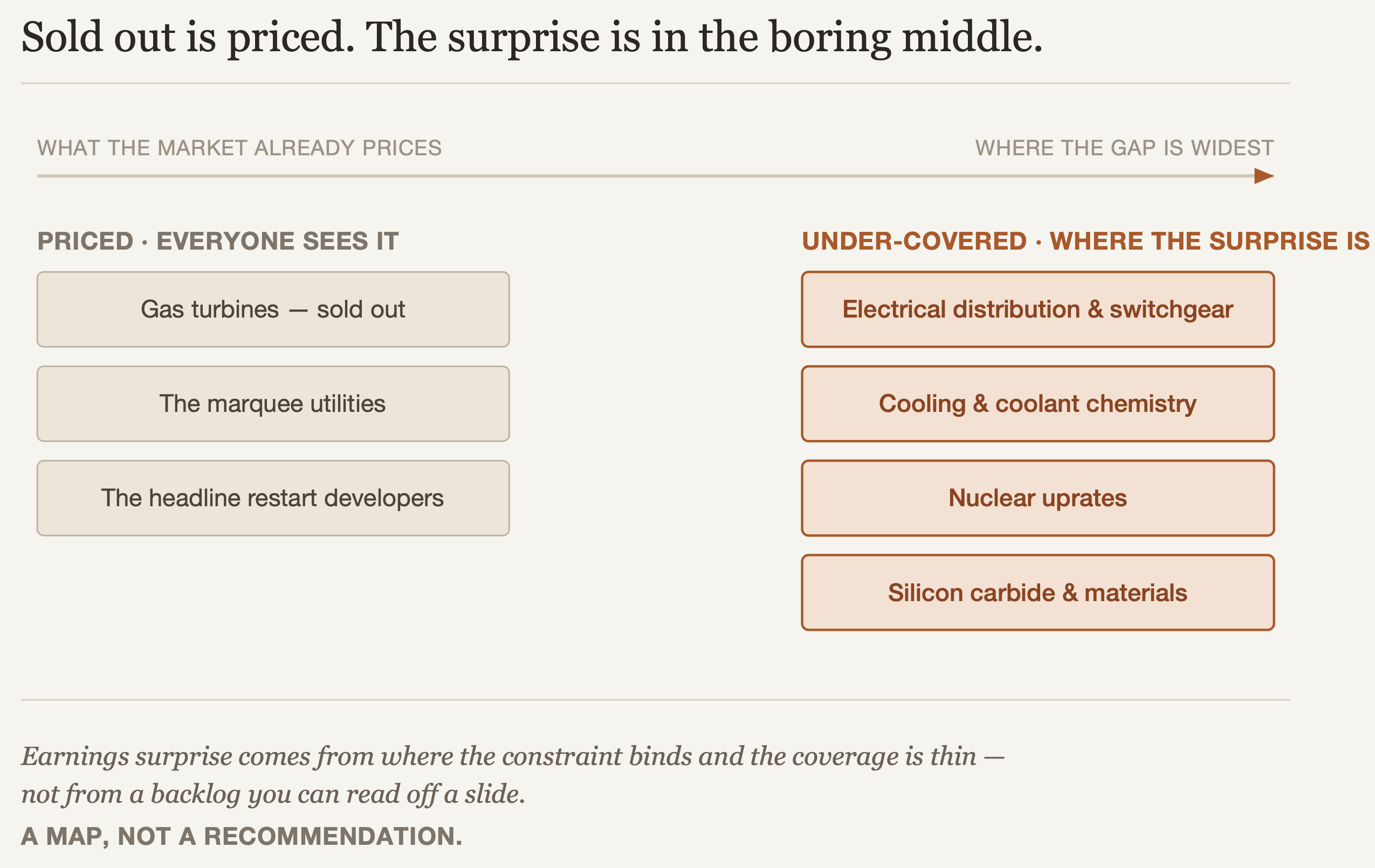
Earnings surprise, the thing that actually moves a holding, comes from somewhere else. It comes from the layers where the physical constraint is biting hard but the spreadsheets have not yet caught up. And by the logic of everything above, that is the deliverability middle of the stack, precisely because it is less glamorous and therefore less covered.
I am not going to tell you what to buy; that is not what this essay is for, and I am no longer in the business of telling anyone what to own. But I can point at where the gap between expectation and physical reality looks widest.
It is in the unfashionable electrical kit, the switchgear and distribution gear that sits a tier below the famous turbine makers, where order books are swelling faster than coverage. It is in cooling, and specifically in the coolant chemistry, now consolidating as the older industrial players buy their way in. It is in the nuclear uprate — the quiet, high-margin business of getting more megawatts out of reactors that already exist, newer as a theme and barely in anyone’s model. And it is in the materials feeding the voltage shift, the silicon-carbide supply chain inheriting a second demand curve it was never built for.
Do Not Be Cisco
Cisco was right about all of it — the infrastructure, the traffic, the case for selling picks and shovels. In the two years after the peak its stock fell almost ninety per cent anyway. That is the part to sit with: you can be completely right about the build and still lose most of your money, because capacity laid down ahead of the revenue gets written off while you wait for the revenue to show up. The railroads are the older version of the same story — they built the next century of American prosperity and ruined most of the men who laid the track. Being right about the build is the easy part. Getting paid for it is the whole game.
The bear case has two sharp edges. The first is efficiency: if the engineers from earlier in this essay win faster than expected, and a token gets another hundred times cheaper, we may not need a second American grid at all — only a little more than the one we have, with a great deal of today’s steel ordered straight into a glut.
The second edge has nothing to do with demand. When the largest loads on the grid build their own power behind the meter, they stop paying for the grid that still backs them up, and that cost rolls onto ordinary households whose bills are already climbing. This is not a forecast; it is already showing up as special tariffs, connection moratoriums and real political anger, and that anger could slow the build more reliably than any transformer queue ever will. The danger is not only that the demand fails to arrive. It is that voters decide they would rather not pay to serve it.
One thing genuinely separates this from Cisco, and it cuts in our favour. Cisco’s demand was a forecast — internet traffic projected, not yet booked. This demand is already here and already metered: tokens consumed, inference rising, the capability curve climbing quarter on quarter. So the question that ruined Cisco’s investors has already been settled for us; the demand is real and arriving.
What is left is the narrower one, whether it grows fast enough to fill this much capacity at these prices. That is a far more answerable question, and a far less frightening one. It is not nothing. But it is survivable, and you survive it the same way every time: by working out who the bust ruins and who it makes rich.
It ruins the builder, whoever pours capital into capacity ahead of the contracts, betting the demand shows up at the price he pencilled in. It rewards whoever owns the scarce thing underneath: the permitted site, the connected substation, the reactor with a signed twenty-year offtake. The railroad mania paid the steelmakers, the landowners and the banks, not most of the people who actually ran trains. So the thing worth owning was never the steel and concrete underneath — it was the contract written against it, and the years that contract still had to run. Amazon’s offtake from the Susquehanna reactor runs to 2042 no matter what a token costs along the way, and that cash flow does not care about the demand curve. That is exactly why you want it.
You want it, too, because of what the electron has quietly become.
A megawatt-hour poured into one of these buildings used to come back out as light, or heat, or motion. Now it comes out as intelligence — reasoning, discovery, working code — the most valuable thing we have ever learned to make from energy. That is why the whole improbable build is rational, and why a scarce, deliverable, contracted electron is the asset of the decade.
Which returns us to the question this essay began with.
What is the next bottleneck?
The honest answer is that there may not be one — at least not the way there has been until now. The constraint walked from chips to memory to optics to power, and at power the pattern breaks. Every earlier wall gave way because a better answer sat one layer down.
Power has nothing underneath it. Underneath power is only the physical world.
And the physical world is further off than the noise suggests. We are nowhere near the limit the laws of physics impose, we still waste energy by a factor of a thousand against what they permit. So the wall that defines this decade is not physics but tempo: how fast a society chooses to pour concrete, wind copper, train electricians and clear permits, a limit we have largely placed on ourselves, and the reason the builders willing to ignore it leave everyone else behind. What waits beyond that wall is not a few gigawatts of shortfall.
If AI and the robots after it do what their builders expect, the demand is a multiple of the entire grid — closer to a wartime mobilisation than to an ordinary capital cycle. No chip, however clever, gets you under that floor; it moves only when a society decides to build.
So when the last mile is finally built and the power is flowing, only one thing will be left to be scarce: the deliverable, contracted power itself, and the title to it.
The revolution looked digital from the front. It is being paid for, in full, from the back — in concrete and copper and high-voltage steel.
If you remember five things
Power is the first wall in the AI build-out you cannot build your way past.
The bottleneck is not making the electrons, it is delivering them to the chip, that is where the surprises might be.
Sold out is priced; the surprise is in the boring middle of the stack.
You cannot efficiency or orbit your way out of it; demand eats every gain.
The cycle that bankrupts the builders enriches the owners of contracted power.
Companies Worth Learning About:
Organised by where they sit in the stack, not as recommendations. Nothing below is advice to buy or sell anything.
Generation — gas. GE Vernova (GEV), Siemens Energy, Mitsubishi Heavy Industries, Bloom Energy (BE).
Generation — nuclear, existing fleet and restarts. Constellation (CEG), Vistra (VST), Talen Energy (TLN), NextEra (NEE), Holtec (Palisades).
Generation — advanced nuclear and fuel. Oklo (OKLO), NuScale (SMR), X-Energy, Kairos Power, TerraPower, BWX Technologies (BWXT), Cameco (CCJ).
Generation — geothermal. Fervo Energy, Ormat (ORA), Sage Geosystems, Liberty Energy (LBRT).
The dodges — efficiency and orbit. d-Matrix, Snowcap, NextSilicon, Ayar Labs (efficiency); Starcloud, Google/Alphabet (Suncatcher), SpaceX (orbit).
The last mile — transformers and grid. Hitachi Energy, Siemens Energy, Quanta Services (PWR).
The last mile — electrical distribution. Eaton (ETN), Hubbell (HUBB), nVent (NVT), Powell Industries (POWL).
The last mile — cooling. Vertiv (VRT), CoolIT, Ecolab (ECL).
The last mile — materials. Wolfspeed (WOLF), onsemi (ON), Freeport-McMoRan (FCX).
Further reading
Vaclav Smil, on the scale and inertia of the energy system — the corrective to anyone who thinks the grid changes quickly.
Packy McCormick had a great piece on Data Centers.
Doomberg, on the energy chain as a system rather than a slogan.
The PJM 2027/2028 Base Residual Auction report, for the auction that cleared at the cap.
Rolf Landauer’s 1961 paper, for why computation and heat are the same subject.
This post is for informational and educational purposes only. It does not constitute investment advice, a recommendation, or an offer to buy or sell any security. The views here are my own, formed from public information and my own research, and are not made on behalf of any current or former employer. I and members of my family may hold positions in the companies or sectors discussed through our personal investments, and those positions may change at any time without notice.