

An auction room goes quiet around the seventh bid. The lot is a first edition of The Catcher in the Rye, dust jacket intact, the Salinger one with the photograph he later had pulled. The hammer drops in the high five figures. The book on the rostrum does not function differently from the paperback for nine dollars on Amazon. It contains the same words in the same order. The bidder is paying for something else.
Across town, a barista at a Starbucks writes a name on a cup. The company pays her hourly to do this, pays rent on the counter where she does it, and pays the marketing team that put her name tag on her chest. Five years ago, the same company spent a great deal of money to remove her. They built mobile ordering and contactless pickup and automated kiosks. They optimized the queue. They watched their customers walk. In 2024 Brian Niccol, the new CEO, wrote a public letter reversing it. Bring back the baristas. Put the names back on the cups. The company is paying her for an act the automated kiosk performs faster and more accurately.
Both are receipts. Both are evidence of a premium above the commodity price of the underlying thing. Both are happening at the same time in the same economy. And the two smartest people I have heard explain them are not telling the same story. Whose story is closer to right will shape what your job, your portfolio, and your kid are about to live through.
Will Manidis is a tech founder who grew up Quaker, sold a healthcare AI company, and now writes on faith, technology, and society. His central observation is that the modern economy built itself on a Protestant assumption it inherited without examining. The Protestant parish system was the original zero-marginal-cost distribution play. Put a church near every village. Make attendance frictionless. Demand becomes universal because no one has alternatives.
The internet absorbed this assumption whole. Drive cost of access to zero, and demand must be infinite. Streaming. Free shipping. Generative AI. Slop.
What is actually happening, Manidis argues, is the opposite of what the assumption predicted. As supply collapses to zero, demand migrates from the thing to the totem of the thing. A first edition of The Catcher in the Rye has outperformed every stock market on earth over the last decade. A three-star meal in Tokyo is hundreds of dollars a plate and climbing fast. Beachfront real estate is not making more beachfront. The parish-economy median, by contrast, is approaching zero and approaching indistinguishable. The slop is free. What still commands real movement: a flight, a pilgrimage, a costly expenditure — is what still has economic gravity.
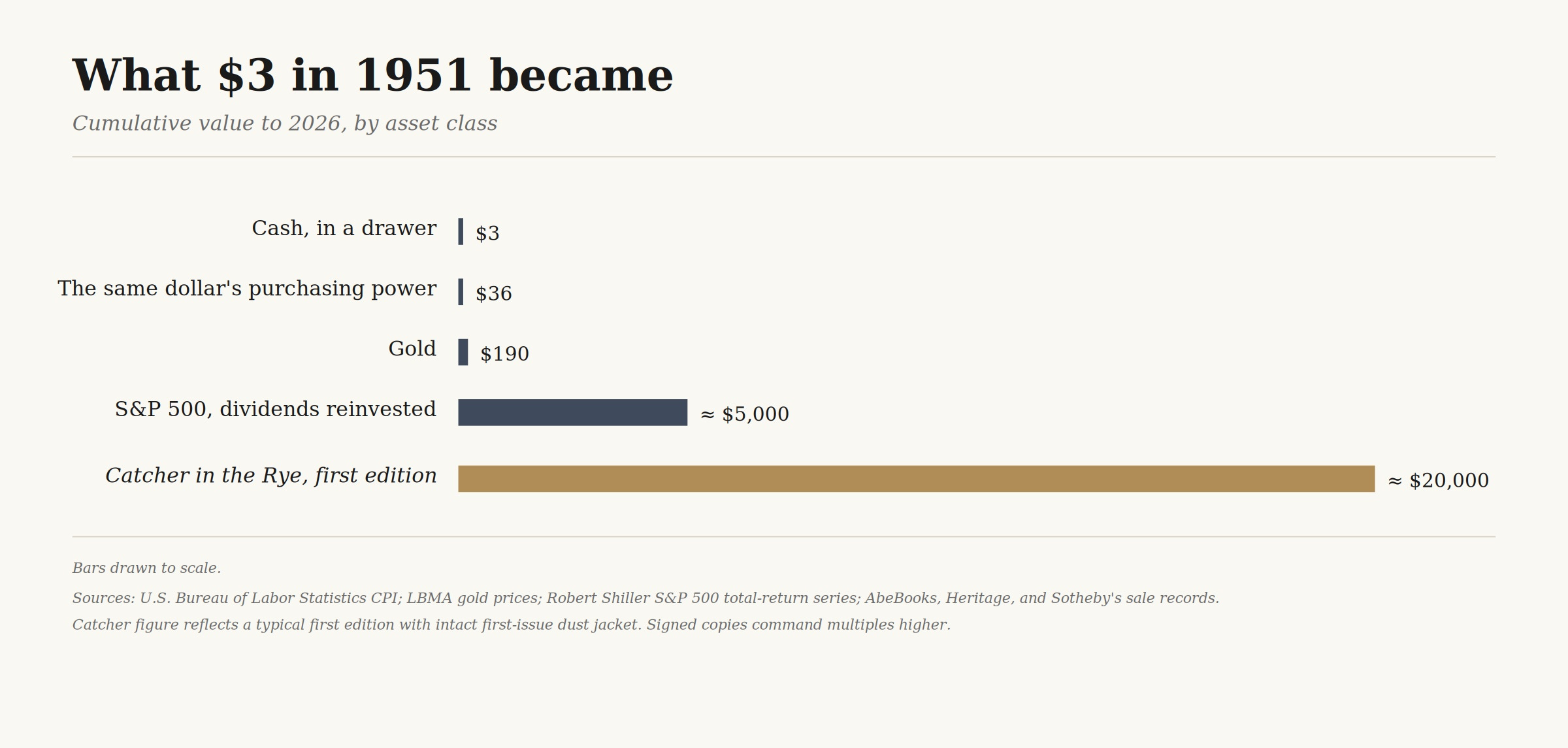
His portfolio call follows from this picture. Short commodity goods, the things you can buy on Amazon and have delivered tomorrow. Long the things that produce motion: known first editions, beachfront, the meal cooked once. The slop option gets cheaper for everyone, which is genuinely good. The totem option gets stratospherically more expensive, which is the K.
Rich people in Britain have always lived in a post-AGI society. The landed gentry take degrees in increasingly asinine fields and wear suits in dark mahogany rooms. The performance of aristocratic virtue is the job, and the performance is what capital accumulates behind.
The conclusion he draws is uncomfortable and serious.
Don’t send your child to trade school, even when it’s the right call materially. Aim her at the costly signal. Get the degree no one needs. Learn the language no one speaks. Capital will not accumulate behind the useful skill. It will accumulate behind the unprofitable one. The economic engine of the next thirty years is the resorting of consumption upward into the totem and downward into the slop, and the middle, which was always a property of the parish economy, will dissolve.
Scarcity attaches to the object.
Alex Imas is a behavioral economist at the University of Chicago. He looks at the same economy and sees something entirely different.
The error in the AI-jobs-apocalypse forecast, Imas argues, is the unit of analysis. The forecast assumes jobs are stacks of separable tasks. Automate enough tasks and the stack gets short enough that the job disappears. But jobs are not stacks. They are O-rings.
The metaphor is from the Challenger disaster. One small rubber ring failed, and the rocket exploded. Nothing else mattered. In a meal: oversalt the dish at the last step and the whole meal is ruined, no matter how well you executed the previous four. The rocket and the meal share a structure. Tasks are bundled, interdependent, and the failure of any one collapses the value of the rest.
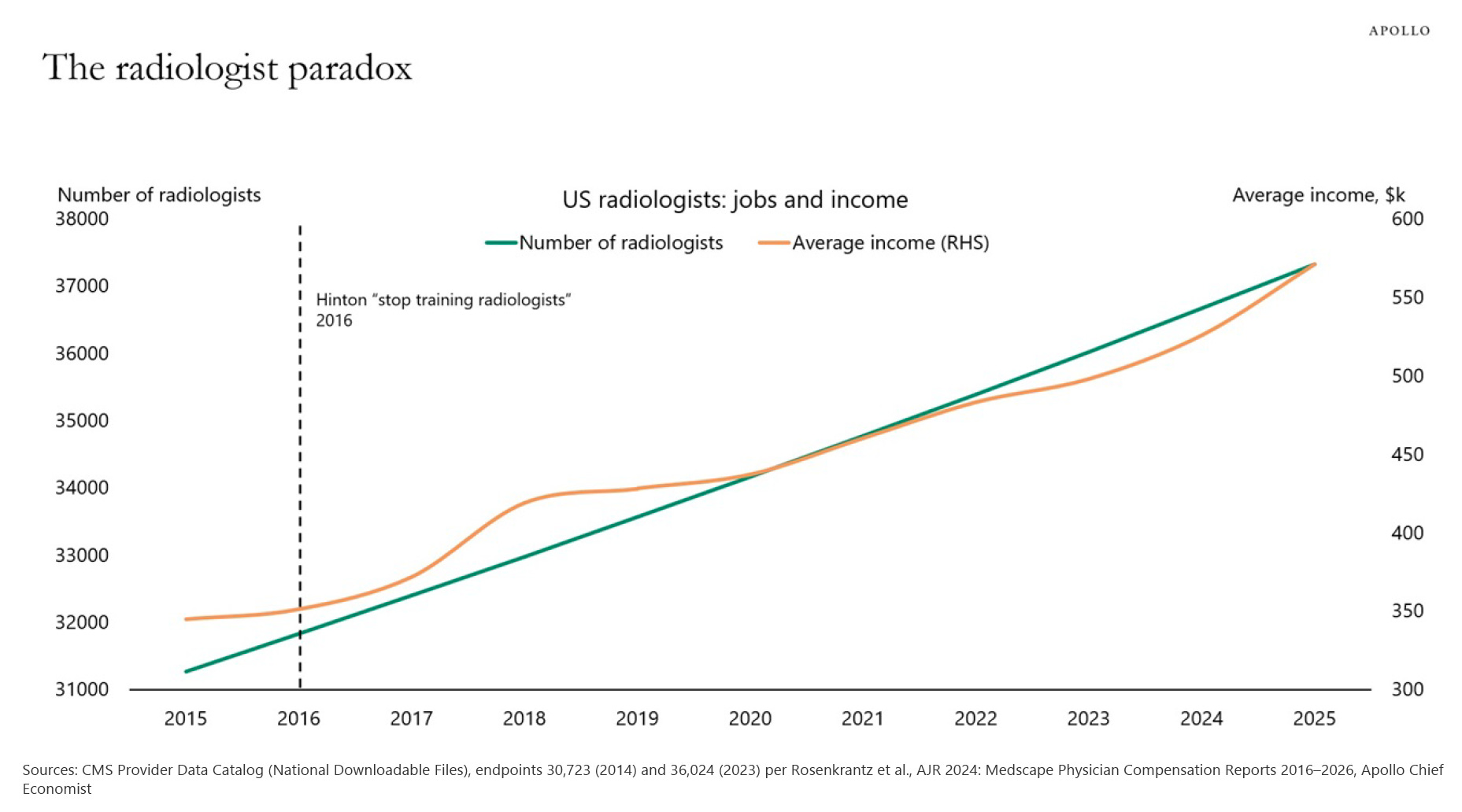
The radiologist’s job holds because the tasks are O-ringed. She has to read the scan and explain the diagnosis to a frightened patient and coordinate the care team. The reading can be automated. The explaining cannot be sloed off without breaking the bundle. The truck driver’s job is more exposed because his tasks are genuinely separable. Driving, safety checks, handing off goods. Each can be automated independently. The job comes apart.
Inside every strong-bundle job is what Imas calls the relational task. It is the part that requires a human to be the source of the act. And here is where his lab work does the real work of the argument.
Take the same t-shirt. Tell half the room they can’t buy it. The half that can almost doubles its willingness to pay. Nothing about the shirt has changed. The hedonic value is identical. Scarcity is doing the work, and scarcity here is just being-told-you-can’t-have-it.
Now run the more interesting version. Identical product. Same room. One human-made copy, one AI-made copy. The human-made copy commands a large premium. The AI-made copy commands nothing. Constrain it. Make it the only one in the world. The brain still refuses. Scarcity does not live in the object. It lives in the maker.
The field receipt that mirrors the lab is Starbucks. They priced the human element. They ran the experiment in public. They paid the price of putting humans back behind the counter because it was worth more than the automation.
A 2026 survey of six thousand executives finds seventy percent expect AI to add jobs or leave them unchanged. Software engineering hiring is recovering after coding agents landed, which is Jevons paradox doing what it always does. Cheaper supply triggers more demand, not less. The historical base rate is on his side too. In 1820, Ricardo predicted automation would devastate employment. Almost every job Ricardo could see has been automated since. Prime-age employment is at a twenty-five-year peak.
Scarcity attaches to the maker.
So which is it. Scarcity in the object, or scarcity in the maker. A first edition appreciating quietly in a climate-controlled room, or a barista writing your name. The auction house or the counter.
Both are happening. The disagreement is not about whether AI creates scarcity-driven premiums. It does. The disagreement is about where those premiums concentrate, and what kind of economy that concentration produces.
First, who commands the premium. Manidis says the object. The first edition is unrepeatable because there are only so many of them. The beachfront is unrepeatable because the ocean does not move. Imas says the human is the source of the premium. The lab data is clean. Same object, different maker, different willingness to pay. Both have evidence. Both predict different industries to bet on.
Second, the middle. Manidis says the middle dissolves because it was always a property of the parish economy. A thing that existed only because near-universal distribution made the median experience the experience that mattered. When the median collapses to zero, the middle has nothing to stand on. Imas says the middle reorganizes around the relational core inside every job. The radiologist’s job, the teacher’s job, the financial advisor’s job, the barista’s job — they look the same on the outside, and they are very different on the inside, because the relational task is now the part that commands the premium. These are not the same claim with different vocabulary. They are different claims about whether the median worker is going up or out.
Third, the dark thing both authors name and neither flinches from. Manidis predicts violence. Not in the abstract. He thinks anti-AI sabotage against grid infrastructure — transformers, data center power lines, the unhardened parts of the grid — is inevitable in places where AI’s wealth creation has visibly skipped the people nearby. If you can’t climb classes, you protect what you have, and at the margin you damage what climbed past you. Imas predicts something quieter and arguably worse. The economy will charge people for the connection they used to get for free. A priced loneliness market. Chatbot substitutes that the stone-age brain in your head recognizes, eventually, as substitutes. The recognition makes the loneliness worse than it was before the substitute. Both are looking at the same underlying fact. Ordinary daily human contact is breaking, and an economy with this much money in it is going to do something with the breakage.
The economy is pricing the same underlying phenomenon in both maps. Unrepeatability.
The first edition is unrepeatable because there are only so many. The barista writing your name is unrepeatable because she is the source and the moment is the moment. Both are scarcity. Both command premiums. Both are responses to the same fact about an AI-saturated supply curve. When everything else is being driven toward zero cost and infinite copyability, the only things that retain economic gravity are the things that cannot be repeated.
What Manidis and Imas are disagreeing about, properly stated, is not whether unrepeatability is being priced. It is where unrepeatability is concentrating.
Manidis says it concentrates in objects and experiences at the top of the market. The first edition. The pilgrimage. The meal cooked once. Therefore the social consequence is stratification. Most people consume infinite cheap slop, and a thin top tier commands the unrepeatable. Imas says unrepeatability lives inside the relational core of nearly every job, distributed across the working economy. The radiologist explaining the diagnosis is unrepeatable in the same economic sense as the first edition. The barista’s “thank you” with your name on the cup is unrepeatable. Therefore the social consequence is redistribution toward the workers who hold the relational core.
Neither view dissolves into the other. The question is not who is right about scarcity. It is where, in this sector and this life, is unrepeatability concentrating right now.
This is the value-capture problem C. Thi Nguyen wrote about, which I came back to in The Question a few months ago. Define value as scarcity in the object, and you will optimize for objects. Define value as scarcity in the maker, and you will optimize for makers. Both are coherent. Both are partial. The scoreboard is small, not wrong, in either case. But you will become whichever score you have decided to keep, and the decision usually happens before you notice you are making it.
Imas’s evidence is recent. Months to two years. His base rates are good and his lab work is clean. Manidis is making a thirty-year claim about the resorting of consumption and class. The labor market can hold at the median for two years and stratify across thirty. The relational sector can grow and the totem sector can run away from it. Both can be right. They are arguing about different parts of the same animal, on different clocks.
So what.
So the question is no longer who’s right. It is which scarcity am I trading in. Of any premium you pay, of any premium you charge, of any job you take, of any thing you are building for your child, is the value living in the object, or in the maker. Most weeks the answer is both. But the mix matters. The mix changes. The mix is what the next ten years are going to be measured by.
The rooms where scarcity attaches to the maker are, for most people, the rooms with the longest economic life left in them. Manidis is right that the totem rooms are real and getting more so. The auction houses, the beachfronts, the meals cooked once will continue to detach from everything around them. The K is real. But the totem rooms are smaller than they look from inside the discourse about them. Most working life will not be lived in those rooms. Most working life will be lived in the rooms where the maker is the source of the scarcity. The radiologist. The barista. The friend who shows up. Imas is right that those rooms are larger and more pervasive than the totem rooms make them look from the outside.
The bet neither author would say out loud in quite this form is that the source rooms are where most people will actually live, and the totem rooms are where most people will spend their fantasy capital looking up.
A way of seeing, not a recommendation. The next time you pay a premium, ask which kind it is. The next time you charge one, ask which kind. The mix tells you what economy you are already living in. Notice when the room you are in is rewarding you for the thing you made or the fact that you made it.
If this gave you a question you didn't have yesterday, send it to the one person who'd take that question seriously.

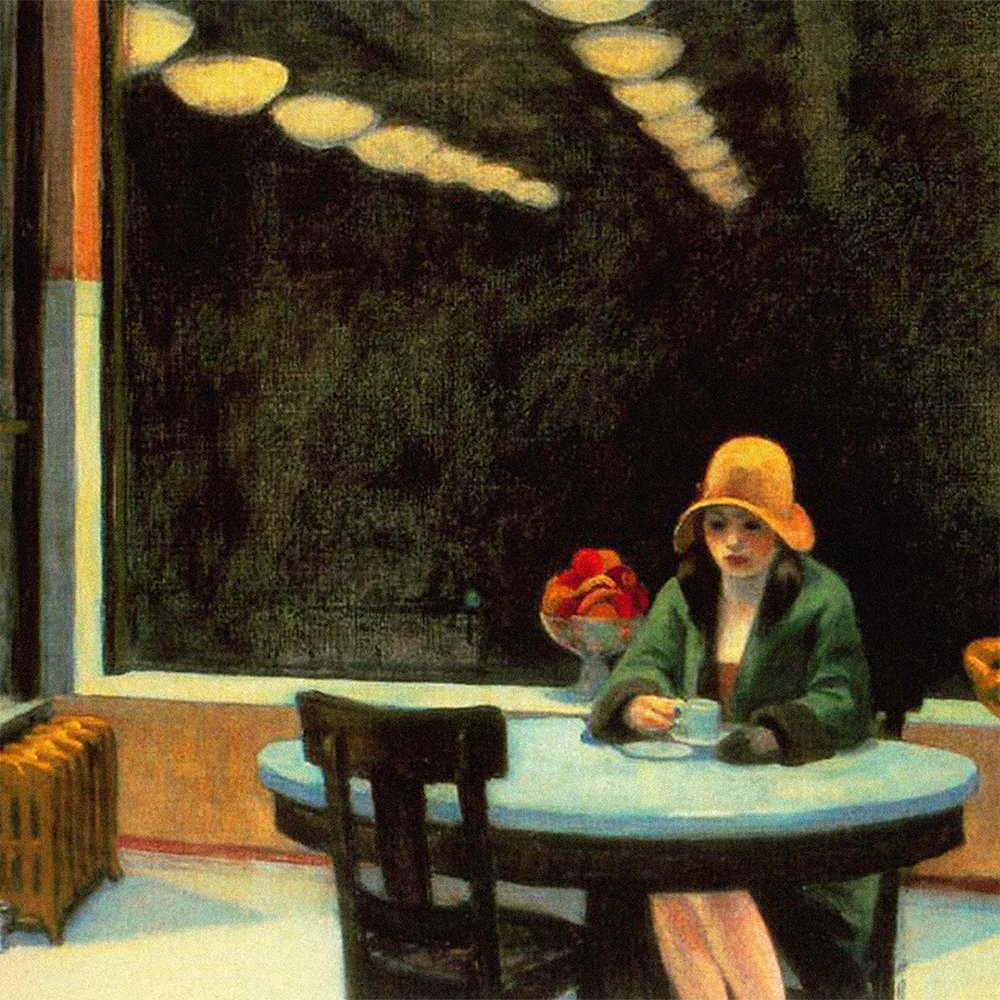
Is that an Ed Hopper painting?