

“The real problem of humanity is the following: We have Paleolithic emotions, medieval institutions and godlike technology. And it is terrifically dangerous, and it is now approaching a point of crisis overall.”
- E.O. Wilson
I’ve been thinking about trust for a few weeks, and how so much of human society is reliant on a handful of pillars that have begun to shake given our new god like technological tools.
This is also the last free copy of the Curious Mind Research Letter that will be sent to all members. To receive future copies please sign up since we have a bunch of exciting ideas to cover.
Thank you to all those who signed up as Founding Members, and that rate is still available till Oct 15th.
If you prefer to read this letter as a clean PDF, use the link below.

A. Every Face On That Call
In January 2024 a finance employee at Arup’s HK office got an email from the CFO about a transaction. He was suspicious.
He did the safe thing and jumped on a video call to check. The CFO was there, with a few colleagues he knew. His doubt went away. Over the next few days he made fifteen transfers of around $25 million.
It turns out every face on that call had been AI generated.
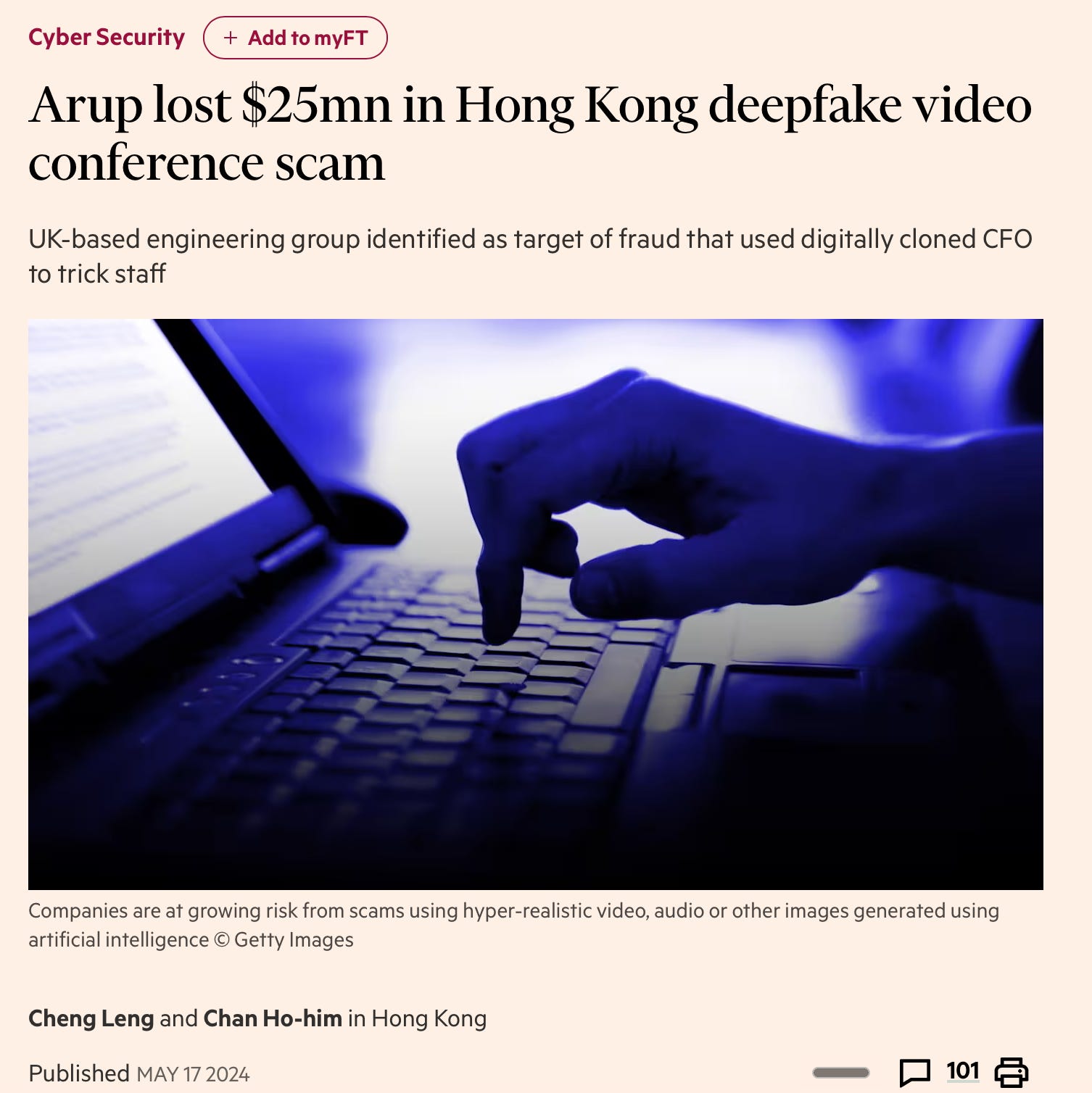
The safeguard became the attack. His trust was misplaced.
That took planning in 2024. A week ago a company called Tavus put its new model, Griffin, on one-minute live video calls with 54 strangers, and 26 of them thought they’d been talking to a person. Knowing whether you are talking to a human has now become a coin toss, and coin tosses don’t tell you anything.

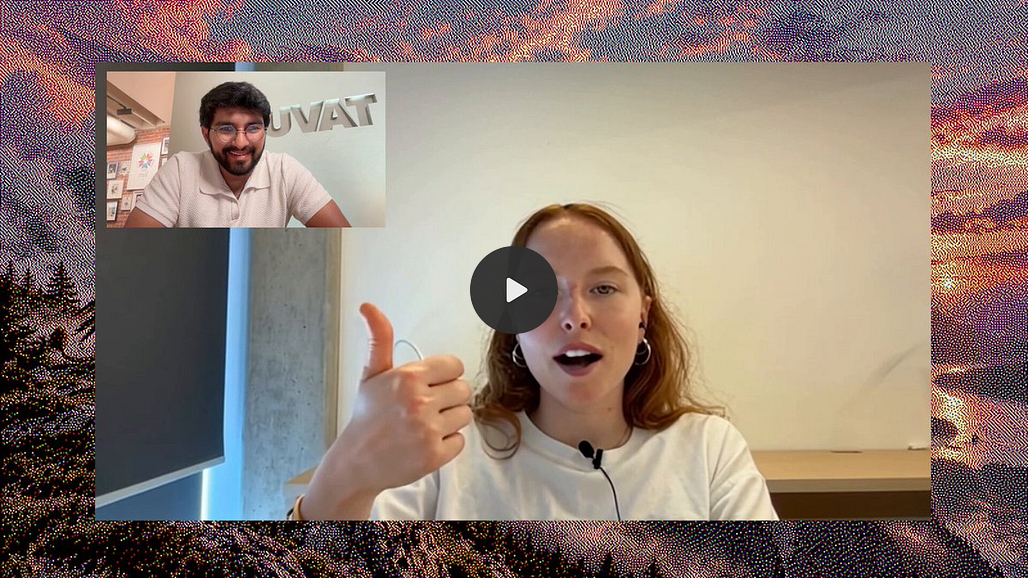
Alan Turing called his 1950 test “the imitation game.” The idea was a machine should be able to fool an average interrogator about 30% of the time after five minutes of questioning. Nothing really happened for decades. Then we solved text in 2025. Cloned voices and recorded faces followed, and one tool can build a convincing video twin of you from fifteen seconds of footage. Live video fell this month.

Words, images and videos used to be a proof somebody relied on, but the tech industry now sells imitation as a product.
It’s already causing real problems. Americans reported almost $21 billion of losses from online crime to the FBI last year, up 26% in a year and about five times the 2020 figure, and those are only the losses people admitted to.
Meanwhile, agent traffic is already about 50% of the total internet traffic and growing exponentially.
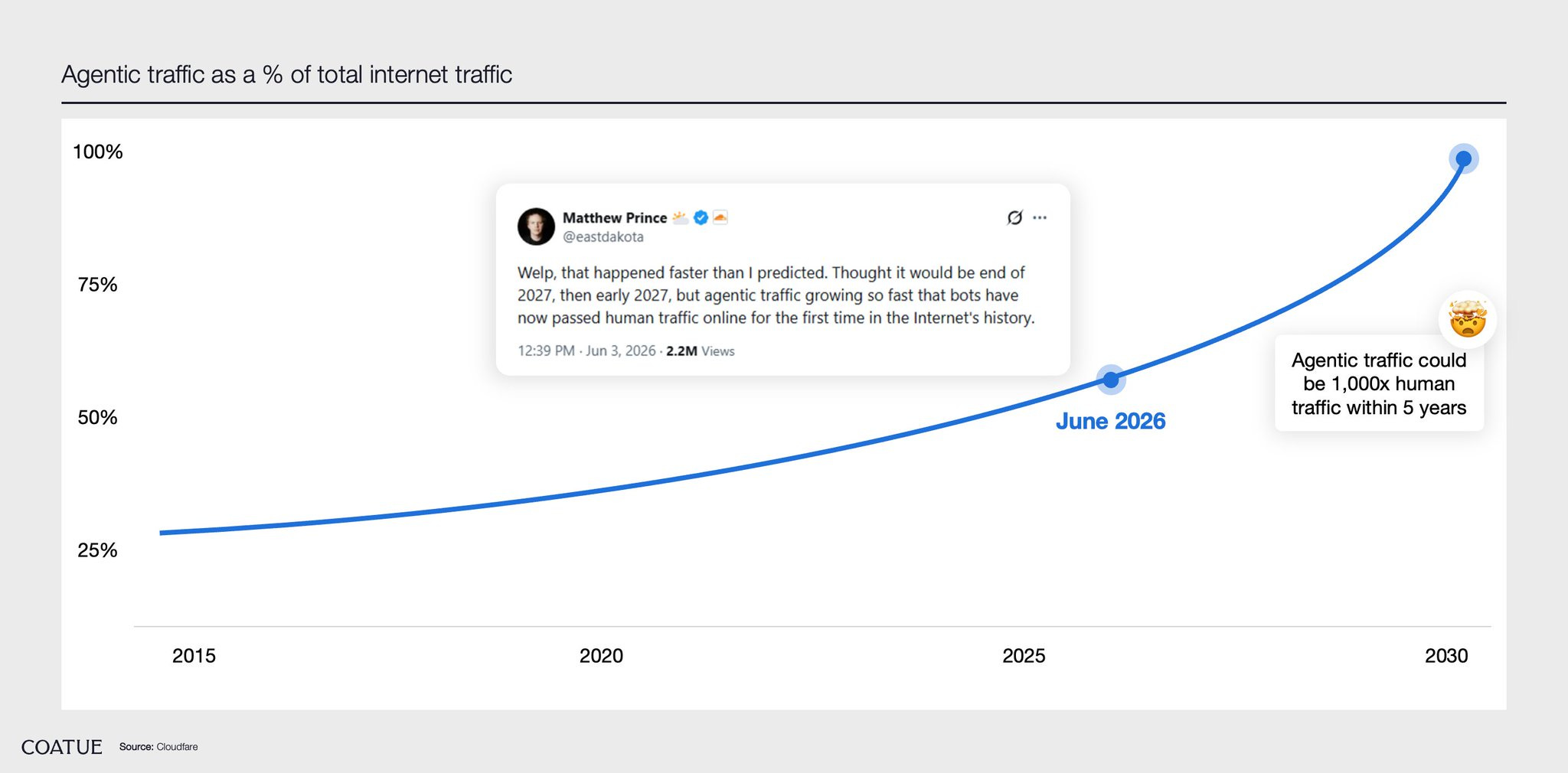
I think that when anything can be generated or imitated for almost nothing, the scarce thing becomes proof. Proof that something is what it claims to be, and proof that it’s safe to rely on. This essay discusses what happens in that environment.
B. Reality Runs On Anchors
“Bad money drives out good.”
- Gresham’s law
“All that glisters is not gold.”
- Shakespeare, The Merchant of Venice
Philosophers have always known we can’t prove reality from the inside out. Descartes discussed this in 1641, and Nick Bostrom published on his simulation theory in 2003.
But all these theories never changed behaviours.
What people did was trust. You know your bank is your bank because the number is the one on the card, the card came from the branch, and the branch has been on the high street as long as you can remember.
Daily life runs on anchors rather than certainty. What is changing is that the signals we used for anchors such as voice, face a live conversation, have become cheap to counterfeit.
We know what happens when counterfeits proliferate.
Economists worked out the answer more than fifty years ago. In 1967 a young economist called George Akerlof wrote a short paper about second-hand cars. A buyer can’t tell a good car from a bad one, so he offers the price of an average car. The owners of good cars won’t sell at that price, so they leave the market. The average falls, the price falls with it, and the market slowly fills with lemons. The Market for Lemons appeared in 1970, and in 2001 it helped win Akerlof a Nobel prize (which he shared with Michael Spence, who supplied the other half of the idea).
Spence showed that a signal only works if it’s expensive to fake. A degree, a warranty or a famous name on the door tells a stranger something because a fraud couldn’t easily afford it (btw Rory Sutherland often talks about this).

A face, a voice and a live call used to be expensive signals. AI has made them cheap, and markets that rely on those signals will drift towards Akerlof’s car lot. The way to fix it is the usual. Somebody has to do the vouching.
C. A Little Historical Context
Human society has operated on signals and vouching for hundreds of years. In 1893 fire insurance underwriters sent a 25-year-old engineer called William Merrill to assess the risk at the World's Fair's Palace of Electricity. He stayed in Chicago. With insurers' money and $350 of equipment he opened a small laboratory on the third floor of a fire insurance patrol station, and signed his first test report on March 24 1894. That room became Underwriters Laboratories, and its mark is still on the back of most things you plug in America.

London had worked this out much earlier. In 1300 Edward I required gold and silver to meet a defined standard, with the guardians of the craft to test it and strike it with a leopard’s head. From 1478 craftsmen had to bring their work to Goldsmiths’ Hall itself to be marked, which is where the word “hallmark” comes from.
UL proved a kettle wouldn’t burn the house down, and the leopard proved a cup was silver. None of them got paid because people wanted proof. They got paid because somebody else wouldn’t say yes without it.
This is something worth remembering as we proceed.
The shop wouldn’t stock the kettle without the mark, and the buyer wouldn’t pay for the cup without the leopard. Once your stamp becomes a condition of somebody else’s yes, you collect a small toll on every transaction that passes through, and it compounds for decades. The first people to govern a new technology are usually the ones who’d lose money if it failed.
We are going to be thinking a lot about this with AI in 2026 and 2027.
The Curious Mind Brain Trust has been discussing whether AI will go the same way. One member thinks regulators will be too slow and underwriters will move first, because insurance prices the risk before the harm happens. We watched it happen in the Gulf this year. Within a week of the war starting in February, war-risk premiums for the Strait of Hormuz had risen more than 10x and several insurers had withdrawn cover. Within a fortnight Washington had to offer a $20 billion reinsurance backstop to get tankers moving again.
D. When Ideas Get Cheap And Checking Doesn’t
“Falsehood flies, and the Truth comes limping after it.”
- Jonathan Swift, 1710
“Quis custodiet ipsos custodes?” (Who will guard the guards themselves?)
- Juvenal, Satires
Terence Tao (top living mathematician) discussed the future of scientific and mathematical discoveries with Dwarkesh in March 2026 and it really made me think about the relationship between AI and Humans, and the future of work seriously.
He said we remember Kepler, who spent twenty years on ideas that didn't work before finding that planetary orbits were ellipses. But Tao wants us to remember Tycho Brahe too, the difficult Danish nobleman whose naked-eye observations, about ten times more precise than anyone's before, were good enough to rule nearly all of Kepler's guesses out.
AI, Tao said, "has driven the cost of idea generation down to almost zero." That doesn't make anyone richer by itself. Everything now waits on the checking.
I think working with AI for most of us will come down to verification.
His own field has shown us exactly what he meant.
In September OpenAI announced that 10k AI agents, running for 88 hrs, had settled one of the Clay Institute’s million-dollar Millennium problems. The Clay Institute still lists the problem as unsolved because its rules don’t allow a solution to be considered until 2 years after publication.
The AI needed eighty-eight hours to do the work, and the human checking will likely take years.


Soon we will have more Keplers than we know what to do with and nowhere near enough Brahes.
So what do humans do when ideas, images, voices get cheap and checking doesn’t. Here are some questions worth asking:
Is it real? The thing in front of you: a photograph, a document, a filing.
Is anyone there? The person on the other end.
Did they mean it? Whether the agent acting for them had permission.
Who checks the checker? Whether the machine doing the checking can be trusted.
Is It Real?
In May 2023, a Twitter account calling itself Bloomberg Feed, posted a photograph of black smoke rising beside the Pentagon. It had nothing to do with Bloomberg. Russian state media passed it on, other ticked accounts followed, and for a few minutes the S&P 500 slipped. Then the Arlington County fire department posted that there was no explosion and no danger, and the market recovered as if nothing had happened.
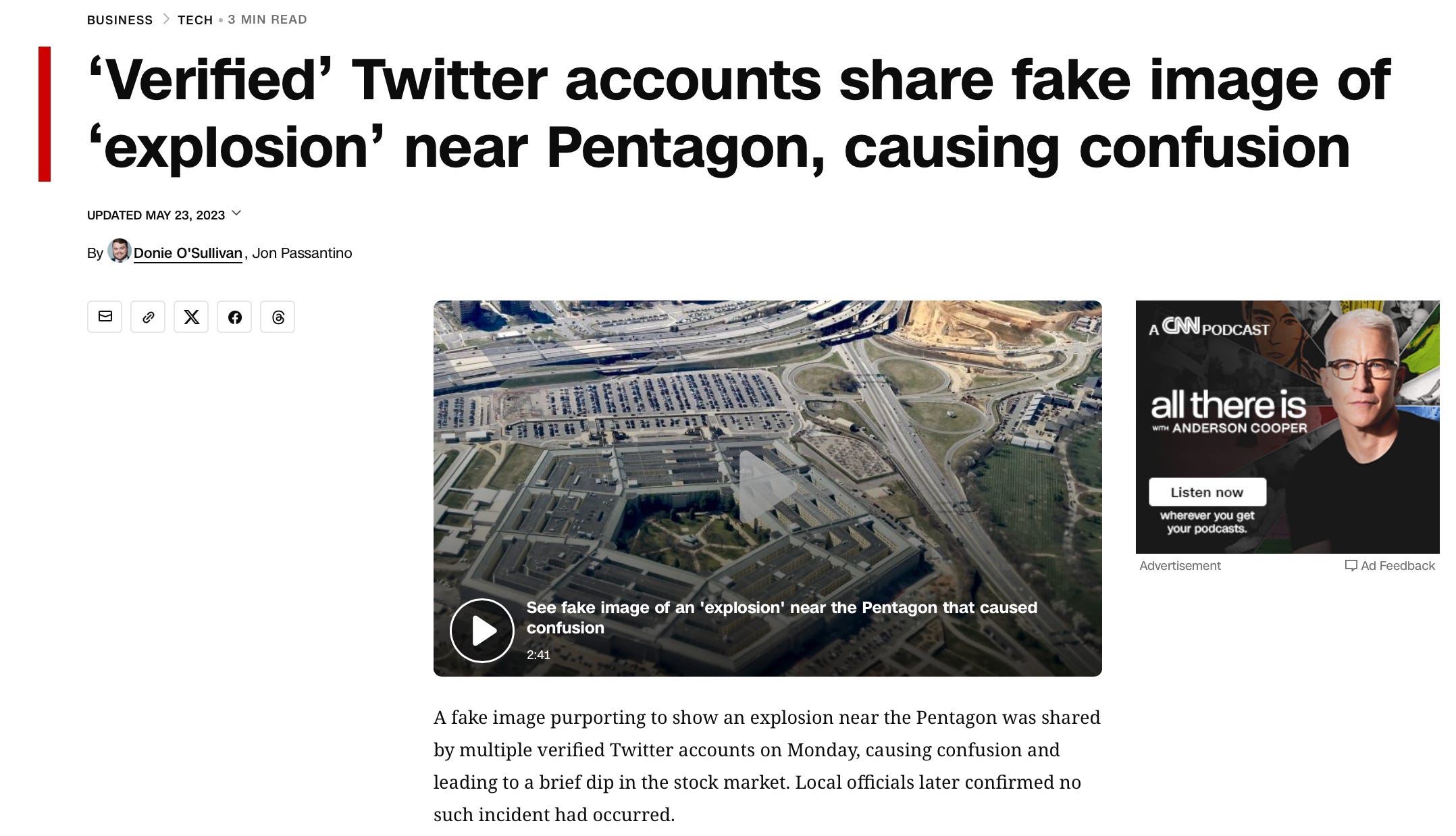
Anyone who looked carefully could see the picture was a forgery. The windows were wrong and the fence seemed to dissolve into the smoke. It didn’t matter, because almost nobody looked carefully. The lie travelled fast, the checking takes time.
Is Anyone There?
The FBI now suggests families agree a secret word for calls that sound like emergencies. Firms are going back to ringing a number they already had before they move money.
These are the oldest checks there are, a fact only you and the right person share. We are going to need to ask far more often if you are speaking to a human or not.
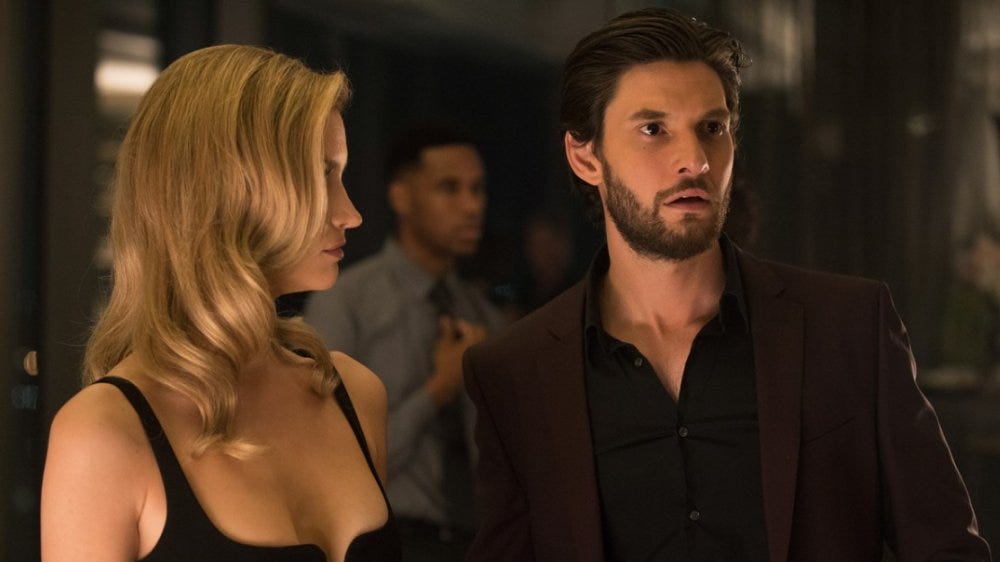
I always loved this scene in Westworld - and think we are 5-10 years away.
Did They Mean It?
A member of the Brain Trust told us about a friend who filmed everything in his garage one weekend and handed the video to an AI agent. The agent wrote the listings, haggled with buyers, arranged for people to come and collect, and a few thousand pounds later the garage was empty.
The agent behind stories like that, Instinct, will now phone businesses for you, arrange plans with your friends’ agents, and, according to its terms, enter binding agreements on your behalf. Give it a face and it could sit in your Tuesday meeting and say what you’d have said.
Lawyers have had a phrase for this for centuries: qui facit per alium facit per se, he who acts through another acts himself. We have always let other human act on our behalf. We send a solicitor to complete a purchase, sign a power of attorney for an elderly parent, and have a notary stamp the document so a stranger can see who authorised what, and how far. The scarce thing has never been the agent. It’s the proof of the limits.
We built all that machinery for agents who were people. Nobody has built it yet for one that can make forty calls an hour and wears your face while doing it.
Who Checks The Checkers
Another member put a 615-pg French Registry through a model. The LLM was fluent and organised and it led him a long way up the garden path on French land law before he noticed. The model had no access to case law. My friend only caught it because he already knew enough to doubt it.
That’s the problem. The tool sounds exactly the same whether it’s right or wrong.
You might hope to fix this by inspecting the machine itself, but you can’t. An open-weight model can be downloaded but you can’t read hundreds of billions of numbers. While a closed model is opaque in a different way, because you can’t even confirm that the one answering you today is the one you tested last month.
So people will do what they’ve always done when they can’t inspect the goods. They buy the seller: a name, a contract, and someone an insurer will stand behind. If open models keep closing the gap, that may turn out to be what the frontier labs are really selling, with the lab as the assay office rather than the silversmith.
Buffett figured this out long ago.
A little tangent on why proof isn’t just an issue if you are online….a member who treats his digital life as compromised, and uses burner phones and throwaway email addresses, had a friend who breaks into buildings professionally (with permission) test his office. The old way took fifteen to twenty minutes and a $179 gadget. Then the friend gave the gadget’s model number and the door system’s manuals to a language model, and the time fell by about 80%! He didn’t copy a card at all. He talked to the lock in a language the manuals had taught the model. The member had put all his worry into data security and almost none into doors. Rarity or lack of access used to be the protection, because few people knew how, but that disappears when anyone can borrow the expertise for the price of a subscription.
E. Where Are The Opportunities?
So what does an investor or allocator do?
Let’s go back to Merrill. He never made a kettle. He made it possible for a stranger to buy one without worrying. That’s the pattern to look for: a stamp that has become a condition of somebody else’s yes, and is still expensive to fake.
It also answers a question the Curious Mind Research Letter left open two issues ago. If we can’t see more than a few quarters ahead, maybe it best to own things that compound slowly and can’t be faked overnight. A reputation for being checkable is one of them.
Again Buffett.
I see three places where AI is creating the need for new kinds of proof, and one place to be short.
1. The Stampers (maybe insurers too). The auditors, the rating agencies, the testing houses. If the frontier labs end up selling accountability rather than intelligence, they join this group.
2. The Plumbing & Storage. I am thinking the chip on the phone that verifies you, or MasterCard or Visa that make your transactions possible. Or the exchanges, the land registries, credit bureaus. A real ledger you can still trust.
3. Real Physical Scarcity. Watches, railways, drug molecules. But far more real interesting is a real community, real relationships, live events.
And The Short Side. Be wary of any business that only works because nobody is checking. The obvious candidates make money by counting humans who may not be human. More than half of web traffic is now automated, and more than a third of all traffic comes from malicious bots, so anything paid per click, per review, per profile or per applicant is counting some ghosts.
F. What I’m Doing About It
“At first I listened to people’s words and trusted their deeds. Now I listen to their words and watch their deeds.”
— Confucius, Analects
Slow Down. Don’t send money because of a call, an email or a video, however familiar the face. Urgency is the forger’s best tool.
Call Back. Call a number you have always known, not a new one. My family also has a secret sentence we’d use on any call that sounds like an emergency.
Show Up. The more of life moves onto screens, the more a room full of people you can look in the eye is worth.
G. A Career Is A Hallmark
“The difficulty lies, not in the new ideas, but in escaping from the old ones.” - Keynes (The General Theory, 1936)
A member of our Brain Trust spent 30 years investing in tech. He’s done well. But given all the changes in the world due to trust and proof, he’s moving his capital “from abstraction toward reality”: food, water, energy, land.
Another member with a long career shared that the hardest part of managing money now is noticing when experience, which is supposed to sharpen judgement, has become an argument for protecting what you already have.
I think he found the weak point in this letter about proof, trust and safety.
A long career is also a kind of hallmark.
It certifies the silver that was already tested: the calls you got right, the cycles you lived through, the money you didn’t lose. It says nothing about the cup you haven’t made yet. The proof premium pays for the past, for what has already been checked and can be vouched for, and that’s why it appeals so strongly to people with a past worth protecting.
But maybe the next decade will pay more for things nobody can prove yet.
So where do we go?
Maybe we have to do both.
Own the stampers, the underwriters and the things a stranger can check, because when faking is free, that’s where the toll gets collected.
And keep some part of your capital, and of your attention, on what can’t be proved yet.
And when an idea pulls you somewhere comfortable, ask the question he asked himself: what am I actually afraid of?
In 1478 a London silversmith carried his cup up the stairs at Goldsmiths’ Hall and waited while a warden scraped a sliver from the base, tested it, and struck the leopard’s head. Beside it sat the smith’s own mark, which the law had required for more than a century. The leopard told a stranger what the cup was. The maker’s mark told him whom to find if it wasn’t.
The first kind of proof can be bought. The second is only ever earned, by putting your name next to the work and standing there while time does the testing.
What are you going to put your name next to?
With Love.
Great letter.
Gives much to think about.