

You are a smart curious person but short on time and surrounded by noise. The Curious Mind tries to offer the best signal to noise ratio across markets, technology and the good life.
If you missed the last issue: When Thinking Is Free, Where Will Returns Come From, The Kids Are Alright, Death Bed Doctor....
Hello from Buenos Aires, I’m travelling across Latin America with some of the Curious Mind Brain Trust to explore the culture, the people and the opportunity set. The continent is changing and while everyone is watching the Middle East, Europe or China the real opportunity might be right here.
In this week’s Curious Mind we cover a lot of ground starting with music & emotion, then going to how investing is changing and end with new macro frameworks.
Quotes I Am Thinking About:
“Music is the hidden arithmetic of a soul that doesn’t know it is counting.”
- Leibniz
“Music expresses that which cannot be said and on which it is impossible to be silent.”
- Hugo
“There is no subtler, no surer means of overturning the existing basis of society than to debauch the currency. The process engages all the hidden forces of economic law on the side of destruction, and does it in a manner which not one man in a million is able to diagnose.”
- Keynes, The Economic Consequences of the Peace
1. The Architecture of Emotion
Music has this amazing ability to make us feel emotion, it even serves as a time travelling tool. Put on a song you used to listen to as a teenager and you are transformed back into your 15 year old self.
Max Richter has done real pioneering work in music and if you’ve seen Arrival or Shutter Island, you’ve heard him. He’s got over 5mm monthly listeners on Spotify. More recently he scored The Leftovers and Hamnet.
Sleep, his 8½-hour lullaby, is meant to be slept through and passed 2 billion streams in 2025. I have been listening to it this week. It’s amazing, check it out.
This is my favourite track from the album.
He sat down with Rick Rubin for episode 200 of Tetragrammaton.
It’s a great discussion on what it takes to make music and gives you a window in to the art and science of why Richter is most important composer of this decade.
But at it’s true core it is a discussion on creativity and the creative process.
2. The Money Cannon
Patrick O’Shaughnessy compares Martin Casado to the NBA Jam player who’s on fire. In a couple of months, Casado has been in the room for 3 of the biggest strategic deals in tech: Cursor, Fei-Fei Li’s World Labs and OpenRouter.
He has the background for it too. He has a PhD in networking. He built Nicira, which VMware bought for $1.26bn, and by his count that was the highest revenue multiple yet paid in enterprise software. At a16z he invests only in infrastructure.
The big question in the conversation: Do the investing habits we built for software still work for AI? Casado thinks many of them don’t. His biggest claim is that money can now buy progress directly, which software has resisted for 50 years.
The 4 BIG IDEAS:
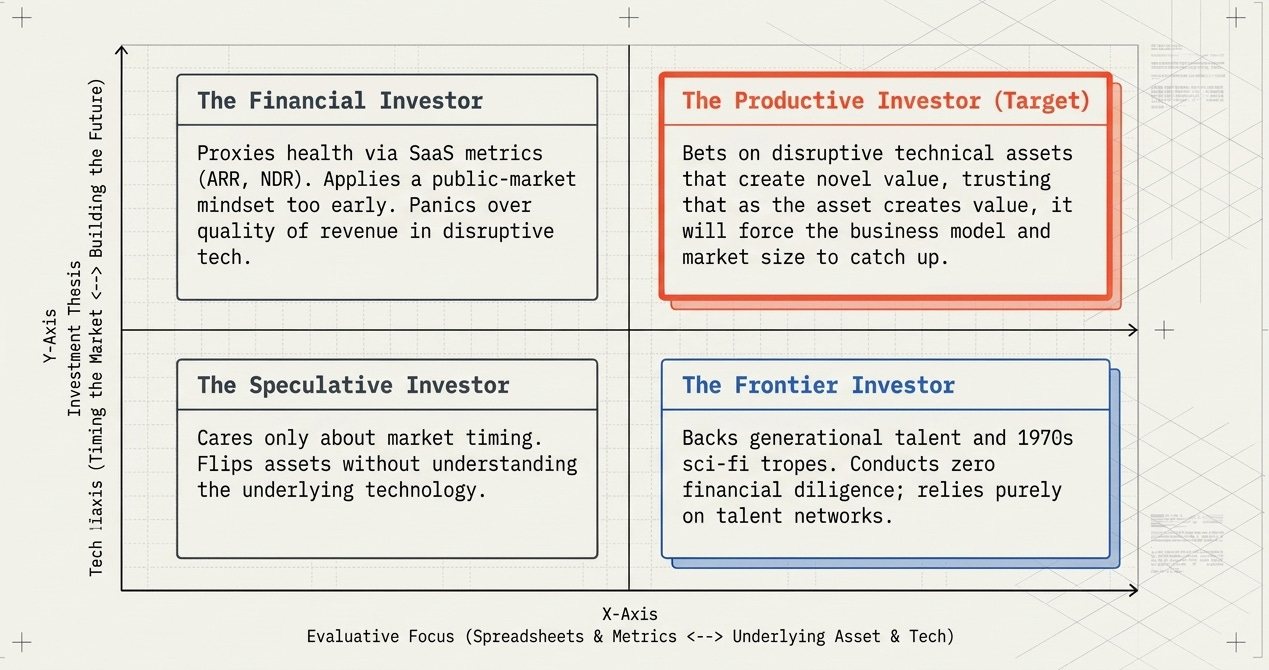
Know which game you’re playing: Casado sees 4 kinds of investor, Financial: investors judge a company by its market size and its metrics. Productive: investors judge the technology and the team, and trust that real value will create its own market. Frontier: investors back brilliant people chasing science fiction, and they don’t overthink it. Speculative: investors ignore the asset and try to time the price. Each is a sound way to invest. The danger is holding all 4 at once. The commonest mistake is bringing a spreadsheet to a revolution. When a junior investor frets about “quality of revenue,” Casado reminds them that nobody knew how to monetise the internet either. Disruptive technology creates its own market, and the business model arrives years later. Screen young companies for clean revenue and you’ll drift towards the ones that aren’t disruptive.
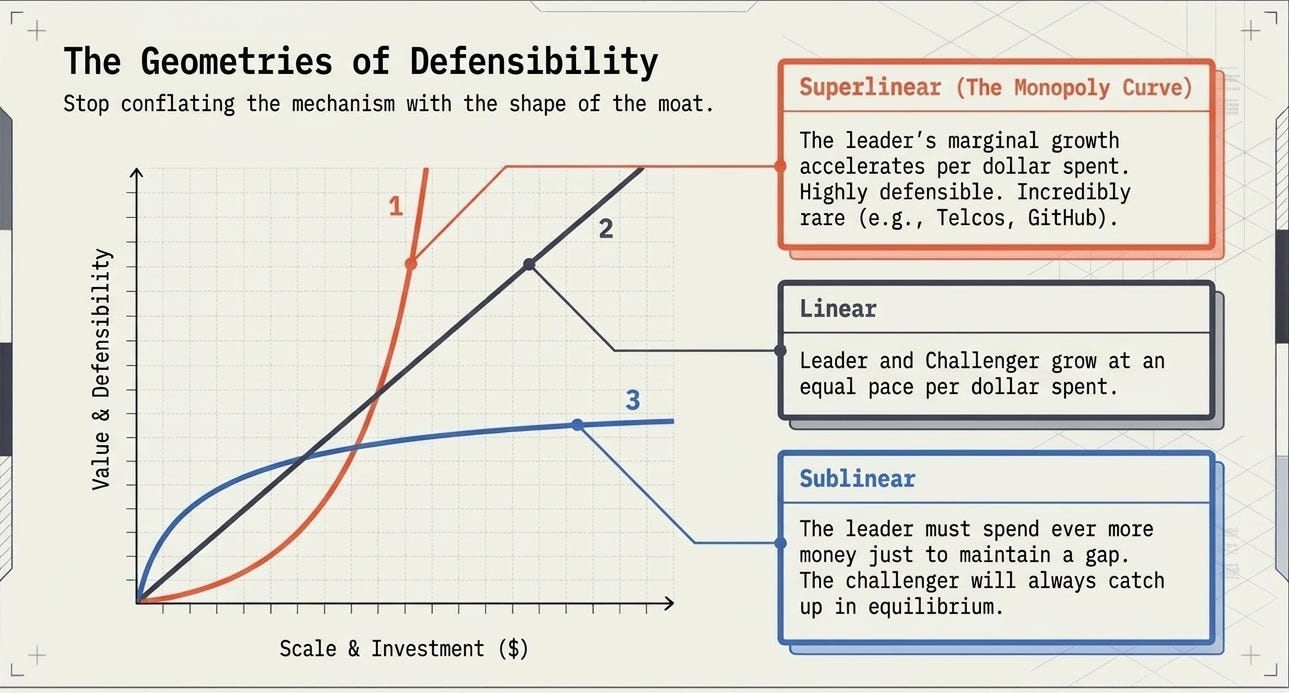
Ask what shape your moat is, then ask whether it matters: Network effects” appears on about 70% of pitch decks, and hardly anyone agrees on what it means. Casado separates the mechanism (brand, scale, a marketplace, a network) from the shape, meaning how the advantage grows as the company grows. A superlinear moat compounds. Give 2 rivals $5m each and the slightly bigger one grows faster, until the gap becomes a monopoly. Telephone networks, LinkedIn and GitHub had this. Very few others have. A sublinear moat leaks. The leader has to spend ever more to grow, so the challenger catches up. People call Uber a network, but drivers and riders use every app. Its real edge was raising more money than anyone else. But in a growing market, defensibility barely matters, because competitors chase new territory and leave each other alone. In a shrinking market, the industry consolidates whatever the moats look like. Investors who wrote off foundation models and neoclouds as indefensible watched both soak up value as the market grew.
Money can finally buy speed: In 1975 Fred Brooks showed that adding engineers to a late software project makes it later (Brook’s’s Law). For 50 years, that kept capital from speeding up progress. If you’d given 5 founders $1bn a decade ago, they’d have sat on it, or “detonated it” hiring engineers. AI changed that, and Casado thinks it’s the biggest shift of all. Anything done on a computer can be simulated, so you can train a model on it. That means you can aim what he calls a “money cannon” at the problem until it’s solved. A team of 20 can now put $1bn to work. Whether it becomes $500m or $2bn is anyone’s guess, but the money gets used, and that is new. He compares it to the Industrial Revolution, when the world stopped being zero-sum. It puts capital allocators close to the steering wheel. It’s also why he thinks the “too much money in venture” crowd has it backwards. Two decades of capital grew the pie, and today’s biggest private companies rival the public giants of 10 years ago. The new limits are chips, power and debt. A Norwegian pension fund choosing between T-bills and a random neocloud’s bonds picks T-bills. So debt flows to the giants, and scale wins again.
In a race, everyone buys the smartest model: For 3 years the best model has taken 80%+ of spending, even when it’s only a hair better than the next one. Patrick asks the obvious question. If most coding is already automated, why keep paying for frontier tokens when a 6-month-old model costs a fraction? Casado’s answer is competition. “I’ve automated all I can” may be true. “So I’ll use a cheaper model” doesn’t follow, because a rival will happily pay 10x for a smarter model that ships better software faster. Competition, more than need, keeps the price up. The catch is a kind of fragility that’s new to software. Old software kept its customers for years. From the usage curves he sees, a frontier model lasts 3 to 6 months. A lab that slips a release by a quarter could lose most of its market. All of this assumes the market keeps growing. If it slows, he sees a very real chance the value “comes crashing back down into open source.”
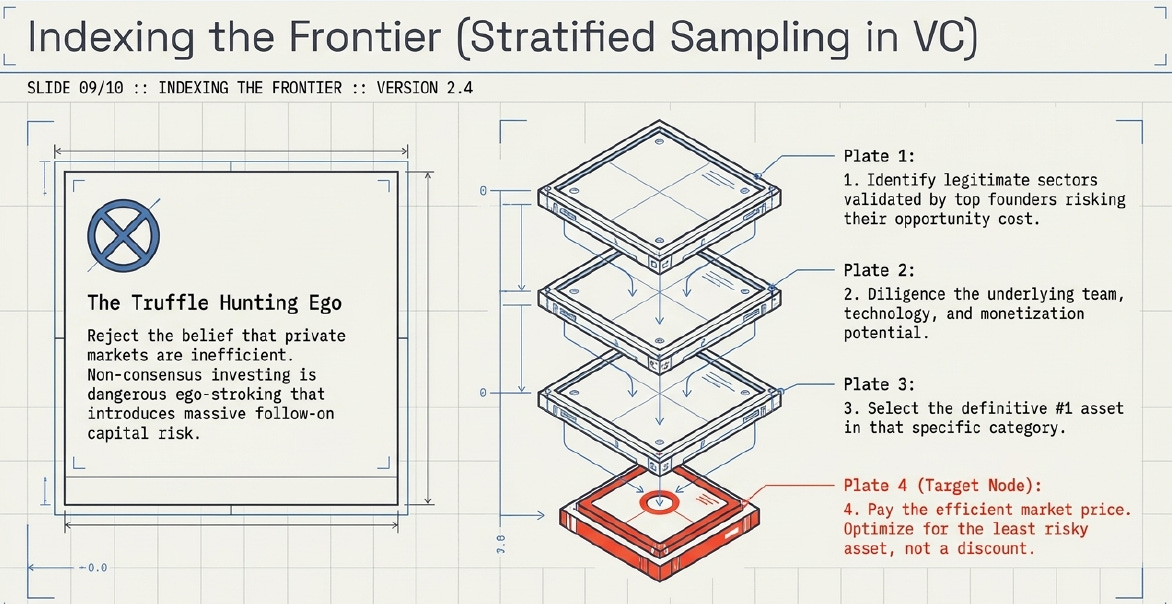
Curious Thinking: The two big ideas for me were about knowing what game you are playing, and that in a race everyone buys the smartest model.
3. When Politics Breaks, Inflation Does The Work
Vincent Deluard, head of global macro strategy at StoneX, spoke to Hidden Forces the day after the US midterms. He began with the election and ended with America’s retirement accounts, with stops at the Mexican peso and French bonds along the way.
The 5 BIG IDEAS:
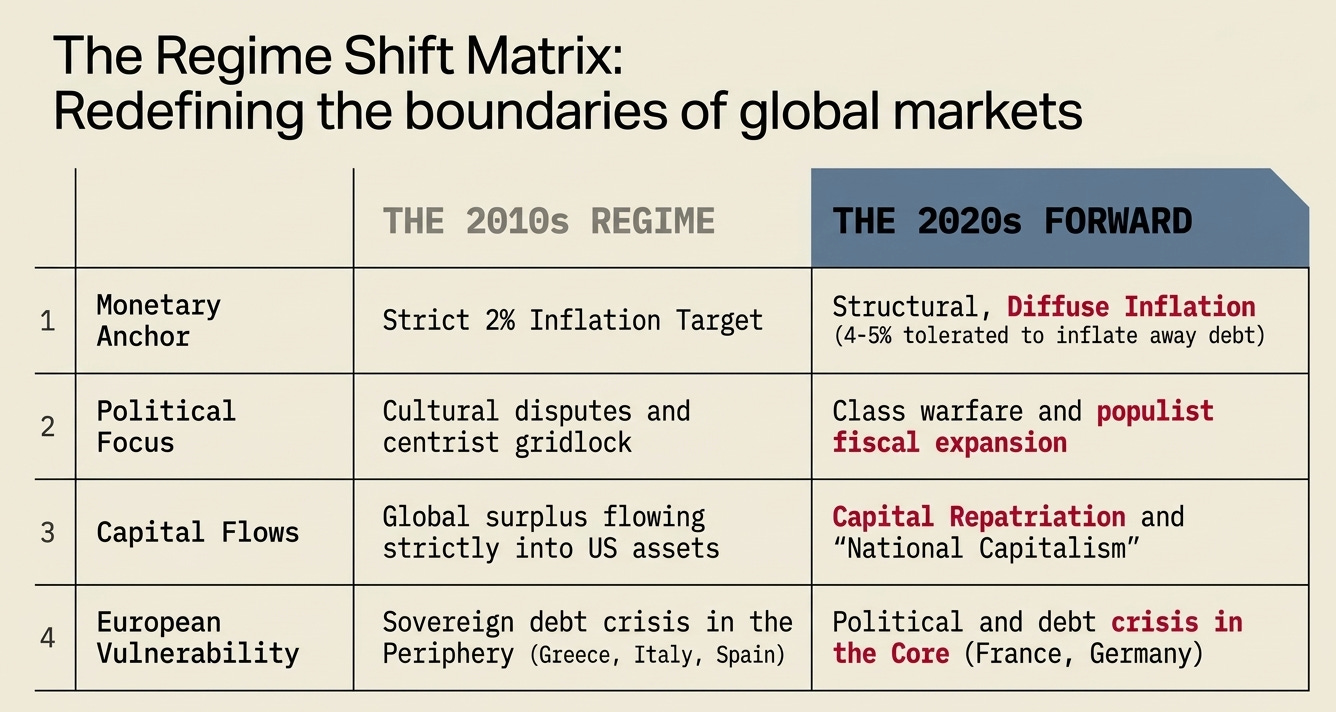
When voters want guns and butter, inflation pays the bill: Deluard calls the midterms an economic election. Prices and corruption decided it, and the culture war barely came up. Campaign money stopped buying results too. Elon Musk’s spending in Texas, he says, “was just burnt.” Something has to give when voters want both a war and big social programmes. In the 1970s the gold anchor gave way. This time it’s the 2% inflation target. The US has missed it for six years, and Deluard reads the new task force on how inflation is measured as a quiet admission that the target is gone. He expects fiscal policy to beat the central bank in every major democracy.
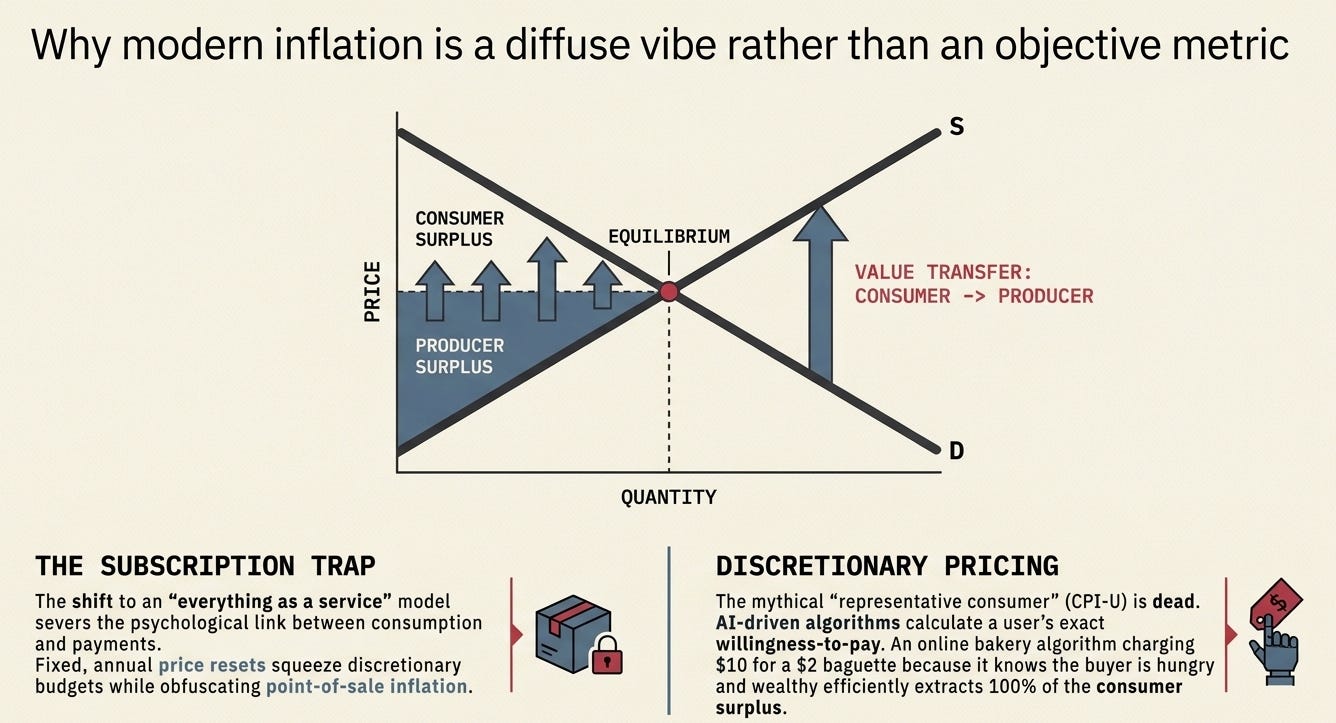
The algorithm knows what you’d pay for a baguette: Walk into a bakery hungry and you might pay $10 for a baguette. The baker doesn’t know that, so he charges $2 and you keep the other $8. Now buy it online from an algorithm that knows you love bread, you’re hungry and you earn well. This time the seller keeps the $8. Do that across the whole economy and money moves from consumers to companies without showing up in any statistic. Subscriptions blur the picture further. The gym, the meal plan and the ski pass are paid up front, so when gasoline doubles there’s less left to cut. When everyone pays a different price, the CPI has no typical consumer left to measure. People feel poorer than the official figures say, and they may be right.
The world wants its savings back: For a decade the US has been where the world parks its money, the other side of its trade deficit. Deluard thinks that foreign money explains most of America’s market outperformance, and he calls its reversal one of the biggest risks to US asset prices. Canada shows how it happens. Its six biggest pension funds keep about 65% of their assets in the US. The trade has worked beautifully, because US stocks returned about 15% a year while the Canadian dollar fell 30%. Now Canada needs pipelines and power projects, and the money to build them is sitting in America. Japan and Europe are heading the same way, bringing savings home for grids, energy and defence. Deluard explains it with the line usually credited to the bank robber Willie Sutton. Why rob banks? Because that’s where the money is.
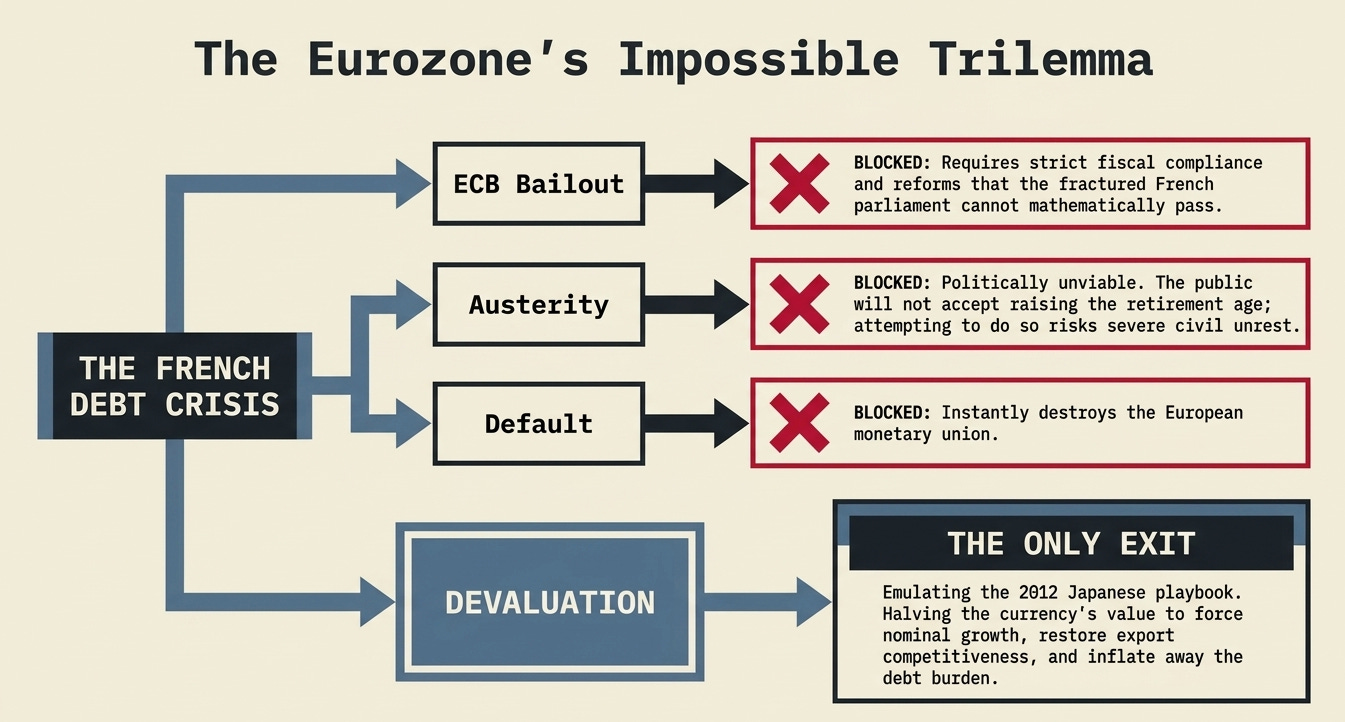
Europe’s debt crisis has moved to its heart: In 2011 the trouble was in Greece, Spain, Portugal and Italy, and a healthy core paid the bill. Now the trouble is in France and Germany themselves, and it’s political. The parties that built the euro are losing ground to parties that have long opposed it. France owes 120% of GDP, holds more than half of that debt abroad, and can’t print its way out. Every year it refinances about €300bn of cheap old debt at around 4%, and that eats most of the spending cuts the government is struggling to pass. Deluard blames a mistake both countries made. Instead of voters choosing politicians, politicians chose the voters, ruling whole parties out of bounds. The centre has shrunk to 15-20%, and April’s election will probably come down to the far left against the far right. His fix is what Japan did in 2012, when it let the yen fall from about 80 to 165 against the dollar. Ten years later Japan’s debt problem is largely solved. Europe would be doing it with inflation already high, so saving the euro probably means 5-7% inflation for several years. That makes the call easy for investors. If the euro breaks up it’s worth nothing, and if it survives it’s worth a lot less.
The perpetual motion machine also runs in reverse: Rising stock prices let American consumers absorb falling real wages, diesel prices that doubled and higher mortgage rates. The top 10% of earners now do so much of the spending that the loop feeds itself. Consumers looked strong because stocks rose, and stocks kept rising because consumers looked strong. Deluard thinks it’s starting to turn. The savings rate is 3.5%, the lowest since the Second World War, and savings have fallen about $500bn since the war began. People are dipping into their 401(k)s. It reminds him of 2007, when households borrowed against their homes to keep spending until house prices fell. If the loop runs backwards, he pictures two guys holding each other as they fall. Early inflation feels like prosperity, because every number goes up together. Eventually people work out that everything costs more and they’re no richer. He thinks that realisation began this summer.
Curious Thinking: We discussed the global funding needs and their implications in our long form research letter The Ledger War, and the potential capital crunch inside AI in Cheap Thinking, Expensive Machines. We are going to be in a delicate place in macro for the next few months.
P.S. Could you do me a favor ? This email takes many hours to put together, including hours of sourcing, curating and writing. If it is helpful to you, then do me a favour and hit the “heart” button so I know it’s useful to you.
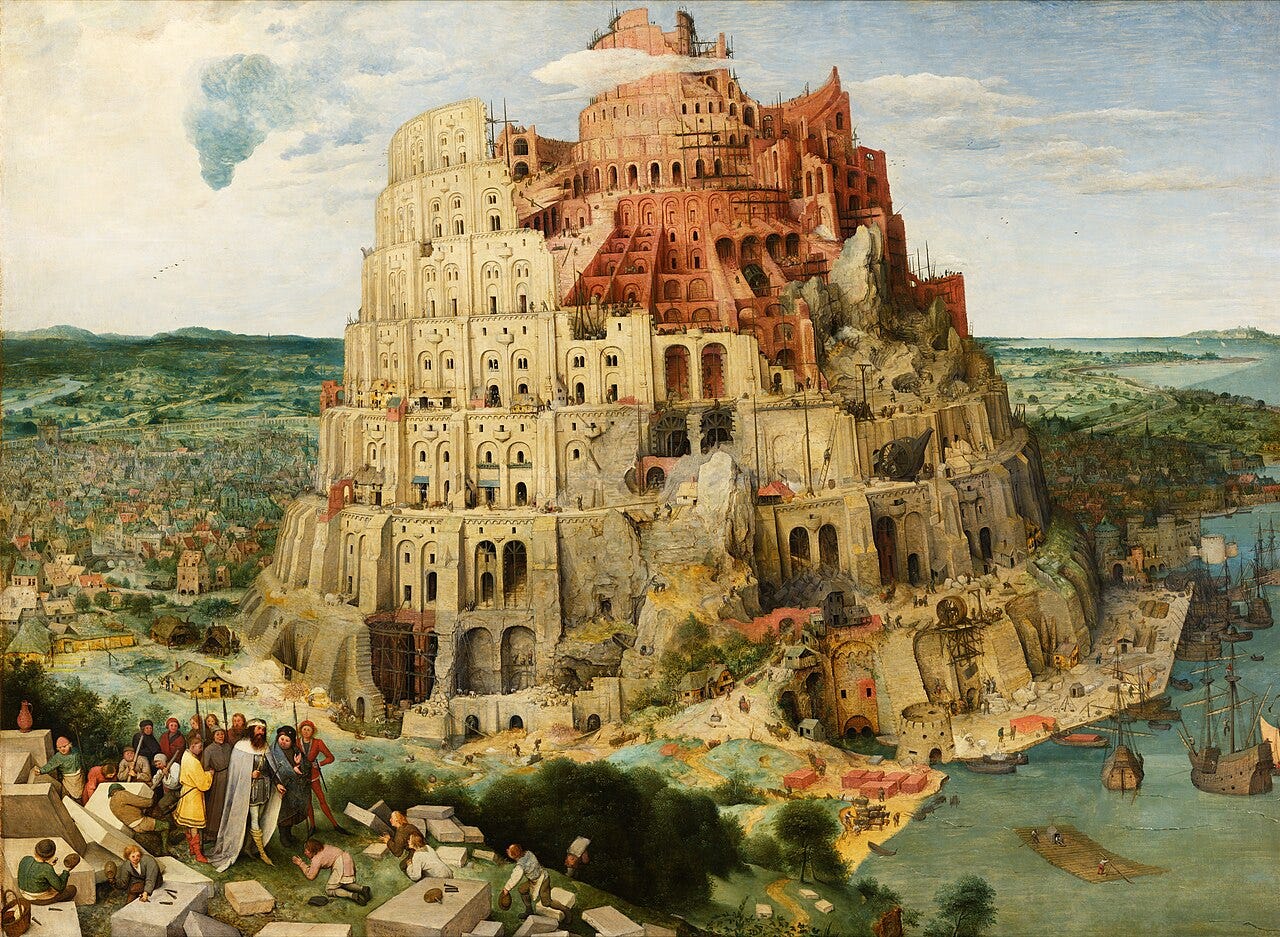
This was a beautiful old movie that I watched last weekend.