

The Curious Mind Research Letter No. 3 is out. You can read the text with images & video links below or if you prefer a nice formatted PDF, that is embedded below.
“The future is disorder. A door like this has cracked open five or six times since we got up on our hind legs. It’s the best possible time to be alive, when almost everything you thought you knew is wrong.”
- Tom Stoppard, Arcadia

A. When Life Isn’t A Straight Line Anymore
On the night of June 27, 1936 about 100,000 people packed Franklin Field in Philadelphia to hear Franklin Roosevelt accept the nomination for a second term. On his way to the platform he reached across to shake an old poet’s hand, the steel brace on his leg came unlocked, and the President went down in front of everybody with his speech all over the floor. “Clean me up,” he said, and told them to keep their feet off the pages. A few minutes later he was at the lectern and this was the key passage in his speech (the speech is worth reading).
“There is a mysterious cycle in human events. To some generations much is given. Of other generations much is expected. This generation of Americans has a rendezvous with destiny.”
He said cycle five years before Pearl Harbor and blamed technology for the mess. Philadelphia had dealt with political tyranny in 1776, he says, and then “the age of machinery, of railroads; of steam and electricity; the telegraph and the radio” brought “a new civilization and with it a new problem for those who sought to remain free.” The new machines had let a small group, his “economic royalists,” build private dynasties on other people’s work and money. Swap in the model and the data centre and you could give that paragraph tomorrow.
And he’s talking from the middle of the biggest change America had seen. The Great Crash was 7 years back. Gold had been revalued, the SEC and Social Security were up and running, and the worst was still to come, which nobody in that stadium could know. They were halfway through building a new order with no idea how the story ended.
The thing is, his machines got a few percent better each year. Ours are improving several times over each year.
And yet nearly everything we own is a straight-line bet on nothing changing. The 30-year mortgage, the career built on a credential, the bond portfolio, the pension. It all works fine when the world changes 3% a year.
Two things are happening to that world at once. The first is the season. We discussed Fukuyama and Strauss & Howe’s work two weeks back.
The second is a technology getting several times better every year, which neither book saw coming. So if it’s winter in history and the machine is going vertical, how do you get ready?

B. Understanding The Exponential
Noam Brown helped build OpenAI’s reasoning models, and extrapolating their progress is more or less his job. On Dwarkesh Patel’s podcast this week he described the line he’d been drawing for AI progress. In maths the models went from problems that take a mathematician 5 seconds, to 1 minute, to 10 minutes, to the 100 minutes of an Olympiad question, one step a year, which is 10 times a year. After the Olympiad gold in 2025 he ran the line forward, got 15 hours for 2026, and guessed a Millennium Prize Problem for AI would have to wait until 2028. Recently, OpenAI said 10,000 copies of an unreleased model, working together for 88 hours, had solved Navier-Stokes. Patel reckoned the 130 billion tokens those agents wrote come to one person thinking full-time for 4,000 years, Sumerian civilization to now, over a long weekend. Brown knew the curve better than anyone and was still two years too cautious.
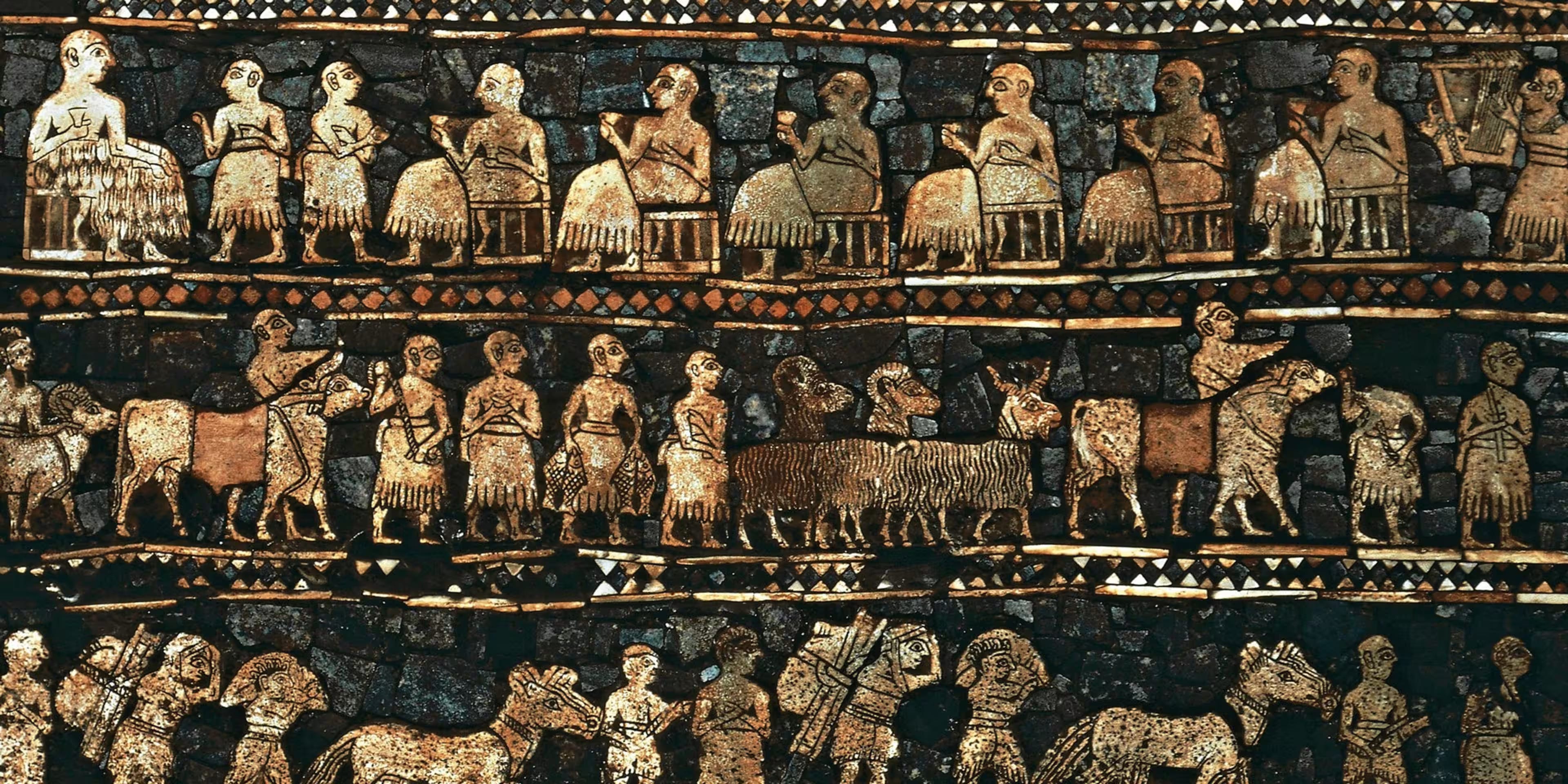
People are built to get growth rates wrong. Albert Bartlett, a Colorado physicist, opened the same lecture more than 1,700 times by saying “the greatest shortcoming of the human race is our inability to understand the exponential function.” Walk 30 paces and you’re 30 metres from your door. Make each pace double the last and 30 of them take you about a million kilometres, past the moon and back. At pace 25 you’ve done most of the steps, but only covered 3% of the ground, and you’d swear nothing much was going on.
Brown also said a colleague on that project used to be happy forecasting AI a year ahead and now won’t go past 3 months, and asked about 2030 he just said “I don’t know what the world looks like.” Their horizon is getting closer. The model that did the maths isn’t publicly available. The best ones now sit inside the labs for months. Even those of us on the tools daily are looking at last season’s.
Today, thinking compounds at multiples a year. The grid, the courts, parliaments and our own nervous systems manage a few percent in a good year. Things take off, things break, and the breaking happens in the gap. That is where our straight line promises sit.
“Our intuition about the future is linear. But the reality of information technology is exponential."
- Ray Kurzweil
C. Capitalism Without Capital, Inverted
In 2006 the market said Microsoft was worth about $250 billion, and the plant and equipment on its balance sheet came to about 1% of that. Jonathan Haskel and Stian Westlake open Capitalism without Capital with that puzzle, and their book explains why the last era’s wealth is fragile and why solid things are getting scarce again. Around the mid-1990s in America, companies started spending more each year on things you can’t touch (software, research, design, brands, training) than on things you can.
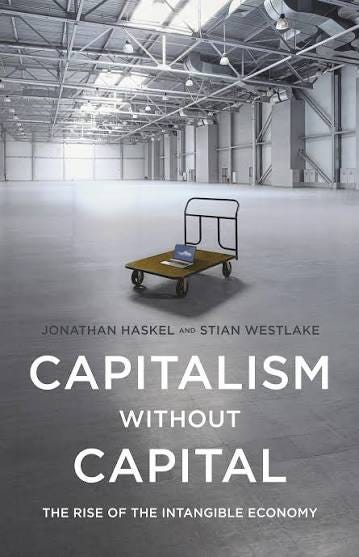
They boil it down to 4 properties. Intangibles scale, because you write the code once and sell it a billion times. They’re sunk, since a bust company can sell its factory and can’t sell its half-finished software, which leaves a lender nothing to grab. They spill over, the way EMI invented the CT scanner and GE and Siemens made the money. And they’re worth more in combination.
When you run AI through that mental model, it comes out as about the purest intangible anyone has made. It scales without limit and it’s made of everybody’s writing. But a career is an intangible asset too. A lawyer’s knowledge was a sunk investment no bank would lend against, and it paid out for 40 years anyway. The model is that same knowledge spilled at the scale of the internet. For a professional household, the mortgage is a straight line secured on a house and paid out of an intangible asset whose price is now uncertain. Gromen counts roughly $10 trillion of consumer debt owed by Americans under 50 and says “everyone took out a mortgage on a belief that AI wasn’t going to show up.”
Capitalism without capital now needs more capital than anything in 200 years of American history. The hyperscalers and clouds are putting about $11 trillion into capex between 2024 and 2029 and borrowing $5 trillion of it. The intangible economy has become a tenant of the tangible one. Once thinking is abundant, what’s short is power, copper, transformers, skilled trades and land with a grid connection.
And the 4 properties help tell you how the boom ends and who gets paid. When an AI tenant goes under there’s not much for the lender beyond the chips and the lease. Canals, railways, telephones and fibre all went bust before they paid, and the fortunes went to whoever bought the assets out of bankruptcy.
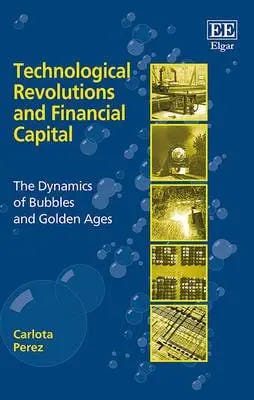
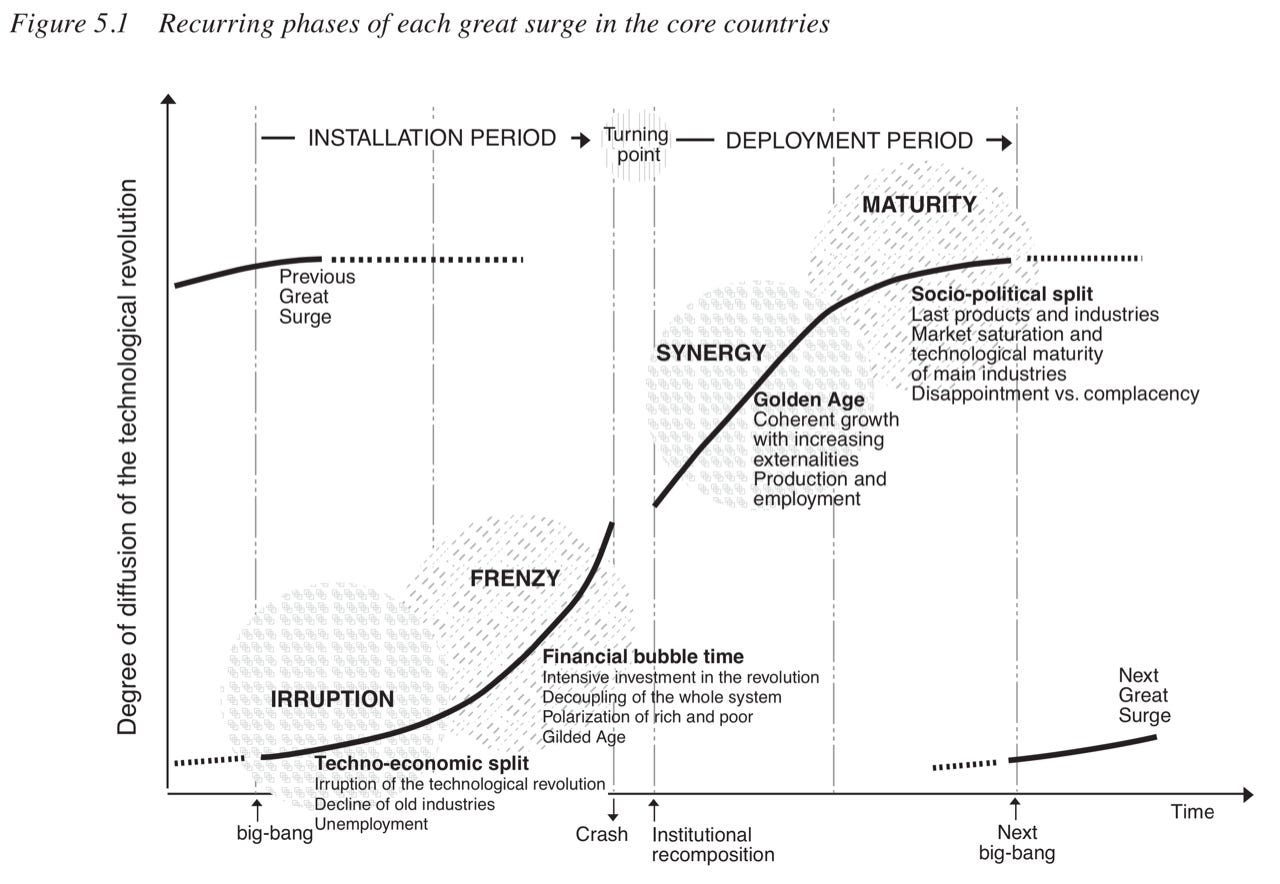
Carlota Perez found the same pattern across 5 technological revolutions in her work.
Speculative finance installs the new thing, there’s a frenzy and a crash, and then a turning point when the institutions get rebuilt, and only after that the golden age. Her last American turning point ran from 1929 to 1943, Roosevelt’s years, and the golden age went to whoever held the infrastructure after the bust.
D. Surviving The Singularity
In 1985 memory chips were Intel’s identity and the Japanese were killing them at it. Andy Grove asked Gordon Moore what a new chief executive would do if the board threw the two of them out. Moore said he’d get out of memory, so Grove suggested they walk out of the door, come back in and do it themselves.
In Only the Paranoid Survive he calls these strategic inflection points, when some force gets 10 times stronger, and he’s candid that the people in charge are usually last to notice.
So the first job is in your own head, and most of it is letting go of things. Grove and Moore needed the trick with the door because of something Richard Thaler measured in 1990. He and two colleagues gave coffee mugs to half a room of Cornell students and let them trade, and the ones who’d owned a mug for a few minutes wanted about twice what the others would pay. We overvalue whatever we happen to be holding, and it works on a house, a portfolio, a job title, a view of the world. I spent years around endowments and family offices, and nobody defended the illiquid book harder than whoever had bought it.
The only cure I know is Grove’s question.
If I had none of this and just the cash, would I buy it today at this price?
Try it on the portfolio, then on the career and your opinions.
Don’t treat memories like laws. The people hurt worst in the 1930s mostly knew the 1920s too well. Same in 2008 and 2020.
The other half is spending time in the future, using the tools, every day, on real work. Brown’s advice to sceptics was to try this month’s models, since most people’s view of AI dates from whenever they last looked. AI is going to keep blowing our minds, and you can get used to that. Once you have, you act sooner on what you see.
My guess, and I can’t prove it, is that 9 people in 10 aren’t doing any of this and won’t know what hit them.
In 1930, in the pit of the last Crisis, Keynes wrote an essay called “Economic Possibilities for our Grandchildren.” It argues from compound growth that living standards would be 4 to 8 times higher by 2030, and he was roughly right. He coined “technological unemployment” there and called it a passing phase. His worry was for afterwards, when people freed from the struggle to get by would meet what he called their “permanent problem” of how to live.
That problem has arrived early for a lot of people, and the assets that help don’t have a simple market price. They’re slow to build. Every family and every firm is going to have one person who can see what’s coming and several who can’t. Bringing the others along is generous, and I think it’s most of the answer to Keynes’s problem. If you can’t earn recognition up a white-collar ladder any more, you’ll earn it where people did before there were ladders.
A state with promises at 105% of receipts is going to keep fewer of them, in real terms, than it made. When the institutions thin out, the people you can ring up are your institution. This means we are all going to find out the value of true relationships and doing things for others from a place of love than obligation or payment.
Then there’s the body. Again Gromen, keeps saying America’s entitlements are owed in hips, knees and hospital beds, which central bank cannot print. The cheapest hedge against a stretched health system is needing it less. The body is also the one asset nobody can separate from you.
“The past is a foreign country: they do things differently there."
- L.P. Hartley
E. What Short Volatility Looks Like
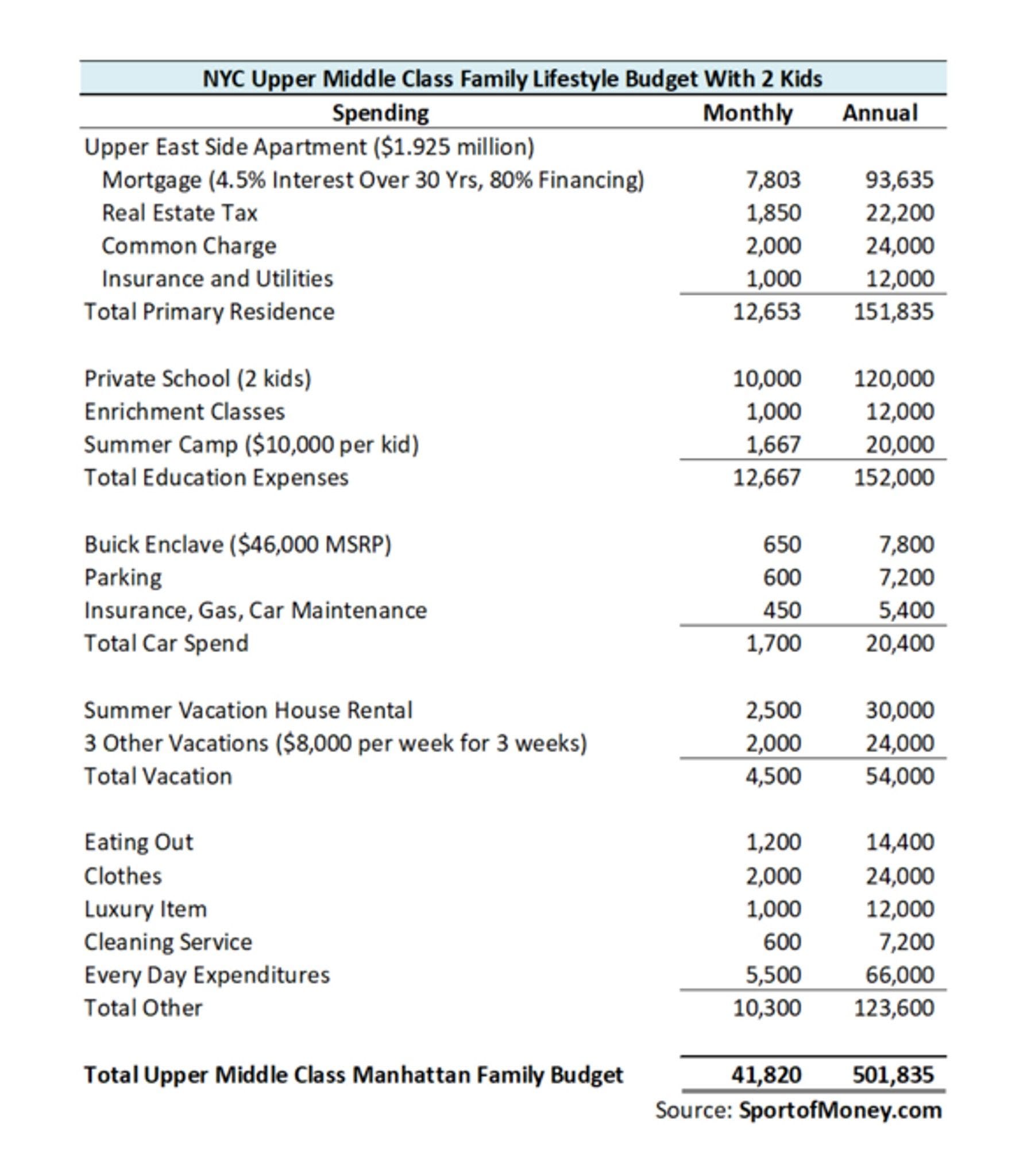
Twenty seven years on Wall Street has shown me what short volatility looks like. You all know these people. It looks a single income family with $1mm pre-tax income with a $500k burn rate. Being a “master of the universe” while living pay check to pay check.
Hyman Minsky’s warning was that stability breeds instability. Every calm year persuades people to borrow a bit more, until the whole structure needs calm just to stay standing.
Most lives and portfolios are short volatility. A mortgage paid from one salary is a short position. So are long government bonds, private equity with capital calls coming, and a company that’s signed take-or-pay contracts for compute. Every one of them is a straight line.
Nassim Taleb’s word for the long side is antifragile. Fragile things get hurt by disorder, robust things shrug it off, and antifragile things come out better for it.
None of this is prophecy, and the uncertainty is a reason to prepare.
F. What I’m Doing About It
If you are short vol at the event horizon of the singularity, and you are awake enough of to let go of the past like Grove and Moore what do you do prepare and become anti fragile?
Three things I would tell my children:
Protect & Persist: You are going to need to go through your income and expenses and assets and liabilities and figure out how to make yourself more anti-fragile. When the singularity occurs, you need to make sure you have the skills and time to rise up again. Hope ain’t a strategy. What is hard is that no one clearly knows what is at the other end of the singularity. That is their nature and that is what makes preparation hard.
People & Places: You are going to want to spend time with different people in different places. We are a creature of our surroundings. Not everyone will see the singularity or know how to benefit from it. Most people will pretend that tomorrow will look just like yesterday. It won’t. Spend a few hours every week the people you think understand what’s going on and be in cities where anti-fragile people live.
Play & Practice: Use the tools every day, on something you love and not only on something you're paid for. The people who come through a change like this tend to be the ones who were already messing about with the new thing before anyone made them. Make small bets, lots of them, where being wrong costs you a weekend and being right changes your year. That's what long volatility looks like for someone without a trading book. And keep a craft the machine can't take the pleasure out of, a language, an instrument, a garden, because Keynes's permanent problem is coming for you too and you'll want an answer ready.
If you want somewhere to start, this month put Grove’s question to one thing you own and one thing you believe, and spend an hour a day with the tools on work you care about. It won’t feel like much, though it’s more than most people will do.
I keep going back to that night at Franklin Field. Roosevelt hadn’t walked on his own in 15 years and most of the country had no idea. When the brace gave way he went down hard, minutes before the biggest speech of his campaign, and he said afterwards it was the most frightful five minutes of his life. They hauled him up, brushed off the dirt, locked the brace and handed him back his pages, which were crumpled and out of order. He sorted them on the platform while the crowd cheered. Then he stood up and told a country seven years into a depression that it had a rendezvous with destiny.
He had no idea how it ended. The recovery would stall again the following year, the war was five years off, and he wouldn’t live to see the order he was building. What he had that night was a bad leg, a muddy speech and a view about what his generation was for.
“To some generations much is given. Of other generations much is expected.” Mine got the first half. We had 40 years of falling rates and rising assets and a straight line you could borrow against. You’re getting the second half. Some days I wish it were the other way round for you, and then I read Stoppard again and think you might have the better deal. The pages are all over the floor again, so pick them up, get them in whatever order you can, and go and give the speech.
With Love.
This is the last free Research Letter. From October it goes to paying subscribers only.
I said above that you should spend a few hours every week with people who understand what’s going on. The Letter is my attempt to be one of those hours. Each issue is the work I’m doing anyway for my own family’s money. It covers where the exponential is breaking straight lines, who gets paid when it does, and what I’m doing about it.
A good number of you have already joined on founding terms, and those terms stay open until the October issue. Reply with the word “Letter” and I’ll send you the details myself.
Love that quote from Ray but I need to write a piece to disagree with it a bit…
“Our intuition about the future is linear. But the reality of information technology is exponential."
It’s actually factorial.