

You are a smart curious person but short on time and surrounded by noise. The Curious Mind tries to offer the best signal to noise ratio across markets, technology and the good life. We hope to even surprise and inspire you with new beautiful ideas.
If you missed the last two issues:
The Curious Mind Research Letter No. 4: The Imitation Game
Quotes I Am Thinking About:
“If the doors of perception were cleansed every thing would appear to man as it is, infinite.”
- William Blake
“Only that day dawns to which we are awake.”
- Henry David Thoreau,
“We suffer more often in imagination than in reality.”
- Seneca
A Few Things Worth Checking Out:
A. Filter Failure
At 35, Robert Greene had worked about 50 jobs and was stuck in a Hollywood television job he hated. His mother quietly asked his girlfriend to talk him into staying. He quit.
Four years later he wrote The 48 Laws of Power.
Six more books followed, and they made him the person people read when they want to understand power, seduction, war and mastery. The Laws of Human Nature runs to 560 pages about why you are envious, irrational and grandiose, and it has sold 1.5 million copies.
Then a stroke in 2018 nearly killed him. He came out of it sure that he had to write the book he’d been putting off for 20 years, one about awe.
The Law of the Sublime is due out on 10 November 2026.
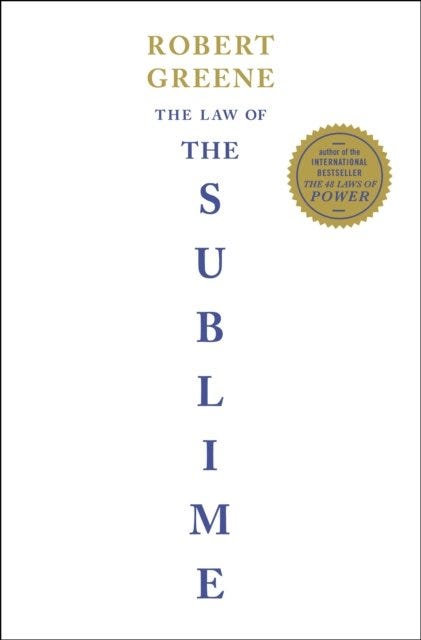
He sat down with Chris Williamson on Modern Wisdom.
The 4 BIG IDEAS:
The filter that keeps you alive is flattening your life: A toddler’s brain filters almost nothing, so a beetle or a cloud is a small wonder. The adult brain gets by on suppression, which is why you can cross a road while planning tomorrow’s meeting. Greene says the filter eventually overreaches, until life is mostly logistics. The neuroscientist Jill Bolte Taylor saw this from the inside (we discussed her in April 2022). During her stroke her brain’s filters failed one at a time, and her inner chatter went silent while the shower water felt like part of her body. She spent 8 years getting her mind back, and then found she missed the stroke. Algorithms do the same filtering for us and do it more efficiently, so the fourth cat video feels exactly like the first. Greene’s sublime is anything that gets you past the filter, even briefly.
Don’t starve the hunger for something larger: 37,000 years ago, people walked into the Chauvet cave in France, in the dark and among bears, to paint by firelight. It did nothing to help them survive. Greene thinks people have always reached past daily life, and that our ancestors did it more readily because death was everywhere around them. We’ve moved death into hospitals, but the hunger hasn’t gone anywhere. It now feeds on what he calls the false sublime, meaning stimulants, porn, superhero films and outrage. You can suppress the appetite, but it will find something to eat.
The more you talk about yourself, the smaller you get: A man named Miguel had the career, the house, the wife and the three children, and still felt hollow. His therapist in Buenos Aires eventually stopped the sessions and told him they would train for 6 weeks and climb Aconcagua instead. Storms turned them back before the summit, and the climb did more for him than years of talking. Endless self-examination thickens the ego, and Zen calls the cure ego attrition. Scale does the same work. The universe is 13.8 billion years old and you get about 80 of them. Children feel small, which is part of why they’re curious. Adults move themselves to the centre of things and the world gets duller.
Your truest self speaks through your body: The Greeks believed everyone is born with a daemon, a second self underneath the one other people describe to you. It’s the thing that has excited you since you were 5 for reasons you can’t explain. Nietzsche followed his out of a professorship and into the Italian sunlight, and the books poured out of him there. Greene’s first draft of the 50 Cent book was cancelled, and he says that was because he wasn’t in it. The way to tell the daemon from impulse is that it feels rebellious and physical, and it’s tied to love. Without love it turns demonic. Greene adds that people who ignore it for long enough pay in their bodies.
Curious Thinking: This is somewhat the goal of my sabbatical, to see and feel the sublime again….and I am happy to report that it is back!
B. Why Every AI Lab Will Be A Biotech Company
Andrew Huberman is sick of talking about morning sunlight. The Stanford neuroscientist spent years turning lab results into daily habits for millions of listeners. Many of you have probably heard him on podcasts.
He was on Invest Like the Best recently in an episode titled: The Frontier of Neurotechnology.
The 2.5 BIG IDEAS:
For talented people, the scarcest input is now their own energy: Huberman starts with the advice carved at Delphi, know thyself. Most people know their sleep number if they’re honest. Copying Musk’s 4 or 5 is a mistake, because nobody else works at that level. The better question is what state you’re in while you work. Some high performers are redlining on stimulants and can’t switch off at night. Others go from a 4am workout to family to the office and stay calm throughout. You can tell who got the balance wrong by looking at them 10 years later. Which means switching off is a skill…..The brain is built to predict, so at night it keeps planning. Two solutions: First, swap thinking for sensation. Let your attention roam from your feet to the sounds in the room to your breath and back, which pulls you into the present. Second, slow your heart with long exhales and lazy inhales, because breathing out slows the heart through the vagus nerve. Every breathing technique, he says, is either inhale-heavy to wake you up or exhale-heavy to calm you down.
The AI labs are quietly becoming brain companies: Huberman thinks Meta, OpenAI, Anthropic and Neuralink will all end up in biotech, because what their founders really want is to read from and write to the brain without opening the skull. He calls Altman, Zuckerberg, Amodei and Musk the big four of brain exploration. Our current tools are blunt. Caffeine and Adderall rev the whole brain, alcohol and sedatives damp it down, and side effects turn up wherever the receptors sit. The prize is precision, with motivation turned up for a block of hard work and turned down for recovery, so your energy runs like a square wave. The real frontier is the waking brain. We have names for every stage of sleep and none for the state you’re in during a good conversation.
Curious Thinking: Maybe the most interesting thing he said was around doing the work that matches your curiosity, because success comes from how precisely you match your genuine curiosity to the work that you do. For me this has meant changing what I do as my curiosity moved.
C. A Sea Change
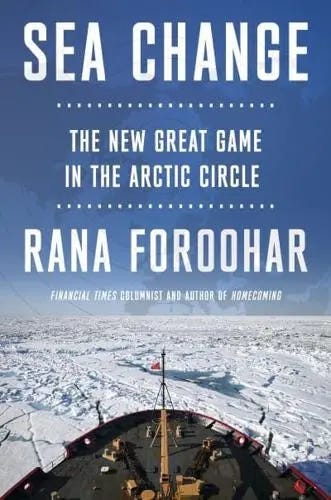
In late 2024, Rana Foroohar spent 10 days aboard the Healy, then the only American icebreaker working in the Arctic. She was the only journalist among 94 people. At night the hull ground through 5 feet of ice with a sound like nails on a blackboard, and the Northern Lights wrapped around the ship.
It’s an odd place to find an FT columnist, but it fits the question she has been chasing for her whole career. Why does an economy that looks so rich on paper leave so many people behind?
She first saw it happen at home. She grew up in rural Indiana, where her father, a Turkish immigrant, ran factories supplying the car industry. She watched families leave their farms for those factories, and then watched the factories close as the work moved to China.
Each of her books takes a different run at that question. Makers and Takers, shortlisted for the FT McKinsey Book of the Year in 2016, asked why Wall Street stopped funding Main Street. Don’t Be Evil turned the same lens on Big Tech. Homecoming argued that the world was moving from global to regional. Sea Change takes the argument out to sea, into a new great game between America and China played out across the top of the world.
She talked it through with Demetri Kofinas on Hidden Forces.
The 3 BIG IDEAS:
The pendulum has swung from efficiency to resilience: Foroohar thinks the rules of political economy reset every 50 to 100 years. The last reset came with Reagan and Thatcher, and the next one is happening now, with both American parties part of it. Rebuilding US shipbuilding has had support from 3 administrations in a row. The clearest result so far is an icebreaker deal with Finland and Canada, which has become an order for 11 ships by 2028. Finland designs about 80% of the world’s icebreakers, so for once the know-how is flowing into America, from a small ally. She expects the same model for chips, rare earths and the ingredients in medicines. For investors, what a government will pay for security is becoming a factor in its own right.
America gave away its sea power while no one was watching: By her count, the US builds 0.2% of the world’s ships and has 187 ocean-going vessels. China has 5,500. Commercial ships carry about 90% of military supplies, which is why she doubts the US Navy could break a Chinese blockade of Taiwan. Over 20 years, China has quietly bought its way into ports and shipping around Hormuz, Suez, Panama and Latin America. Iran has now shown it can hold Hormuz, China buys its oil, and more of that oil is paid for outside dollars. The fight over sea lanes and the fight over the dollar are turning into one fight.
Melting ice is drawing a new map: The route straight over the North Pole is open for about 3 weeks a year, and by 2030–35 that could be 3 months. A Chinese shipping line says its Arctic route cuts journey time by 40%. Russia holds about two-thirds of the Arctic and is arming it again, and China calls itself a “near-Arctic” nation. There’s plenty under the ice to fight over too. Only 15% of the seabed has been mapped, and she says it holds the largest rare-earth reserves China hasn’t already locked up. Greenland, which may break from Denmark within 10 years, sits right in the middle.
Curious Thinking: Listening to this conversation gave me far greater context on the Greenland noise from earlier this year and made me realise how geo-strategic the Arctic is.
D. Baby-Backed Securities
In 2029 Singapore passes a law giving parents a cut of the taxes their children will pay as adults. Within a few years banks are buying up those claims, bundling them into securities, and paying a premium for babies whose embryos scored well for IQ. By 2050 four in ten Chinese children are born through state programmes. Later in the century humanity splits into what are effectively separate species, and the most restless of them start sending copies of their brains to other star systems by radio.
That’s the plot of Dispatches From The Future: World War E, a 30-page special report by Peter Berezin, BCA Research’s chief economist. It’s written as history, looking back from somewhere late in the century.
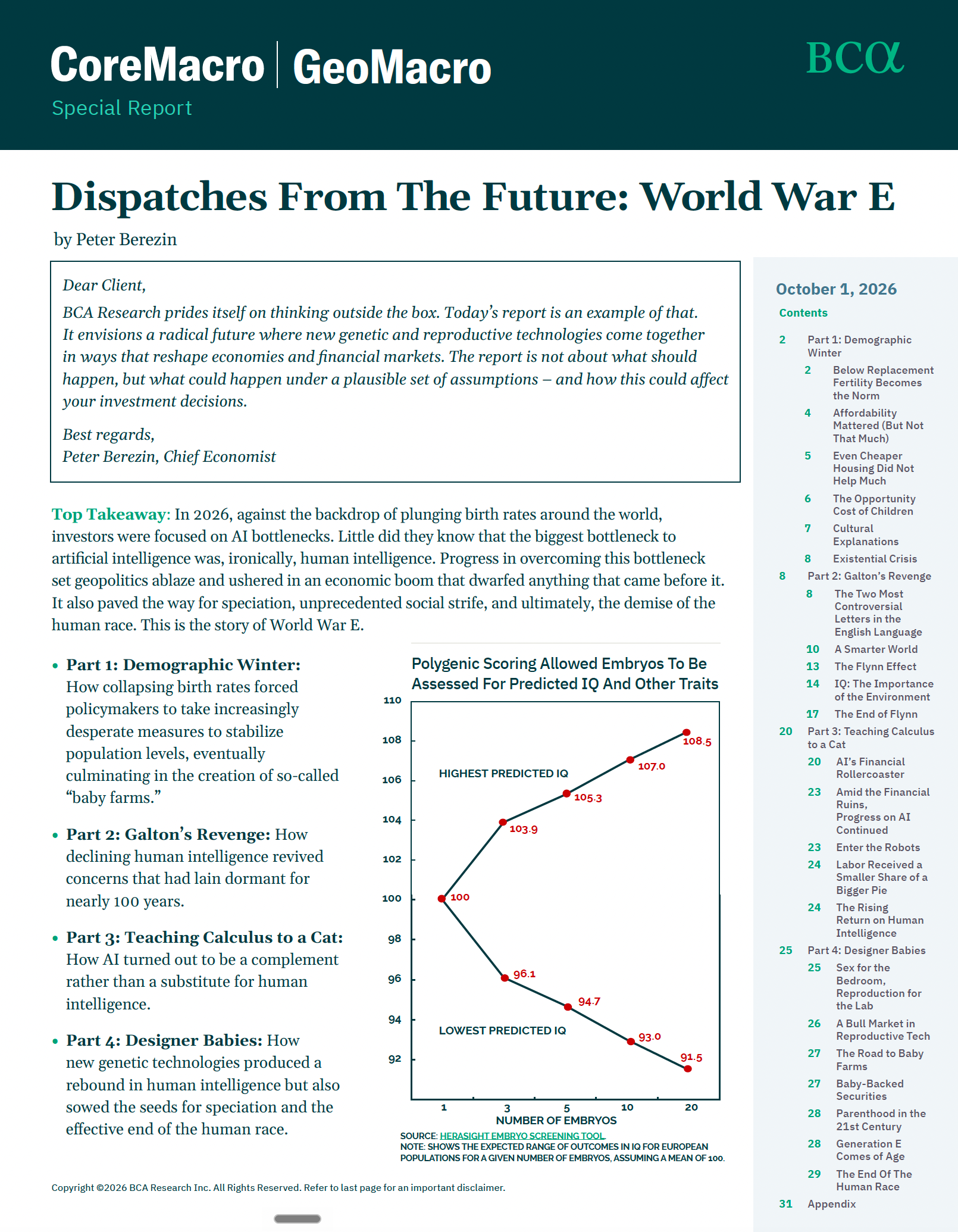
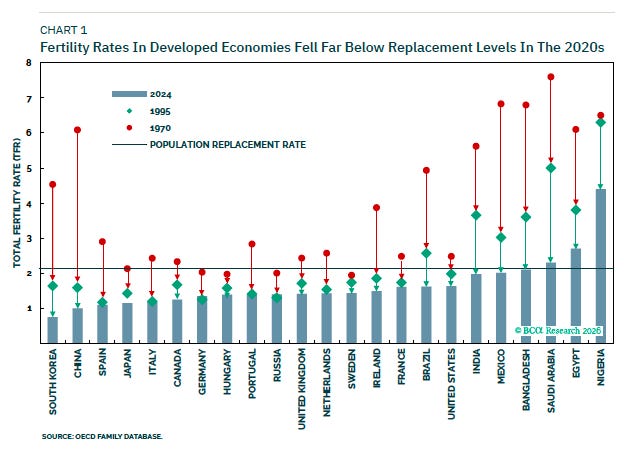
Most of the report is sober, though. It rests on around thirty charts of real data: OECD fertility tables, Norwegian conscription records, the PISA results that came out last month, Epoch’s figures on the falling price of AI.
The 3 BIG IDEAS:
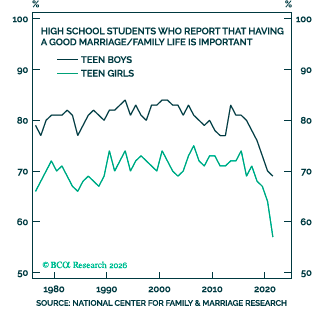
You can’t pay people to have babies: Governments have tried cash, cheaper childcare and cheaper housing, and none of it does much. Cut housing costs by a tenth and you get about 0.03 extra children per woman. Childcare got cheaper relative to wages across most of the OECD over the past decade, and births fell anyway. Berezin thinks the cause is cultural, because the drop after 2010 hit almost every country at once. He points to phones, social media’s status ladder, and dating apps that make every relationship feel provisional. The most striking chart tracks American liberal high-school girls. Their expectation of marrying fell from around three-quarters to about 60% in little more than a decade. Once the cheap fixes fail, governments start reaching for strange ones, which is where the Singapore law comes from.
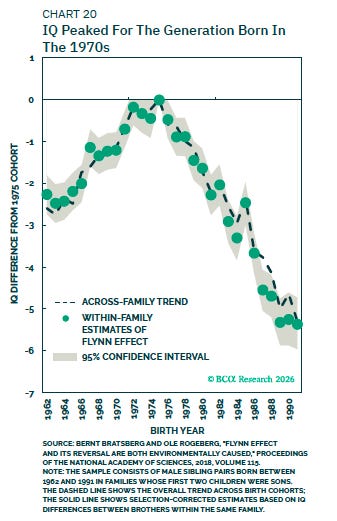
We’re getting dumber, and genes aren’t to blame: Fewer children is only half the worry, because the ones being born are testing worse. IQ scores rose about three points a decade for most of the 20th century. In rich countries they peaked with people born in the mid-1970s. Those Norwegian conscription records show men born around 1990 scoring about five points lower. The gap shows up even between brothers in the same family, which rules out immigration or “the wrong people having kids” as the explanation. Something in how children grow up has changed. PISA 2025 kept sliding, with OECD reading and maths scores both at record lows.
Smarter machines need smarter babies: The better AI gets, the clearer the next bottleneck becomes. Berezin calls it the problem of teaching calculus to a cat. However good the teacher, the cat won’t get it.
As AI produces more sophisticated work, the scarce resource becomes people who can understand it, check it and decide what to do with it (we discussed this in our Curious Mind Research Letter titled: After the Imitation Game). Oversight can’t be fully handed over either, because you can’t predict what a complex AI system will do without running it. Human intelligence ends up as the constraint on how much value AI delivers, which turns the usual fear of AI replacing people on its head. The question becomes how to make people smarter. Berezin’s answer is a chain of dominoes:
Embryos can be scored for predicted IQ. Lab-grown eggs mean parents can create hundreds of embryos to choose from.
Singapore lets parents keep a slice of their children’s future taxes. Banks buy those claims, bundle them, sell them on, and pay more for high-scoring babies.
Companies start raising children, then states do. China reaches 40% state-born, and everyone else races to keep up.
Curious Thinking: The clever bit is that nobody has to want designer babies for any of this to happen. Once a child’s future tax bill can be sold to a bank, the bank has a view on which embryo you pick. Run the chain long enough and the gap between the enhanced and everyone else stops being social and becomes biological. That’s the species split he ends on.
E. Whatever You Shame, You Repeat
Joe Hudson once told a CEO, in front of his whole executive team, that his anxiety and fear were going to destroy the company and everyone in the room knew it. The CEO looked at him and said he was right. Hudson calls that a normal Tuesday.
People pay a great deal for those Tuesdays.
Hudson coaches the research and compute teams at OpenAI and works with all the major AI labs, so a good number of the people building AGI bring him their fears, their egos and their fights. Sam Altman has been a client, along with executives at Apple, Google and the NBA. A few years ago he was taking on only about 12 CEOs and leaders a year.
He came to it sideways. At 13 he had an alcoholic father, a green mohawk and a habit of lying, until a friend told him everyone knew and they’d all like him more if he stopped.
He’s unusually easy to check. He gets paid like an investor, taking a share of the growth he helps create, often in stock. A couple of hundred of his coaching sessions are on YouTube, so you can watch him work and make up your own mind.
He spoke to Codie Sanchez on her Big Deal podcast.
The 5 BIG IDEAS:
Work ethic is overrated. A few great decisions a day can carry a career: Hudson’s clients range from people who work around the clock to people who, by his estimate, put in 2 or 3 good hours a week. The hours don’t predict the wealth. He’s never seen a Silicon Valley start-up fail for lack of effort, because they all work flat out, so effort can’t be what separates the winners. Decisions do, and he thinks 5 or 6 great ones a day is enough. A venture investor can be a hopeless board member with low emotional intelligence and still thrive, as long as they can spot great founders. When winners do work long hours, he puts it down to obsession, usually with something bigger than money. Founders running on the need to impress their father or the neighbours tend to burn out, sell, spend a year or two in their pyjamas and then hate themselves for not starting again. Hudson says he does nothing for money he wouldn’t do for free, and he hires the same way, by asking what each candidate would do if nobody paid them.
Every feeling you refuse to feel takes options off the table: We decide with emotion, Hudson says. Remove the brain’s emotional centre and choosing a lunch spot can take hours. So if you can’t stand sadness, failure or embarrassment, you won’t even see the choices that risk them. His name for the extreme case is the golden algorithm. Whatever you try hardest to avoid, you invite, in exactly the shape you feared. The conflict-avoidant CEO ends up running a company at war with itself. When a business is in trouble, his first instruction is to look at whatever you least want to look at. Open the bill, check the number you keep spinning, follow the doubt you’ve been ignoring. That’s where the inefficiency is, and where the money is.
Whatever you shame, you repeat: List the habits you’ve been trying to change for a decade. Hudson bets every one is a should, and a should is shame wearing a suit. 10 years without progress is fair evidence that beating yourself up doesn’t work. Small children change enormously without an inner critic, and if a boss spoke to you the way you speak to yourself, you’d resign. His fix is to turn the should back into a want and make it more fun. Ask how you could enjoy exercise 10% more this week and you’ll probably keep going back.
Trust is built in hard conversations that end quickly: Hudson judges leaders on 2 things. Do hard conversations happen fast, and do they resolve fast? Yellers fail the test and so do avoiders. He’s scathing about teams that try to build trust by being nice. For him, trust is what’s left after a team goes through something difficult and comes out better.
As AI makes knowledge cheap, culture is what’s left to compete on: Hudson sees more capital chasing fewer, better-paid people, as AI turns effort and knowledge into commodities. What’s left is creativity, judgement and how well a team works together, which is to say culture. The leader’s job, he says, is to set a few elegant rules and let people play, the way Uber’s drivers run on a handful of them. His own are blunt. Every email ends with “Action needed”, a name, a task and a date, which he says cut email by 30% and lifted productivity by 35 to 40%. There are no one-on-ones, because they breed politics. Anything you tell one colleague, assume you’ve told everyone.
Curious Thinking: Anyone who has run money knows the position they’ve stopped checking, that’s usually where the money is. It’s certainly where the losses like to hide.
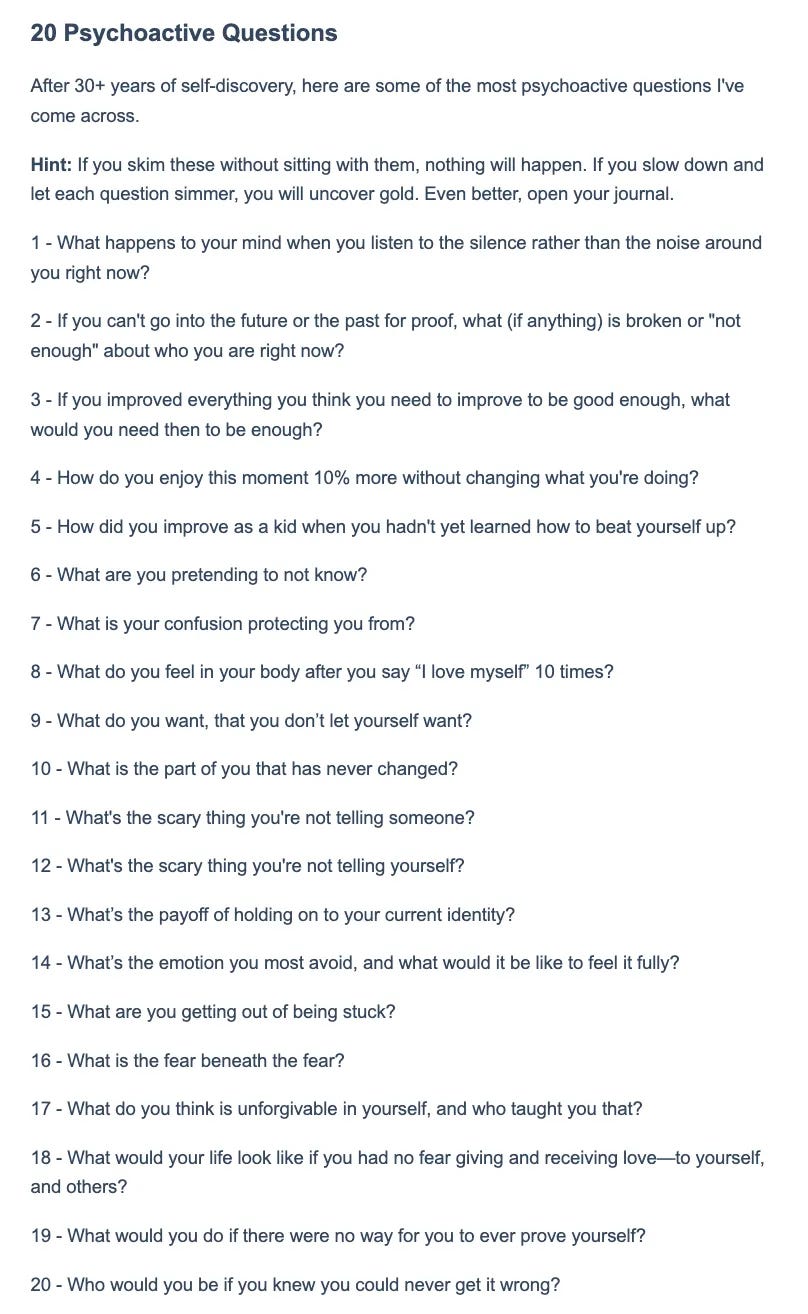
If you want to dive deeper, try these questions:
With Love.
P.S. Could you do me a favor ? This email takes many hours to put together, including hours of sourcing, curating and writing. If it is helpful to you, then do me a favor and hit the “heart” button so I know it’s useful to you.
wow...looking forward to digging thru your material
Excellent and useful takeaways from each source. Thank you for the effort you put into this labor of love!