

You are a smart curious person but short on time and surrounded by noise. The Curious Mind tries to offer the best signal to noise ratio across markets, technology and the good life. We hope to even surprise and inspire you with new beautiful ideas.
If you missed the last two issues:
The Event Horizon - Curious Mind Research Letter 3
Quotes I Am Thinking About:
"We all have our time machines, don't we. Those that take us back are memories ... And those that carry us forward, are dreams.”
- H.G. Wells (English writer)
"Life is like riding a bicycle. To keep your balance you must keep moving.”
- Einstein
"A man is rich in proportion to the number of things which he can afford to let alone."
- Thoreau
"The difficulty lies not so much in developing new ideas as in escaping from old ones."
- Keynes
"Computers are useless. They can only give you answers."
- Picasso
A Few Things Worth Checking Out:
A. The Hottest Agent in San Francisco
Noah Shinn is the founder of Instinct, a personal AI assistant that doesn’t have an app. It has a phone number, an email address and a computer, and it gets on with things. It’s invite-only and has spent nothing on marketing. It’s growing about 10% a day, and more than $1 billion a year already passes through it.
It is in talks to raise $1 billion at a $10 billion valuation less than a month after raising $250 million at a $2.5 billion valuation.
He spoke to Patrick at Invest Like the Best.

A couple of things I picked up:
People trust it: Three weeks in, 40% of users have given Instinct a credit card. Once someone shares even one sensitive thing, retention is 80%, which is almost unheard of in consumer tech. Time to the first credit card or first password is how the company measures trust. The trust is also social. Instinct agents can talk to each other, but only inside a “trusted person network.” Your spouse might see everything and a colleague only your work calendar. If someone goes looking for more than you gave them, your Instinct tells you. On the technical side, everything coming in passes through a firewall, and every action goes past a watchdog that runs separately from the agent and has different incentives. So if the model invents a name that doesn’t exist, the watchdog catches it before anything happens.
The agent’s revenue decides whose side it’s on: Patrick asked what I think is the key question: who pays the assistant? An employee is loyal partly because you pay them. A free agent paid for by advertisers is working for someone else. Noah’s answer is the best line in the conversation. Picture an agent that’s smarter than you, more socially aware and more persuasive, and whose business depends on getting you to buy things. “I just don’t want to build that reality.” So Instinct is free for users and paid for by merchants, the way Apple Pay works. Its design reflects the same thinking. Instinct doesn’t just complete tasks. It works toward higher goals: build trust, keep the user safe, have their back. Most of the time that means doing what you asked, but not always.
Businesses that live on attention will lose, and those that sell a service will win: Noah went through every digital business he could think of and asked one question: how much of the revenue comes from holding the user’s attention, and how much from delivering the thing itself? Patrick summed it up: “Any product dependent on consumer laziness or inertia is toast.” Instinct will cancel the subscriptions you forgot about, all the way through to the confirmation email, and then tell you how much you saved. Noah thinks it cuts the other way too. When ordering a ride takes zero clicks because your agent already knows your calendar, and dinner is waiting because it knew your flight was late, people use those businesses more.
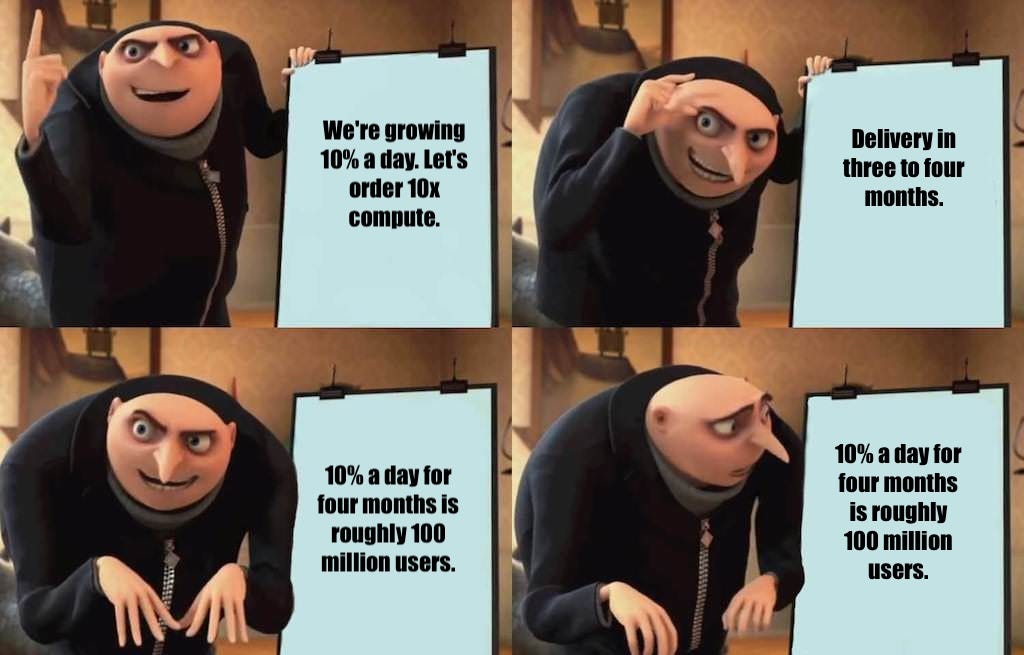
The hardest part is buying compute: Noah spends 40% of his time on compute. At the current growth rate of 10% a day, the compute he needs doubles every week. New capacity takes three to four months to arrive, and if you need it urgently you pay 3–4x. Even if growth slowed to 5–8% a day, three or four months of it would mean around 100 million users. Buy 2x and it’s gone in a week. Buy 10x and you might still be short in a month. The bigger point is about how agents work. Coding tools mostly sit idle until you prompt them. Instinct is proactive by nature. It wakes at 6am because you get up at 7, checks your day, decides whether to bother you and goes back to sleep. Most of its work happens without anyone asking. Noah’s guess is that this kind of workload needs orders of magnitude more tokens than anyone has planned for.
Curious Thinking: the demand story for AI infrastructure has mostly been about training and coding. If proactive consumer agents catch on, the next wave of inference demand comes from millions of assistants working in the background, and every order has to be placed months before anyone knows how many will be needed.
B. From GLP to GDP
Four experts sat around a table in Austin for nearly three hours and talked about how not to die. Chris Williamson, who hosts Modern Wisdom, asked the questions. Ben Greenfield has spent well over a decade as the internet’s most committed human guinea pig. Dr Gabrielle Lyon trained in geriatrics and wrote Forever Strong. Her practice rests on the idea that muscle is the organ of longevity. Brigham Buhler founded Ways2Well, a clinic and compounding pharmacy with more than 70,000 patients, and he has spent the last few years lobbying Washington over access to peptides.
The conversation drifted all over the place: peptides, stem cells, hyperbaric chambers, and a light-and-sound lamp designed to make you feel you’re being born. Under all that was a serious argument about GLP-1s, testosterone, and who gets to decide what goes into your body.
We’re about to swap one epidemic for another: Medicine spent fifty years fighting obesity and mostly lost. GLP-1s are winning that fight in about five, and Lyon says the forecast is 40 to 60 million Americans taking them. The worry is what comes after. The weight comes off fast, protein intake drops, and training stops because patients feel too flat and nauseous to lift. So the muscle goes with the fat. In the panel’s words, we’re going from people who are too big to people who are too frail. Lyon’s line is the one to remember. “Osteoporosis is a pediatric disease with geriatric outcomes.” The muscle and bone you build young is a savings account you draw down for the rest of your life. Greenfield was asked to choose between muscle and VO2 max, and he chose muscle. Failing to outrun a lion is less likely to kill you than a frail step off a kerb.
A drug that dulls appetite may dull every appetite: GLP-1 receptors are in the brain’s reward circuitry as well as the gut, which is why the drugs are being tested on alcohol and drug addiction. Lyon sees it in her clinic. Some patients get less pleasure from sex, from food and from spending. Early signs suggest libido may rise in men and fall in women. Williamson asked what happens to an economy that runs on wanting things when tens of millions of people take a weekly shot that makes them want less. From GLP to GDP. Nobody knows. For anyone who owns consumer stocks, it’s a question worth keeping in view.

The advice the panel could all agree on is cheap and a bit dull:
Lift heavy.
Add 10 to 20 second sprints a few times a week.
Walk a little faster than feels natural.
Eat 1.2 to 1.6 g of protein per kg of body weight.
Leave 12 to 16 hours between dinner and breakfast.

As Lyon said, “It doesn’t have to be complicated to be effective.”
A quick one on Testosterone: Lyon’s answer is that for men, testosterone may be the single most revealing number on a blood test. Low levels track with heart disease, diabetes, bone loss and depression.
Curious Thinking: Lift heavy and tell your parents to do the same!
C. Great Leaps in Biological Theory
In 1961 a British biochemist named Peter Mitchell explained how every cell in your body makes its energy. He had no experimental evidence. His colleagues shrugged, so he left Cambridge, set up a lab in a Cornish country house with family money, and spent seventeen years proving himself right. He won the Nobel Prize in 1978.
I think the next century will be about biology not computing. Computing will fade into the background very soon, and what will matter is what we do with it. The most important work for humanity is in biology because the human body is still a mystery.
Ulkar Aghayeva tells the story of science and discovery in a new essay titled Great Leaps in Biological Theory for Asimov Press. Her question is one investors should care about too. How does anyone see the answer before the evidence exists?
The leaps didn’t come from more data. They came from philosophy, from ideas borrowed elsewhere, and from taking seriously the odd facts everyone else had learned to ignore.

Five big ideas.
Sometimes you have to believe in the cat before you trip over it: Jeremy Gunawardena says doing biology is like hunting for a black cat in a dark cellar without knowing a cat is there. Mostly you find it by falling over it. A good theory can conjure the cat before the accident. Mitchell proposed that cells make energy by pumping protons across membranes with “not a shred of experimental evidence.” The theory came first and told experimenters where to look.
The breakthroughs came from philosophy: Mitchell’s thinking grew out of Heraclitus. As a graduate student he invented “statids” (stable structures) and “fluctids” (things in constant flux, like a flame), which combine into a “fluctoid,” like a Bunsen burner. His examiners rejected the thesis as too speculative. It turned out to be a neat description of what he later proposed: a fixed membrane with a stream of protons flowing through it. Niels Jerne, the immunologist, drew on Darwin, R.A. Fisher’s statistics, and Kierkegaard’s reading of Socrates, where learning is really recollection. A germ doesn’t teach the body to make an antibody. The ability was already there. Scientists rarely admit how much their big-picture beliefs steer them. Theories of immunity swung from Darwinian to Lamarckian and back, tracking the fashions in evolutionary biology.
Pay attention to the facts everyone has learned to ignore: The ruling theory of cell energy predicted a chemical intermediate nobody could find and couldn’t explain why the process needed membranes. The ruling theory of immunity couldn’t explain why antibodies outlasted the germ, why booster shots worked, or why antibodies improved over time. Healthy animals also carried antibodies against things they had never met. Immunologists had seen these for decades and written them off as impossible. Jerne saw them as proof that selection was at work. The clue was hiding in the pile marked “noise.”
Big ideas are relay races, and being usefully wrong counts: Clonal selection (Your body already carries a vast library of immune cells, each pre-built to recognise one specific target, and when a germ shows up it doesn't teach the body anything new but simply picks out the few cells that already match it and makes them multiply) passed through four people over sixty years. Paul Ehrlich imagined a ready-made repertoire of receptors in the 1890s, then lost confidence in it himself. Jerne revived the idea but had selection acting on antibody molecules when it acts on cells. Macfarlane Burnet called Jerne’s version “attractive, though obviously wrong,” then fixed it. David Talmage made the same fix in a review article. Nobody ever won a Nobel for clonal selection itself, though it underpins immune memory, tolerance and monoclonal antibodies. A wrong idea with the right shape can be worth more than a correct idea with no reach.
New ideas need somewhere to shelter while they grow up: Mitchell needed his own lab and his own money. Burnet was so unsure of clonal selection that he published it in the obscure Australian Journal of Science, so that “very few people in America or England would see it” if it turned out wrong. Aghayeva asks in a footnote what would have become of Mitchell under the normal grant system. Anyone who has backed a contrarian thesis knows the pattern. Being right early looks exactly like being wrong, until it doesn’t, and it only pays if your capital is patient enough to wait.
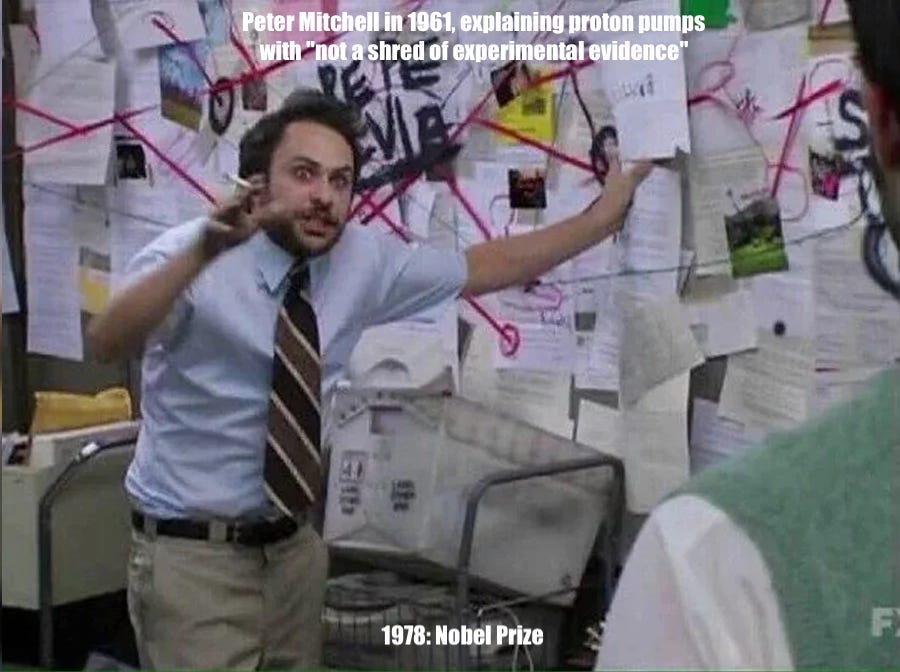
Curious Thinking: In biology or in investing, the information edge is mostly gone. Everyone has the same filings, the same transcripts, the same data feeds. What’s left is the interpretive edge, and that comes from the ideas you bring from outside the field. The best investors I know read history, physics, biology, and old philosophy, not because it’s charming but because it gives them a second lens on facts everyone else is looking at through one.
Which takes us to the weirdness premium essay from a few weeks ago.
D. Broken China
In September 2021 a crowd gathered outside Evergrande’s headquarters in Shenzhen, demanding their money back. The company owed about $310 billion, roughly the GDP of Finland, and most of that depended on selling flats that hadn’t been built yet.
Logan Wright opens his new book with that scene. He sees it as the start of China’s financial crisis, even though Beijing has never called it one.

Wright runs China macro research at Rhodium Group. He moved to Beijing in 2001 as a graduate student with mediocre Chinese, and spent years getting officials to talk to him about the exchange rate over dinner. Broken China, published this week, argues that the world’s largest economy by purchasing power is in structural decline. He also thinks the renminbi is overvalued, and that China’s leaders are far less in control than most of the West assumes.
He made his case to Demetri Kofinas on Hidden Forces on the evening Xi landed in Washington for his summit with Trump.
These are the five BIG ideas:
In China, the banks are the economy: From 2008 to 2016, Chinese lenders created $24–27 trillion of credit on top of an economy of about $6 trillion. That works out to lending a Germany or a Japan every year for eight years. For a decade this credit absorbed China’s political shocks, keeping failing firms open and provincial jobs safe. Now the same credit is dragging growth down. People ask Wright how China can be broken if it’s never had a financial crisis. “You can avoid a financial crisis every day,” he says, “if you just continue to provide short-term liquidity.” A better test is to look at what countries usually look like five years after a crisis: deflation, stretched budgets, bad loans nobody will write down, and a growing need for foreign demand. China fits that picture.
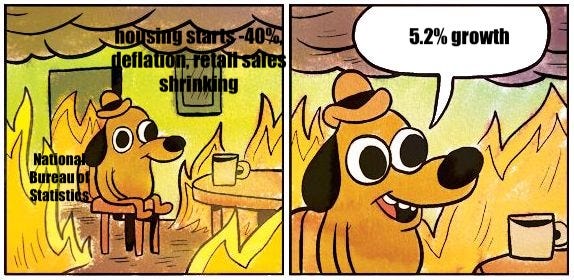
The GDP number is written for the party: In 2022 housing starts fell 40% in an industry worth a fifth of the economy, retail sales shrank, and Beijing still reported 3% growth. Wright puts growth in 2023 nearer 1.5% than the official 5.2%, and thinks it has probably turned negative now. He can’t think of any economy that grew 5% in real terms through years of deflation. In 2009 an official explained the logic to him: “If we actually said it was five, everyone in the system would think it’s zero.” The number keeps party cadres calm. Abroad it supports Beijing’s favourite line, that China’s rise is inevitable, so deal with us now.
Confidence died with the bailout: Chinese savers used to assume the state would always cover losses. When interbank rates hit 30% in 2013, they bought more high-yield products, expecting the government to pay out rather than face protests. Xi ended that. Protesters were cleared away in 2018 and never repaid. After that the defaults came one a year: P2P lenders in 2018, small banks in 2019, trusts in 2020, developers in 2021, mortgages in 2022, local government financing vehicles in 2023. Asked why Beijing can’t restore the guarantee, Wright says: “First, don’t want to. Second of all, no one will believe you.” The same loss of trust keeps money leaving the country, which is one reason he thinks the renminbi is overvalued.
Brezhnev chose decay, and so has Xi: Fixing the system means deciding who loses, and nobody wants to fly to Liaoning to tell the party committee its factories are finished. So 59% of new loans now go out at or below the 3% prime rate, mostly to state firms rolling over old debt. That share was in the mid-20s in 2020. The Soviets faced the same choice in the 1960s. They dropped market reform and bet on cybernetics to make planning work. Beijing is making that bet with AI. Oil money carried Moscow through the 1970s, and the bill arrived in the 1980s. Beijing’s long-term planning is mostly a myth. Nobody planned the biggest credit boom in a century or an 80% collapse in housing starts. “There’s a lot of long-term planning in China,” Wright says. “It changes every three to six months.”
A declining China is a nearer threat, and a deterrable one: China can’t create demand at home, so it has to keep foreign markets open. That hands the leverage to the G7, as long as the G7 acts together. Beijing is betting it won’t before 2029, and it’s building up choke points in the meantime. Wright doesn’t think the West can simply wait China out. Its weakness is the reason to act now. The West needs to protect itself from China’s overflow while its own leverage grows and Beijing’s shrinks. China can’t double defence spending from here, which makes the threats it poses deterrable rather than inexorable. The risk he flags is that Beijing hasn’t yet accepted that time is against it, and the shock will come when it does.
E. What Is Your Edge?
I was recently on Kevin Muir’s Market Huddle podcast discussing lessons I have learnt over 27 years in finance.
Some of the ideas we covered:
Decide what the money is for before you decide what to do with it: Money is a tool. That sounds obvious, yet most investors never write down what they’re solving for, and that’s how they end up chasing someone else’s game.
Your time horizon is set by whose money you’re running: Patience costs nothing, and it’s one of the few edges left that most professionals structurally can’t use.
You can believe in a revolution and still hedge it: Conviction and humility can sit in the same portfolio. Get the big shift right, and make sure being wrong on timing won’t kill you.
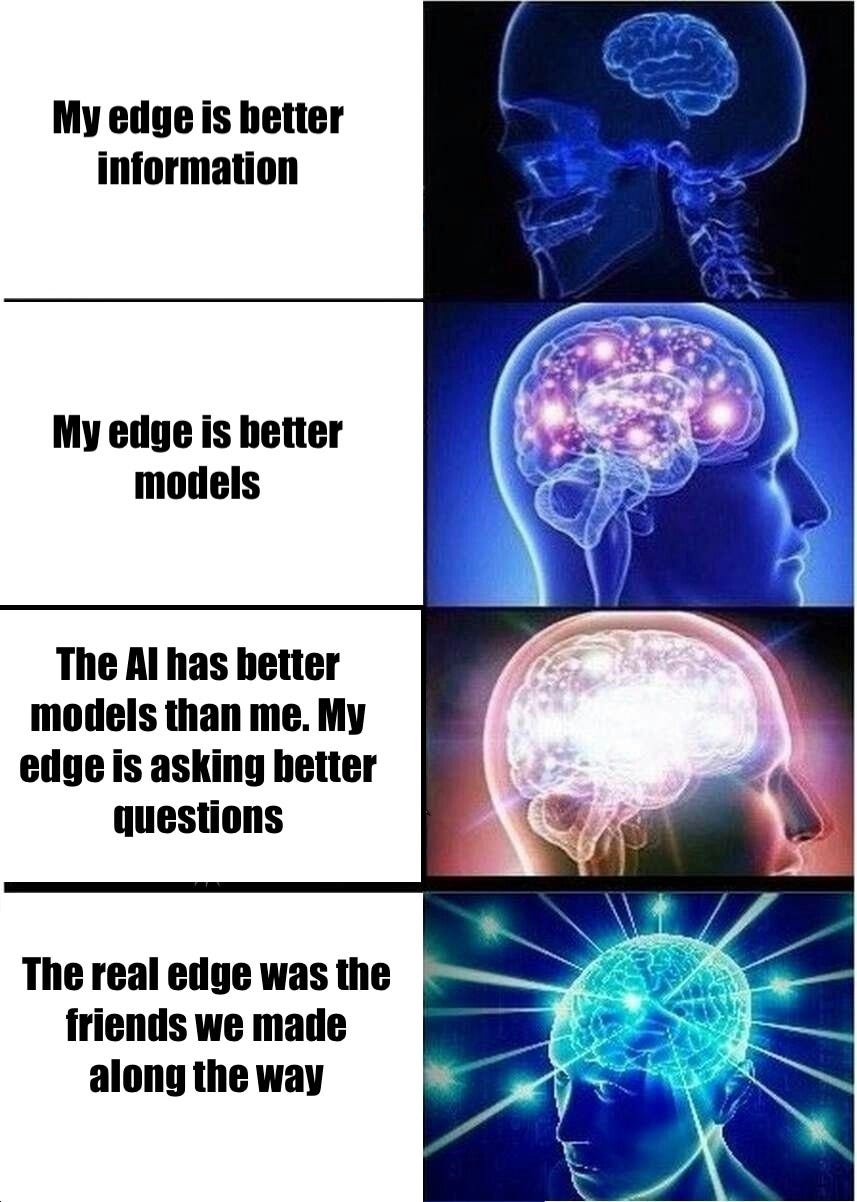
The machines will do the analysis, so learn to ask better questions:
AI already does in seconds the research, data work and modelling that used to fill a junior analyst’s week, and entry-level hiring is shrinking as a result. The way through has two parts. Become a power user of the tools, then invest in what they can’t do: judgment, character, curiosity, and the ability to ask the question nobody else in the room thought of.Compound yourself, and the people around you: Looks for cognitive diversity and polite disagreement. The most valuable information in markets is tacit, and it lives in people’s heads rather than in any database. The best compounding asset most of us own is the people who believe in us.
P.S. Could you do me a favor ? This email takes many hours to put together, including hours of sourcing, curating and writing. If it is helpful to you, then do me a favor and hit the “heart” button so I know it’s useful to you.
Great newsletter as usual 👏
Wow, really great stuff in your news letters Sir. Thank you and will share with those who are wise enough to listen!